Technics SX-PR603 Digital Piano

MrChips

Joined Oct 2, 2009
34,857
There is a control voltage PMUT on this board.

Measure the voltage with respect to GND on each leg of the resistor. You can use a DMM for this. The expected voltage readings are low voltage, between 0 V and +5 V.

If the voltage is 0 V then the outputs are muted.
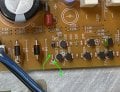
Technics SX PR603 PMUT.jpg
 

Thread Starter

emmet422

Joined Sep 1, 2024
58
There is a control voltage PMUT on this board.

Measure the voltage with respect to GND on each leg of the resistor. You can use a DMM for this. The expected voltage readings are low voltage, between 0 V and +5 V.

If the voltage is 0 V then the outputs are muted.
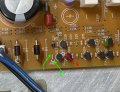
About 3.2 volts on the Pmut pins
 

Thread Starter

emmet422

Joined Sep 1, 2024
58
reply:
using a 10:1 probe. 2-4 volts peak to peak, symmetric around zero. amplitude is dependent on the volume control position.

you wrote:
You just need to see that the waveform is symmetrical about 0V axis and give us an estimate of the peak-to-peak voltage.
 

MrChips

Joined Oct 2, 2009
34,857
There are two headphone jacks.
When you get a chance, plug a headphone connector into the jacks. Do this a number of times.
If the contacts are dirty, the main speakers will be muted.

We can pursue this and test it later.
 

Thread Starter

emmet422

Joined Sep 1, 2024
58
Hi again-

just because it was easy, i reset the piano using the three-rythym-key startup. No improvement.

I tried the headphone jack insertion/removal, and no luck with that either.
The power indicator for the piano - ( light on the headphone jack board) does not come on, which seems like it might be related.

I got hold of a service manual that tells me i have to take apart half the piano to get at the JACK-2 board- (K on pg 68 of service manual) but if you can tell me what voltages should be seen on the 6-pin connector C3 on the AS board(B on pg 68), maybe the problem is on the big board ( more accessible)?

There is no mad rush here, and I’ll be most appreciative for any guidance.
 

Thread Starter

emmet422

Joined Sep 1, 2024
58
I measured dc about 14 v on one of the pins on that connector. maybe it (ouch) is something on the jack output board?
 

MrChips

Joined Oct 2, 2009
34,857
Don't bother to do random checks. The proper approach is to go through tests in a systematic matter.

Let us review the signals at PMUT and HPS.

Take a voltage reading with respect to GND at HPS. Possible readings are about 3V or 0V.

Technics SX PR603 PMUT.jpg
 

MrChips

Joined Oct 2, 2009
34,857
HPS is reading 13.6 Vdc

PMUT is 3.22 on one side, 3.23 on the other
Ok. HPS is out of wack.
HPS stands for HeadPhone Switch.

Test #1
Disconnect the power cord.
With the DMM set to measure continuity or low value resistance, look for continuity to GND.

Test #2.
Get a short piece of jumper wire. Solder the wire to HPS and the other end to GND.
With luck, the sound output should come back to life.
 

Thread Starter

emmet422

Joined Sep 1, 2024
58
Progress!

attached jumper- got sound, very distorted with either keyboard or demo

the ohmmeter seems ok with the solder joint, but it’s a trick getting in there
 
Last edited:

MrChips

Joined Oct 2, 2009
34,857
Ok. We will tackle one problem at a time.

As suspected, when headphones are inserted into either headphones jack, they break a contact to GND.
This is sent as HPS signal to the amplifier.

With no headphones inserted, HPS should be a connection to GND.

You have two options:

1) Get to the headphones jack and fix the problem. Note that the problem could also be a bad connection along the wires where HPS runs.

2) Leave HPS permanently connected to GND. Unfortunately, this means that you cannot play in private using headphones.

I suggest before taking things apart and we look for a bad HPS connection. I will post other places where HPS runs.
 

MrChips

Joined Oct 2, 2009
34,857
Remove AC power.

Locate connector CN3.
Pin-3 is Earth
Pin-6 is HPS

Disconnect the cable into CN3. The wires lead back to the headphones connector.
With the DMM on continuity test, you want to measure continuity between pin-3 and pin-6 cables leading back to the headphones.

Pin-1 is the WHITE cable.

Technics SX PR603 HPS.jpg
 

Thread Starter

emmet422

Joined Sep 1, 2024
58
disassembled keyboard etc, discovered connector hanging loose.
reconnected, removed ground wire from HPS, now get sound.
power light came back on as well

Headphones are stereo and lovely , wowsa!!

piano speakers: single channel and has the high frequency noise problem.

if you have the patience to help me with the speaker circuitry, i’ll be most grateful.

:)
 
Last edited:

MrChips

Joined Oct 2, 2009
34,857
disassembled keyboard etc, discovered connector hanging loose.
reconnected, removed ground wire from HPS, now get sound.
power light came back on as well

Headphones are stereo and lovely , wowsa!!

piano speakers: single channel and has the high frequency noise problem.

if you have the patience to help me with the speaker circuitry, i’ll be most grateful.

:)
That's good news. Glad you found that problem.

Ok, we're making good progress. Stick with me. We can get to the rest in good time. I have a few irons in the fire right now.

Is the sound from the headphones crystal clear and no distortion?
 

MrChips

Joined Oct 2, 2009
34,857
It is back to some voltage checks and signal tracing.

With the DMM set to measure voltage, check the +15 V and -15 V supplies with respect to GND.

With the oscilloscope, set the INPUT Channels to DC, VOLTS/DIV to 5 V.
Examine the +15 V and -15 V supplies and check that they are reasonably noise free.

Using both CH 1 and CH 2 inputs, examine and compare AMPL and AMPR. Adjust the VOLTS/DIV for suitable waveforms on the oscilloscope screen. It would be good to know the peak-to-peak voltages seen when DEMO song is being played (or a middle C key). If the keyboard has continuous note output, i.e. organ, violin or flute, then it would be easier to just hold the key down.

AMPL = Amplifier Left Channel
AMPR = Amplifier Right Channel

Compare the two channels, looking for distortion or clipping on high or low signals.

Technics SX PR603 amp1.jpg
 
Top