Technics SX-PR603 Digital Piano

MrChips

Joined Oct 2, 2009
34,872
Before removing the board, it would be helpful to gather some information on the signals driving the gate of each of the four transistors.

Signals GATE-A1 and GATE-A2 on CN6 and CN8 drive the power MOSFETs for SPR (speaker Right channel).
Signals GATE-B1 and GATE-B2 on CN7 and CN9 drive the power MOSFETs for SPL (speaker Left channel).

The only convenient places to test these four signals are on the ASUB board at the emitter junctions of the drive transistors, for example Q109 and Q121. You would have to solder a short jumper wire on to the ASUB board in order to access these for test point. Note that the pin numbers on CN8 and CN9 do not match those shown on the schematic.

J321 is one test point for GATE-A2, at Q110 and Q122
J322 is one test point for GATE-B2, at Q120 and Q124

GATE-A1, is at Q109 and Q121
GATE-B1, is at Q119 and Q123
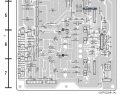
Technics SX PR603 amp ASUB pcb layout.jpg


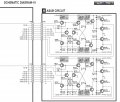
Technics SX PR603 amp ASUB circuit.jpg

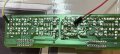
Technics SX PR603 amp CN6 CN7.jpg
 

MrChips

Joined Oct 2, 2009
34,872
Looking ahead, in two weeks I will be away for another six weeks.

If all four GATE signal do not check out ok then there is a problem on the ASUB board.
Otherwise, you will very likely need to replace one or more of the four MOSFET devices Q16 - Q19.
Q16 and Q18 are FX30KMJ-3.
Q17 and Q19 are FS30KMJ-3.

Do not test with loudspeakers connected if you not measure 0V at the speaker outputs. In other words, any DC voltage at the speaker outputs can damage the speakers.

You will also need to check that the loudspeakers are not already damaged.
 

Thread Starter

emmet422

Joined Sep 1, 2024
58
what do i expect at the A and B test points?
guessing the audio signal?

I will test w/o speakers connected, but think they are ok so far. at least the tweeters
I can inspect the woofers or maybe even test w/a signal generator
 
Last edited:

MrChips

Joined Oct 2, 2009
34,872
You cannot test the woofers with just a signal generator. You need a power amplifier to test them.

Here is the synopsys. If there was 40VDC output on SPR, then the woofer would be blown. The tweeter is protected from DC volts by a series capacitor.

You can test the loudspeaker with an ordinary 1.5V battery. Connect the battery to the speaker terminals (or wires) and you should be able to see and hear the speaker cone move.

Also, to test for free movement on the speaker cone, use the fingers of both hands to gently depress the speaker cone. The cone should move freely with no rubbing or scraping felt or heard from the speaker coil.
 

MrChips

Joined Oct 2, 2009
34,872
At the GATE-A1 and GATE-B1 signals, I expect to see the audio signals riding on a positive DC voltage, about 2V.

At the GATE-A2 and GATE-B2 signals, I expect to see the audio signals riding on a negative DC voltage, about -2V.

I don't know the exact voltages. I would have to run a simulation on the circuit.
 

Thread Starter

emmet422

Joined Sep 1, 2024
58
have delayed departure for work by a couple of hours.
looked at the signals on the jumpers and it looked like a small DC offset - maybe 200mv, but i didn’t see anything obviously like an audio overlay.
just attached jumpers
probably screwed up, but the on on Q119 looks like 40V as soon as i turn on power.
as does the one on Q109. Tried AC coupling and got some 60 cycle noise.
here is an image of my jumpers in case i got those wrong

Also - looked at RHS speaker and it still moves, but no response with the 1.5 v battery, though it looks like it drew some current. But no response from the other woofer either ( it made noise before), so maybe my connections are lousy- just jammed thin wires in connector)
 

Attachments

Last edited:

MrChips

Joined Oct 2, 2009
34,872
You cannot test the MOSFETs with the DMM.

On the ASUB board, Q123, 2SC1815 could be shorting.
You can test Q123 for short while it is on the board. You are looking to see if there is short between emitter and collector.

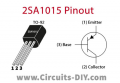
If you plan on ordering transistors, get 2SC1815 and 2SA1015 while you're at it.

The jury is still out on the FX30KMJ and FS30KMJ. We need to verify the gate signals first.
If no short is found on Q123, then it is possible that one of the power MOSFETs is bad.
(There is some inconsistency with which channel is showing 40 V. I have to double check this in my next post).

1725979425088.png
 

MrChips

Joined Oct 2, 2009
34,872
So far, you have reported in post #79 that SPR reads 40V.

SPR is driven by GATE-A1 and GATE-A2.

GATE-A1 is driven by Q121 and Q109.
GATE-A2 is driven by Q110 and Q122

Hence we should be looking at Q121 and not Q123.
 

Thread Starter

emmet422

Joined Sep 1, 2024
58
Hi again; i am back at work, 1.5 hour drive from the piano, but just in case, i brought the amplifier board with me.

I can remove and test/replace transistors, or if you think it’s better, I’ll wait until I’m back at the piano to do more tests when i get back on the 25th.
though it sounded like you will be leaving about then, for 6 weeks.
how best to proceed?
I can at least replace the 2ohm resistor.
 

MrChips

Joined Oct 2, 2009
34,872
Check the small transistors, Q109, Q110, Q119, Q120, Q121, Q122, Q123, Q124, while still on the board.
Look up and identify the legs on the transistor.

I will give them to you here.

1725993388503.png


1725993452765.png


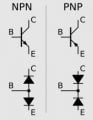
NPN and PNP transistors can be modeled as two diodes for the purpose of testing with a DMM in diode test mode.

NPN should show forward voltage of about 0.65V from B to C and B to E.
PNP should show forward voltage of about 0.65V from C to B and E to B.
All other readings should be high resistance.

Don't forget to measure resistance from C to E and E to C. You are looking for high resistance or open circuit.

NOTE that all other components will affect in-circuit measurements.

NPN PNP transistors.jpg
 

Thread Starter

emmet422

Joined Sep 1, 2024
58
Looking ahead, in two weeks I will be away for another six weeks.

If all four GATE signal do not check out ok then there is a problem on the ASUB board.
Otherwise, you will very likely need to replace one or more of the four MOSFET devices Q16 - Q19.


Q16 and Q18 are FX30KMJ-3.
Q17 and Q19 are FS30KMJ-3.

Do not test with loudspeakers connected if you not measure 0V at the speaker outputs. In other words, any DC voltage at the speaker outputs can damage the speakers.

You will also need to check that the loudspeakers are not already damaged.

I didn’t find any shorted terminals in the Q109-124 series, but Q16 is bad. It will take 2-3 weeks for replacement to get here.
Have located speakers that i can use in case the originals are no longer good, and will make sure there is no dc output on the speaker terminals before connecting them.
Will also check if there is a small but finite resistance across the original speaker wires to make sure they are electrically safe before trying them, assuming i get signal through the replacement speakers.

What with my travel and the delivery time on the transistors, it sounds like there may be a communication gap. I wish you a pleasant ‘away’ time. I’ll post again if/when there is progress from this end.
 

MrChips

Joined Oct 2, 2009
34,872
Sounds like a good plan. A bad Q16 (shorting) can cause the output to go to +40V. Let's keep our fingers crossed that this is the only problem (besides the blown speaker).

I will check in on your progress from time to time.
 

Thread Starter

emmet422

Joined Sep 1, 2024
58
I’m back!!
the power transistors are all replaced with new ones that are rated for 60 rather than 30 V
I also replaced the ugly 10 ohm parallel equivalent with a real 2 ohm resistor.

The headphones deliver lovely music, but there is some high frequency noise on the (new) speakers- which now both work
The noise persists when i unplug the tweeters.

what next? try to capture a scope trace somewhere without blowing up the main board again??
 

Thread Starter

emmet422

Joined Sep 1, 2024
58
the noise is present on both speakers
and is worst when the main volume is turned down- ( in demo mode)
trying to play as keyboard, noise is BAD

when i turn off the demo, there is a buzz that slowly subsides. capacitor???
 

Thread Starter

emmet422

Joined Sep 1, 2024
58
i saw the other thread on PR 603 buzzing, which suggested replacing q109 and q119.

The service manual and post lists these as 2SA1015, but my piano has A1285 transistors. Looks like those are rated for a higher voltage?

btw, i got the same AC readings as the person with the piano in the UK. 30 VAC to ground and 60VAC between posts.
The transformer only has two wires connected to CN2, so the other diagnostics didn’t yield anything.
 

Attachments

Last edited:
Top