Technics SU-VX800 amplifier

JoeJester

Joined Apr 26, 2005
4,390
Here's my thought for the future ...

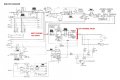
Should the right channel not exhibit the same waveform, the next test is the input to the x4 section (which is the output of the x3 section) and compare the channels. We will keep working backwards till we don't see ANY spikes on the left channel.

Once we box that area .... we can move through the circuits to find the culprit.VX-800-BLOCK-TROUBLESHOOTING.jpg
 
Last edited:

Thread Starter

Marius83

Joined Dec 28, 2017
423
Thanks for taking your time explaining... but still... i can't get the oscilloscope to trigger..

I sat the slope to positive,
I measured at the probe, it was about 0.57 V at Q503 Emitter were it's connected, so there was contact.
I tried setting the trigger level at different voltages from 0.0 to over 1, nothing happens..

I also tried setting the voltage from 1 V to 2 V, and tried X1 at the probe, but stille i can't get it to trigger... i must be doing something wrong...hm
 

JoeJester

Joined Apr 26, 2005
4,390
Marius,.

Not getting it to trigger means nothing exceeded the trigger level. In this case, that is a good thing.

I'm sure your surprised that nothing was a good thing, and I apologize for not making that clear.

Did you test both the positive and negative slopes?

You might want to decrease the time base to 500 uS
 

JoeJester

Joined Apr 26, 2005
4,390
Let the test run the whole 30 minutes on both channels.....both slopes. You should not have to watch it after the first few mins, so you can set your timer and only check it if your curious before the end of 30 minutes.

Should it get triggered, we would need to view that waveform. You do that be positioning the trace on the time scale and decreasing the time base.

On Edit ....

The final test you should move the balance to the left channel, monitor the emitter signal in AUTO .... then increase the volume. Hopefully there will be no signal other than the emitter voltage changing. Do the volume increases in 5 min increments till you get 50% of the adjustment. I think if there were going to be a self-oscillating circuit, in the previous stages it should be there by then.
 
Last edited:

Thread Starter

Marius83

Joined Dec 28, 2017
423
Marius,.

Not getting it to trigger means nothing exceeded the trigger level. In this case, that is a good thing.

I'm sure your surprised that nothing was a good thing, and I apologize for not making that clear.

Did you test both the positive and negative slopes?

You might want to decrease the time base to 500 uS
I kinda figured :) ... but... if the signal i'm measuring on is 0.57 Volt, shouldn't it trigger if i set trigger point to lower voltage than that?
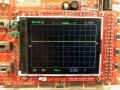
I don't have 500 uS as a choice at time base, nearest is 50uS, next is 0.1 ms.
But when i put it on 50 uS, the line get so straight, i can't see any "spikes" anymore.... i see the spikes best at 0.1 ms..
I have the probe at X1, since were measuring at so low voltage as about 5 volts..?
Wouldn't it be more accurate than using X10 and get a "lower" reading at the display?

Lots of questions here, but..


DSO11.jpg
 
Last edited:

Thread Starter

Marius83

Joined Dec 28, 2017
423
Let the test run the whole 30 minutes on both channels.....both slopes. You should not have to watch it after the first few mins, so you can set your timer and only check it if your curious before the end of 30 minutes.

Should it get triggered, we would need to view that waveform. You do that be positioning the trace on the time scale and decreasing the time base.

On Edit ....

The final test you should move the balance to the left channel, monitor the emitter signal in AUTO .... then increase the volume. Hopefully there will be no signal other than the emitter voltage changing. Do the volume increases in 5 min increments till you get 50% of the adjustment. I think if there were going to be a self-oscillating circuit, in the previous stages it should be there by then.

So if i'm about to run this test now, can i use the oscilloscope as i have set in in my last picture attached ?:)

At that trigger point, with that voltage setting and that time base?
So, if i do a long test at LEFT first, both negative and positive slope without any triggered, we're good...
And after that i will perform the same test with same settings at Q504 Emitter at RIGHT channel..
Am i correct?
 

JoeJester

Joined Apr 26, 2005
4,390
... but... if the signal i'm measuring on is 0.57 Volt, shouldn't it trigger if i set trigger point to lower voltage than that?
Yes, once the trigger level is exceeded, you get a trace. You set it for 0.56 and the signal displayed is 0.8V so the scope triggered. So to get a spike to trigger the scope set the trigger level to 1.0V

We are interesting in those big spikes, not the bias. X10 makes your probe a 1 Mohm input impedance. The x1 makes it much lower. Stick with x10 and do the divisions. It's easy moving the decimal place in your head, in fact it becomes second nature.

I don't have 500 uS as a choice at time base, nearest is 50uS, next is 0.1 ms.
100 uS is fine. once you get the spike displayed, you might end up going lower than that 100 uS.


But when i put it on 50 uS, the line get so straight, i can't see any "spikes" anymore.... i see the spikes best at 0.1 ms..
I have the probe at X1, since were measuring at so low voltage as about 5 volts..?
Wouldn't it be more accurate than using X10 and get a "lower" reading at the display?
We are looking for the characteristics of the spike. If you see the FULL spike, positive or negative one, that is our interest. The spike has a rise time, a peak, pulse width, and a fall time. The x10 probe will allow you to see up to the 60V rails. X1 will not allow that.

Your latest display showed 0.8V DC on the test point, which I assume is the emitter of the transistor before the diode.

The time the scope triggered and the end of the display time, the spike did not happen. In fact with the auto triggering, you can't determine anything besides there was spikes. There is a time between spikes which you can determine the frequency and that can clue in to the source of the problem. For instance, if it were 20mS or 10mS ... and your mains are 50 Hz, the source would be associated with power. That means one of the decoupling capacitors could be bad. A different period of time would lead us elsewhere. The period of time between two positive pulses or two negative pulses will determine the frequency.

The two major tests, left and right channel, will determine if we need to look further, if those spikes don't exist on the right channel, we have more work to do. if they are similar in size and shape .... we will ignore them. Irrespective, we need to KNOW before we install the other outputs and proceed to do a full functional test. The other option is to not test, install some more transistors and take our chances.

Accuracy will always be a problem with any scope as the beam width (the line) is not fine, but yes, x1 can be more accurate, but with the x10 and the setting at 0.1V/cm the results would be the same, so which is more accurate? In my book that is a toss up, which leads back to impedance and loading the circuit which can produce inaccurate readings.
 
Last edited:

Thread Starter

Marius83

Joined Dec 28, 2017
423
I have now let it idled with the scope attached to Q504 Emitter, half an hour at positive slope and half an hour at negative slope without getting triggered...

So i guess the next test you suggested would be this:
The final test you should move the balance to the left channel, monitor the emitter signal in AUTO .... then increase the volume. Hopefully there will be no signal other than the emitter voltage changing. Do the volume increases in 5 min increments till you get 50% of the adjustment. I think if there were going to be a self-oscillating circuit, in the previous stages it should be there by then.

So by that you want me to hook the oscilloscope at Q503 Emitter at LEFT again, right?
Set the balance all to LEFT, and try to increase the volume button, right ?
What about the speaker selector, it is set to OFF, any relevance?

And that should work without any problems if everything works as it should... even without Q515 and Q517 in circuit.
 

MrChips

Joined Oct 2, 2009
34,830
The reason for all four power transistors Q507, Q509, Q515, and Q517 is for higher power output.
The reason why we left off Q515 and Q517 is so that you don't blow all four transistors at the same time.

You can do an audio test with music if you keep the volume low.
 

Thread Starter

Marius83

Joined Dec 28, 2017
423
I'm doing a music test right now.. it's been playing on LEFT channel for about 30 minutes now... i connected the oscilloscope to Q503 Emitter, it shows the music signal..
Sound is clear..

Low quality video:

DMM is measuring at TP501
Probe is set at X1 at the moment..

I have the volume knob at about 10 o'clock
 
Last edited:

JoeJester

Joined Apr 26, 2005
4,390
Looking pretty good right now

Not much left to do but tie up the remaining loose ends .... and then retest ... and then finally test all the functions ....

You should be able to do the final ICQ adjustments with all the transistors in before the intermediate test before the final full function test.

This thread has already made me ask about test equipment, and now added the question ... where are you getting your parts if their parts show up on the counterfeit list.
 
Last edited:

JoeJester

Joined Apr 26, 2005
4,390
Just a little hint .... about the oscilloscope

Music is typically between 10 Hz and 30 kHz. Your Y scale on the oscilloscope is 12 cm wide.

At 0.1 mS/cm, the highest signal you can see is 20 kHz (2 cycles in 1 cm). The lowest signal you can see is 833 Hz, 1 cycle for the whole screen.

As far as the music 10 Hz would be 100 mS. You would be setting the time/cm to about 10mS/cm to see 1 cycle of 10 Hz. The high end is 30 kHz or 33 uS or 0.033 mS. If you had that signal, you would need to lower the time base for a clear picture or your screen would be blocked out. Music is a mix of all the frequencies.

I may have shown you this before .... the time base on this was 20 mS/cm


Thread Starter

Marius83

Joined Dec 28, 2017
423
thanks again, i could try to set up the scope in a different way, but it was just set the way i did earlier when it idled to look if something triggered it..

So... LEFT channel plays music......
If the last two power transistors only are for more output power... then the LEFT channel is working like it should at the moment...am i right..

So what do you suggest.... to install Q515/Q517 then try to set the VR adjustment again, and hope something doesn't blow up..?
 

MrChips

Joined Oct 2, 2009
34,830
thanks again, i could try to set up the scope in a different way, but it was just set the way i did earlier when it idled to look if something triggered it..

So... LEFT channel plays music......
If the last two power transistors only are for more output power... then the LEFT channel is working like it should at the moment...am i right..

So what do you suggest.... to install Q515/Q517 then try to set the VR adjustment again, and hope something doesn't blow up..?
Go for it!
 

JoeJester

Joined Apr 26, 2005
4,390
Yeah, you proved that there is nothing prior to those final transistors were causing a problem (unless we can think of why the ICQ adjustment would have caused the failures). The path from the emitters were verified earlier and they seem normal. It worked with one-half the circuit for a sufficient period of time, so yes, time to finish up, go for the full setup.

I'm leaning heavily towards the counterfeit causing us the grief and additional troubleshooting. I'm sure MrChips filed that tidbit in his notes as did I.
 

Thread Starter

Marius83

Joined Dec 28, 2017
423
I turned down VR403 (TP501) ... and installed the last power transistors Q515/Q517

Being a little nervous i powered up, and adjusted VR403.

It has now been idling in 20 minutes, without blowing anything up!
TP501 is now at about 5.0 mV

I still have the scope connected to Q503 Emitter
And, after 20 minutes idling it suddenly triggered... when this occured, it seemed like the voltage at TP501 went a little down slowly, i don't know if it would affect, but it was down at 4.1 mV when i powered off.

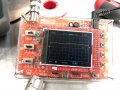
dso111.jpg


I set it in Auto and tried to film what was happening, video got on the side again..... should have made a new one... but..
What is happening here? Please let me know how to set the scope if you want me to monitor it in another way.


JoeJester

Joined Apr 26, 2005
4,390
I saw some peaks more than 1V ... but all in all it looked normal. The trigger level has to be below 0.5V to trigger as that is the published value for the voltage at the test point you are observing. The increased trigger level, to above 1V requires the single trace, otherwise it would trigger, go off, trigger, go off ... as fast as whatever you had the time base set for.

If everything still looks good, go ahead an put on a long set of music for you to enjoy.

try a quarter power and then later move it up another quarter, you can repeat it up to the power capability of your speakers if you wish ....
 

Thread Starter

Marius83

Joined Dec 28, 2017
423
Okey... i just thought it was strange the trace suddenly started to jump...also under the "center" line.. did you see the video?
I haven't noticed this happening before it suddenly started after 20 minutes... oh well, i don't know enough about it.

I have now played music on LEFT channel for 30 minutes on 50% volume... at one point i had it on about 60% volume.... pressing my little test speaker... sounded good.

I have the transistors fixed to the heat sink, but not with pasta yet.
I felt on them, Q507 and Q517 was hot to the touch... might indicate the lack of pasta at the moment.

As i felt they were a little hot, i decided to turn down the volume.... as i turned down... the sound distorted a little/disappeared at some points... and as the volume was on it's way down... a little smoke came from the power transistor area, and it blew both 2A main fuses.:mad:

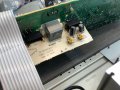
I don't know if the volume knob potentiometer itself did cause the distortion as i turned it..
OR the little PCB could have some bad connection the way it sits right now, it's hard to turn it and not moving a little bit on it..
The distortion at some points did occur when the volume was turned up too..not so much though...

Could a bad connection there cause something to happen?


This amp is a never ending story...o_O:D


volume.jpg
 
Top