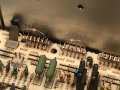
Technics SU-VX800 amplifier

Thread Starter

Marius83

Joined Dec 28, 2017
423
I could try to buy four other power transistors from for example Digikey, instead of installing the four ones i have... then we could look away from that possibility of the transistors being faulty... would that be a good idea?

About insulation pad, i have bought new ceramic insulators to use on the power transistors!
But at the moment i were adjusting the amp, none of the transistors were screwed in to the heat sink, all were just standing on their legs with good clearance to the heat sink.
I could not feel any heat from them, before or after.... it only went about a minute after adjusting VR403 before the fuses blew.
 

MrChips

Joined Oct 2, 2009
34,830
Do not install all four power transistors at once.
For testing, install one pair only, one NPN and one PNP. I have no problems installing the ones you have for a test. I don't believe that the transistors are at fault. The fault is somewhere before that. I have not done the simulation as yet.
 

MisterBill2

Joined Jan 23, 2018
27,592
I think that those amplifiers are direct coupled, which means that a problem at the first stage can rapidly destroy a whole lot of expensive parts . That is why I refuse to even look at Technics brand amplifiers.
 

JoeJester

Joined Apr 26, 2005
4,390
I think that those amplifiers are direct coupled, which means that a problem at the first stage can rapidly destroy a whole lot of expensive parts .
I would think to get to an amplitude to destroy the latter stage, it would have to be amplified enough to see on an oscilloscope.

I also think that if there is that type of tendency, there are troubleshooting techniques that could done without having the high price components installed to effectively solve the problem.

Granted, in the world of compensated servicing, those techniques would not enhance the bottom line unless you charged your shop hourly rate and allocate the proper time for the repair.

It all boils down to time is money and whether or not the customer wants to pay for the repair. I had a client ask about restoring the television that was her parents for sentimental reasons. I quoted her the maximum labor costs plus parts as what it could get to, so she decided sentimental reasons wasn't worth that much money. Had it became a simple problem, her bill could have been considerably lower, but I told her the worst case scenario.

Troubleshooting begins when wholesale replacement of the electrolytic capacitors fail to correct the problem.
 
Last edited:

Thread Starter

Marius83

Joined Dec 28, 2017
423
Just to be sure i now tested Q501,Q419,Q421 out of circuit. All were ok.

Q501: hFE: 235
Q421; hFE: 230
Q419: hFE: 181

Then i installed all again, and Q503, Q505 and a new resistor 330ohm at R513, and replaced the 2A glass fuses.
I also turned down all VR's.

Power ON.

Stable, and relays clicking.

Voltage measurement:

R503: -5.38 Volt / -5.48 Volt
R509: -4.44 Volt both legs
R511: -6.02 Volt both legs
R513: -5.0 Volt / -5.4 Volt
 

Thread Starter

Marius83

Joined Dec 28, 2017
423
It's a bit hard to know what i should measure at both sides on the resistors... my interpretation of the schematics would be this:

R503: -0.5 V / on the other side i'm not sure..
R509: +11 V on both sides(?)
R511: -11 V / -1 V at the other(?)
R513: -0.5 V / +0.5 V

I'm not sure if i understand it right..
But if i'm somehow right... compared to my readings something is way off...... am i right?

R503: -5.38 Volt / -5.48 Volt
R509: -4.44 Volt both legs
R511: -6.02 Volt both legs
R513: -5.0 Volt / -5.4 Volt
 

JoeJester

Joined Apr 26, 2005
4,390
Marius,

Your voltages look about normal considering there is nothing loading the Q503/505 transistors.

Put one pair of transistors in, one pnp and 1 npn, then remeasure. That will get you closer to the desired readings. I think you should affix the transistors to their heat sink.

Adjust the ICQ at the x4 stage to be normal and the x5 stage to be the lower of the allowed value.

The readings should be closer to what is on the schematic.

Take the readings again, if the set lasts 20 minutes. Keep monitoring TP501 throughout the whole 20 minutes. If the TP501 reading rises to above the higher ICQ figure, power down.

If you can connect your second meter to the input of the x4 stage, that too should be monitored. I'd expect zero volts, but you can use the 2 volt scale. Same thing, if you see a rapid rise in voltage, in either direction, power down.
 

MrChips

Joined Oct 2, 2009
34,830
Do you have any common rectifier diodes such as 1N4001 - 1N4007 series?
Instead of taking the risk of blowing more power transistors, you can test the idle voltages by replacing Q507 and Q509 with diodes.

Instead of Q507 NPN, install one diode at Q507 base to emitter, cathode (band on the diode) at emitter.
Instead of Q509 PNP, install one diode at Q509 emitter to base, cathode at base.
These two will supply a PN junction load to the 2.2 resistors as if the transistors were in place.
(Credit goes to JoeJester for suggesting this test.)

Do the test as suggested by @JoeJester above.
 

JoeJester

Joined Apr 26, 2005
4,390
any small signal diode will do .... especially if they cost pennies.

The 1n4000 series can have a forward current of 1A
The 1n4148 has a forward current of 300 mA
The MA165TA has a forward current of 100 mA.

whatever the cheapest and most diodes you have hanging around will work to provide some kind of a load for that circuit and it won't be too expensive if they pop while investigating this problem. If we can't replicate the problem this way, and do not see an indication of some runaway signal, we get closer to the transistors as the problem. Here is an application note about Understanding Power Transistor breakdowns from OnSemi.

If you go the diode route, I don't think you will get the TP501 over 2 mV. In that case, just put that VR at the same position as the right channel.

You should be able to adjust TP401 L and R to their normal values.
 
Last edited:

Thread Starter

Marius83

Joined Dec 28, 2017
423
Okey....... i think i will try with the diodes.. But i only got the MA165 diodes, which can stand the lowest amperage you described @JoeJester, should i try with them, or would it be more ideal with some who could handle more power?
If so i could get some others.......
 

JoeJester

Joined Apr 26, 2005
4,390
@Marius83

Use the MA165 as we are not trying to drive any speakers. The whole point is to eliminate or find the source of any problems that could have caused you to destroy those transistors without damaging the 60V supplies. That also means IF a 60 volt supply fails, we will be looking elsewhere.30

I'm talking about the diodes that you substituted for the base-emitter junction here ....
TP501 will increase, but less but not exceed 30 mV IF a diode shorts. If a diode opens, TP501 will go to zero.
 
Last edited:

Thread Starter

Marius83

Joined Dec 28, 2017
423
Been a little busy, i will try with the diodes now.
But, just to avoid any misunderstanding, is the picture correct? -these are MA165 diodes.

ma165.jpg
 
Last edited:

JoeJester

Joined Apr 26, 2005
4,390
looking good. When you setup the long term test with the second meter .... just connect the meter to the base side of either transistor. Hopefully it remains constant and doesn't jump change considerably.

if you want to, use a x10 probe and monitor the other transistor base. An oscillation would look like a periodic signal occurring for a period of time.

remember, let it run for at least 20 minutes unless you see something happening. That means a change of 20% of the meter readings on the base.

Good luck and I await the results.
 

Thread Starter

Marius83

Joined Dec 28, 2017
423
I took a new voltage test with the diodes in place, all VR's turned down in this measurement.

R503: -0.39 V / -0.5 V
R509: +0.9 V / +0.9 V
R511: -1.19 V / -1.18 V
R513: -0.57 V / +0.29 V
 

Thread Starter

Marius83

Joined Dec 28, 2017
423
I turned Power ON.

Adjusted both TP401 LEFT and RIGHT to about 25 mV as in the manual.
Then i monitored TP401 RIGHT and adjusted TP502 to about 3 mV and i let it idle for about 15 minutes, it rised to 5 mV... the manual says it okey, TP401 RIGHT was still around 25mV, so that looked ok!

Then i looked at the LEFT channel.
I have not used the oscilloscope yet, but i am monitoring TP401 LEFT, as i adjusted TP501.

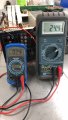
I do get over 2 mV, closer to 3 if i want at TP501, but i have to turn VR403 pretty far, i have it now set at 2.4 mV and it's about 70% turn...

It has now idled for 30 minutes, by that time the voltage has almost stood still, biggest variation vould be 0.4 mV at TP401 LEFT

Should i try to raise the voltage a little bit to see if something happens ? :rolleyes:


adjust.jpg
 

MrChips

Joined Oct 2, 2009
34,830
Looks good so far.

Something catastrophic occurred in order to blow all four power transistors. For that to happen Q503 and Q505 both had to be driven hard into the on state. I cannot see in the schematics what would have caused it.

VR403 adjustment while monitoring TP501 is basically checking the idle current with no audio signal. You want it to be slightly positive in order to minimize cross-over distortion while not wasting power. Set it to between 3mV and 5mV and leave it on as long as you wish, checking that it does not increase above 15mV.
 

JoeJester

Joined Apr 26, 2005
4,390
On the TP501 adjustment,, it will be about 2 mV at about the normal setting as the TP502 setting. You will NEVER get within the values specified when using the diodes because the current is in the microamps and there is no transistor to increase the current.

Just set the TP501 resistor adjustment close to the TP502 resistor adjustment, and monitor a base signal on the emitters in the left channel. You can have a DMM on one and the oscilloscope x10 probe, and set the oscilloscope to 0.5V (which ends up as 5 V/cm. Set zero for center graticule.

We won't have to monitor anything else in this test.

Those transistors with a heat sink can dissipate the power listed on the specification sheet. However, without a heat sink, it doesn't take much to initiate a thermal runaway.

This might come down to you setting the trigger level at a voltage and the trace as single. That way we KNOW there was something that triggered the o'scope because there was a single trace on the scope. At the 0.5V scope setting, put the trigger at 0.2 setting set the slope to positive. That way no matter how fast a spike occurs, and if it exceeds 2 volts, the scope will trigger. You will not have to maintain a watch on the scope, you just have to check it at some interval less that the time you estimated those transistors smoked, to see if something spiked. Afterwards we can move the slope to negative and retest.

I know this seems boring, and would not be productive in a service shop that doesn't use data similar to "real time" or whatever you auto mechanics use to time jobs.
 
Last edited:
Top