Technics SU-VX800 amplifier

JoeJester

Joined Apr 26, 2005
4,390
The TS firmware is a little behind. Here is the page describing the "improvements" with each page for his particular DSO138. While the improvements are note worthy, I feel they are unnecessary at this time. the DC offset problem, now known, can be mentally included if we are on the 10 mV/cm range. Right now, the only measurements being done at that range are AC ripple. I don't foresee other measurements where we would use that range.


on edit ... forgot the link.

https://jyetech.com/Products/LcdScope/Firmwares_138.php
 
Last edited:

Thread Starter

Marius83

Joined Dec 28, 2017
423
Under 100 mV is a good number. There typically no spec on ripple voltage, however, in the days of vacuum tubes, we kept it under 5 percent as a rule of thumb. In solid state, it could be detrimental in some circuits if not somewhat minimum so we can tighten up that a bit.

I checked with my circuits, and I have all but one pre-amplifier modeled, but I do know the gain of that amplifier, so the simulation is working as I've seen the specifications with respect to output, and given the ICQs adjusted properly.

I just finished the screen recording of the +60V that is the equivalent measurements you did on J209. The simulation ripple was about 180 mV peak to peak and we know that is less than 1 percent of the supply voltage. Your scope showed something similar if not less.

I know I am using models and not the components you have in front of you. I also expect the values calculated in the simulation would agree within 5 percent or so of what you observe. I've enjoyed working on this problem with you two.

If I seem harsh at times, it's because I can't see what you've done as you take the measurements. If I have a question, I ask. So, bear with this old man, who can get cantankerous at times.
Hehe.. i think you need to bear more with me than me with you JoeJester :D

Impressive thread about fixing the DSO MrChips, i might do that later if i get the chance!

So.... the conclusion after my scoping is... that my AC ripple is fine, we don't need to replace the rectifier ?
But this is measured without almost any load on the power supply right... could it change as we gradually put more load on it.. or is the AC ripple pretty stable anyway?

I feel like i want to replace it anyway, just to be sure it's not causing any problems.. or is it a total waste..:rolleyes:

What would be our next move... hmm...
 

JoeJester

Joined Apr 26, 2005
4,390
The ripple can increase as the load current increases. We can reserve judgement till later. I'm sure you will be checking it again, and again, as the amplifier is edging closer to being repaired.

The next move would be up to how MrChips wants to guide you towards restoring the parts you removed.

Nothing is a total waste if your picking up some knowledge.
 

Thread Starter

Marius83

Joined Dec 28, 2017
423
Okey. :)

I guess the last problem was, we didn't find out why R505 and R506 got fried instantly...

Then we got a tip to check the rectifier, which we have done... so i guess were back at the problem with the resistors burning up still.....
 

abrsvc

Joined Jun 16, 2018
163
Okey. :)

I guess the last problem was, we didn't find out why R505 and R506 got fried instantly...

Then we got a tip to check the rectifier, which we have done... so i guess were back at the problem with the resistors burning up still.....
R505 and R506 are the feeds for the B+ and B- supplies. I have seen these smoke when an output transistor has shorted.
 

abrsvc

Joined Jun 16, 2018
163
The last time I saw the schematic, those resistors are for the x4xx circuits. The x5xx circuits do not have that protection..
From page 22 of 26 of the service manual:

R505 drops the B- from -60.2 to -60.1 (according to the schematic) with C425 connected to ground.
R606 drops the B+ from 60.0 to 59.9.

The 60.0V should be seen at the collector of Q507 and Q508
The -60.1V should be seen at the collector of Q509 and Q510
 

MrChips

Joined Oct 2, 2009
34,841
R505 and R506 are both 6.8Ω.
According to the schematic, the voltage across each resistor is 0.1V.
Current is about 15mA. Power dissipation is 1.5mW.
My simulation shows about 100mA. Power is about 70mW.

These supply Q4xx transistors, not Q5xx transistors.
 

JoeJester

Joined Apr 26, 2005
4,390
That is an easy mistake to make ... in fact, I did till I put all the schematics together in one file.

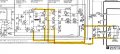
Look at this portion of the schematic with only one channel of the x5xx power amplifiers.

60V line.jpg

Attached is the whole schematic in pdf version.
 

Attachments

Last edited:

MrChips

Joined Oct 2, 2009
34,841
Just to review where we're at.

We've had components blowing mysteriously with no rational explanations.
Someone reported bad components, rectifiers and capacitors in the ±60VDC primary power supply. We thought that we should step back to take a look at this.

TS has DSO138 single channel oscilloscope. This is the best we have to work with for now. TS bought 10X probe to allow viewing 60VDC range.
DSO138 specs says max input voltage is 50V.

When attempting to measure power supply AC ripple at most sensitive setting at 10mV (effectively 100mV with 10X probe), DSO138 has DC offset. For the time being, TS advised not to use10mV setting and always set probe to 10X.

For the moment, there is no significant amount of ripple. The next step would be to increase the current draw and examine ripple again.

@R!f@@ where were you when we needed you?
 

JoeJester

Joined Apr 26, 2005
4,390
I would recommend working towards the finals, replacing the extracted components in an orderly manner with tests after each replacement or paired replacement.

Test each component prior to inserting to ensure the component is good.

I agree @R!f@@ would be a good addition.
 

MrChips

Joined Oct 2, 2009
34,841
We left off at the end of April, early May 2018. (I had to make a trip out west). See page 15, post #281.

Here's the list of all components off the board at this moment (see post #285).

R505
R506
C425
C426

IC401
IC402

Q501
Q503
Q505
Q507
Q509
Q515
Q517

Q423
Q425
Q427
Q429

Q424
Q426
Q428
Q430

R401
R402

At last check, R505 and R506 are still blowing even when changed from 6.8Ω to 100Ω as a test.
There appears to be a low resistance path or a short in the 4xx sections.

We will need to go back and do static resistance tests with power off. (page 15, post #288)
 

BR-549

Joined Sep 22, 2013
4,931
One could temporarily sever the power rails at a convenient location and install a series pot. Keeping mindful of the power of pot.....one can trace down to the branch of the high current sink. If the pot is low power.....try intermittent, successive voltage drop measurements in branches. The voltage drops won't be normal.....but they are still proportional. Measure the voltage drop INSIDE branch....not common to other branches.

Only let a little current loose....and follow it.
 

MrChips

Joined Oct 2, 2009
34,841
The circuit is laid out in four sections.
There is the Left and Right Channel and in each channel there is the Current Stabilizer (Q4xx components) and the Power Amp (Q5xx components). It would be nice to be able to isolate and check each of the four sections. Unfortunately, the way the power traces run on the PCB it is not easy to do so.
 

Thread Starter

Marius83

Joined Dec 28, 2017
423
Just out of curiosity, do you have the speakers or a resistive load connected when your making these tests?
Hmm.. Speakers connected to the terminals of the ampflifier?

No, nothing is connected.... the main board had the two plugs from the power supply connected.. that’s it
 

MrChips

Joined Oct 2, 2009
34,841
No one likes to see components go up in smoke.
However, eventually you will have to install R505 and R506 and conduct power on tests.
R505 and R506 are behaving as fuses in this case. Without them we would be blowing more transistors.
How many spares of 6.8Ω resistors do you have?

The way going forward would be to install R505 and R506 and do power on tests.
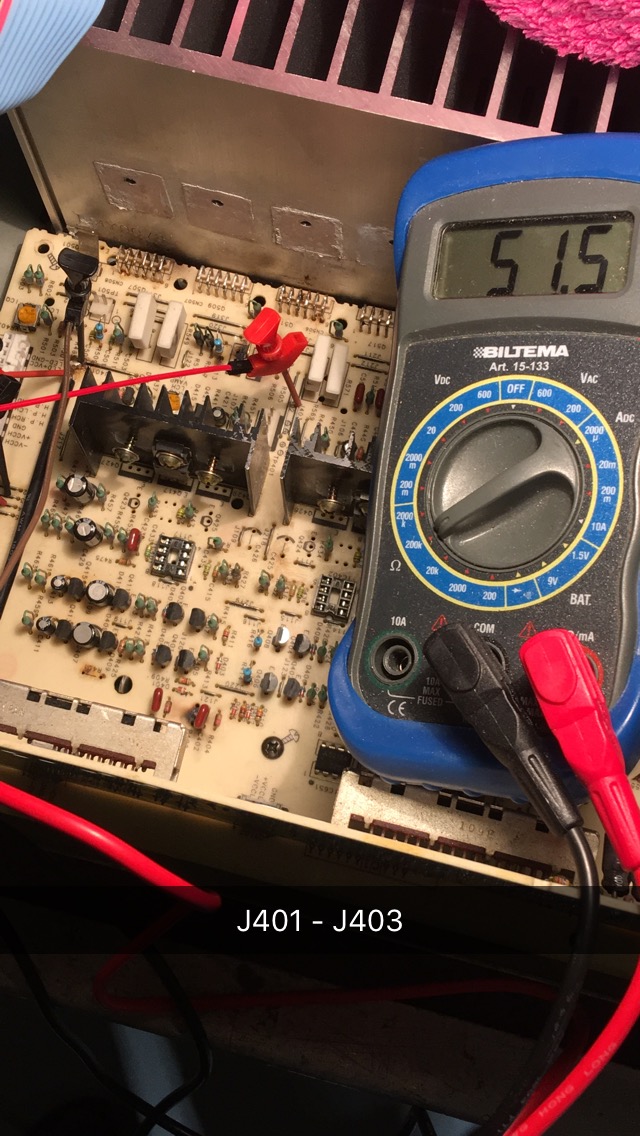
Measure the DC voltages at both legs of R505 and R506.
Then examine the voltages again with the oscilloscope and attempt to get an estimate of the ripple voltage.

Then we will add the missing components one at a time starting from left to right in the 4xx section.
The power 5xx section will be added later.
 
Top