Technics SU-VX800 amplifier

JoeJester

Joined Apr 26, 2005
4,390
As far as the load, if you don't have speakers, put a resistor of 4 to 16 ohms and a decent reasonable wattage (5 or 10). I don't expect it to be 100 watts unless you crank that baby up. There is a protection circuit for when the speakers are too low in impedance. The speakers ground, via the speaker, is the only ground for the x4xx and x5xx circuits.

The tests you will be doing, at Mr Chips directions, will be at what is called quiescence or "resting state". We can't apply any audio signals till these current problem(s) are sorted out.
 

MrChips

Joined Oct 2, 2009
34,841
I believe the load at the speaker connection is not essential at this point.
There is a protection circuit IC501 and speaker relays RL502 and RL503 that are engaged after the DC balance has been confirmed to be safe. I don't think we are any way near there as yet.
 

Thread Starter

Marius83

Joined Dec 28, 2017
423
No one likes to see components go up in smoke.
However, eventually you will have to install R505 and R506 and conduct power on tests.
R505 and R506 are behaving as fuses in this case. Without them we would be blowing more transistors.
How many spares of 6.8Ω resistors do you have?
I have a lot of 6.8Ω spares now :)

I also want to replace the rectifier just to have it out of our way, we can measure the ripple later on anyway, but i want to replace the rectifier.

The page you linked to earlier did not ship international.

I found this on ebay, same number but it has VS- in the front on the code, would it matter?
If not i'm ordering at once so i can have it soon.

https://www.ebay.com/itm/VISHAY-FOR...659455&hash=item3f5c9ebd03:g:d6AAAOxyCepSa79i
 

Thread Starter

Marius83

Joined Dec 28, 2017
423
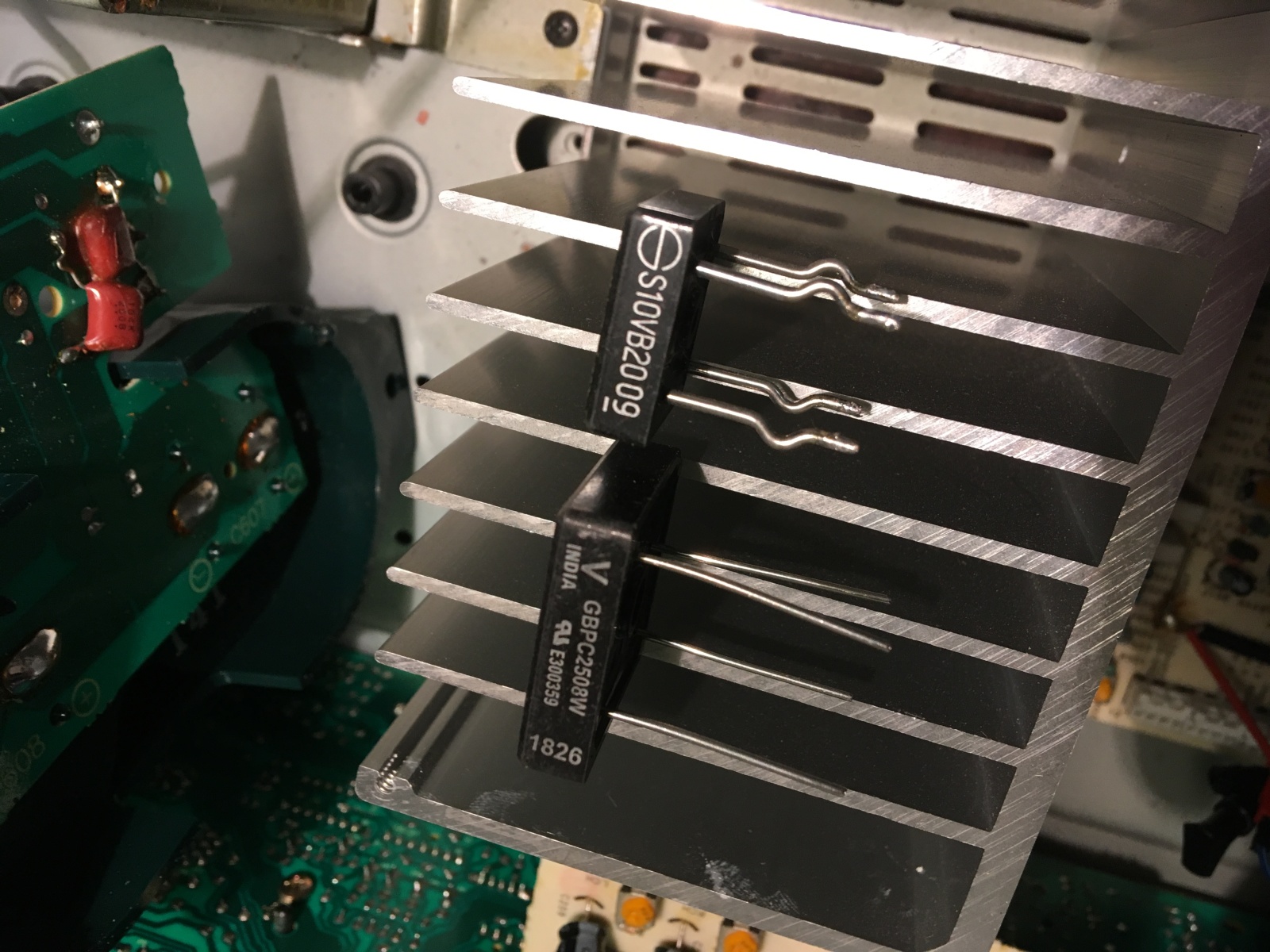
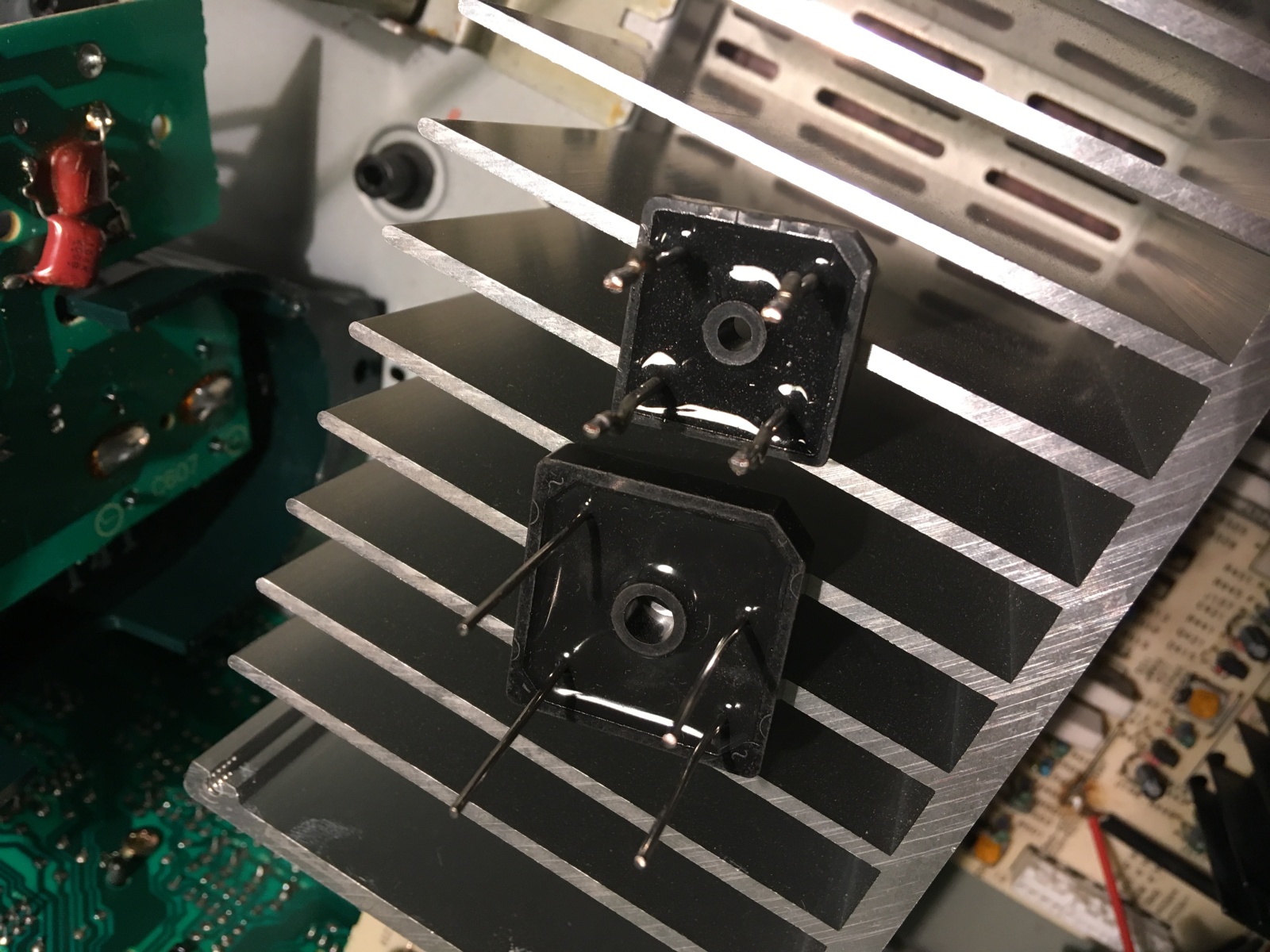
Finally got my new bridge rectifier ... it was a bit bigger than the old one.. but that's no problem as long it's the correct part ..

Just put it in the way the old one sat? one corner is flat..


MrChips

Joined Oct 2, 2009
34,841
The flat corner is the +ve output pin. Make sure that the bridge is aligned correctly.
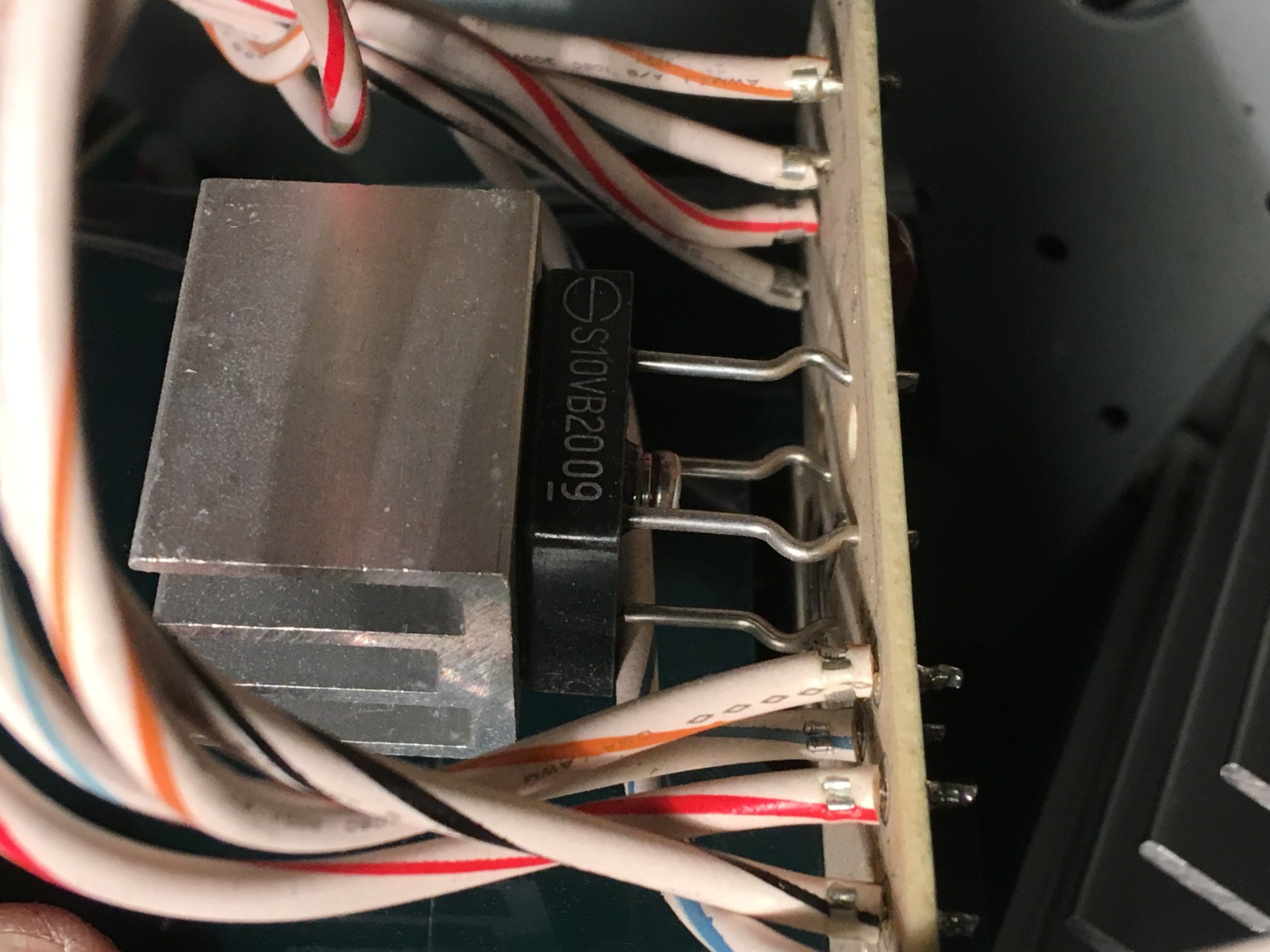
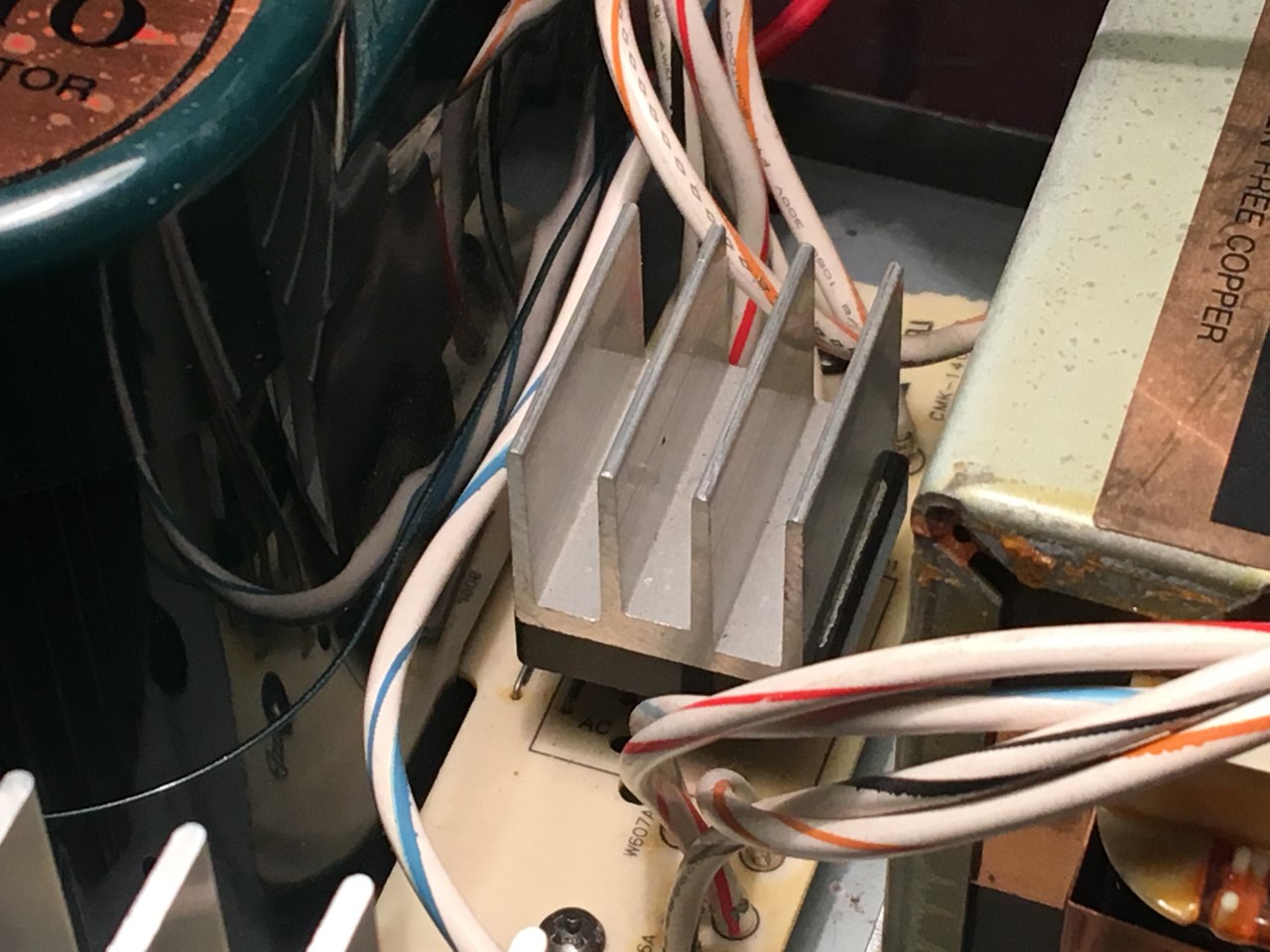
Was there a heatsink on the bridge?


Thread Starter

Marius83

Joined Dec 28, 2017
423
Yes it was a heatsink on it..

So just put the new one with the flat corner where the old one had the flat corner, right? :)


MrChips

Joined Oct 2, 2009
34,841
Yes. Bridge rectifiers in a square package are always arranged with +ve and -ve diagonally opposed.
Put some bends in the leads just like the original to make the component stand up away from the circuit board.

I notice that the lead size is different but that should be ok.
GBPC2508W is rated at 25A @ 800V.
 

MrChips

Joined Oct 2, 2009
34,841
Welcome back!

I have to review where we are at the moment.
I guess the next step is to apply power and measure the +60V and -60V rails with your DMM and oscilloscope.

Are you testing on the kitchen table or are you in the frigid garage?
 

Thread Starter

Marius83

Joined Dec 28, 2017
423
Welcome back!

I have to review where we are at the moment.
I guess the next step is to apply power and measure the +60V and -60V rails with your DMM and oscilloscope.

Are you testing on the kitchen table or are you in the frigid garage?
Thanks.
I am still in the garage, i hope that's not a problem :)

So, measure power with dmm at first, at R505 and R506 wasn't it...
 

JoeJester

Joined Apr 26, 2005
4,390
Did you measure it with your oscilloscope as well?

The scope ground would be where you had the black probe. Make zero volts your center scale and set it for 50 V per cm.
 

MrChips

Joined Oct 2, 2009
34,841
I've been thinking of what to do next with this difficult and exasperating amplifier repair.

Why is this such a difficult repair?
Firstly, we have here a 360W power amplifier drawing 870W of AC mains power. Any shorts could/would result in a lot of sparks and smoke as you have well discovered.

Secondly, the power stages are DC coupled with DC feedback. This allows for high power output down to the lowest audio frequencies. This also means that any short or DC imbalance will upset all the DC bias voltages.

I know it must be frustrating, not to mention the stress, to do the power-on smoke test.
Hence we are going to add a new test setup. A number of members have suggested a dim bulb test setup.

We are going to try two approaches simultaneously.

1) The first setup will be a 100W (240V) incandescent light bulb in a screw-type socket. You will need some AC components.

(I suggest that you get a power bar with an ON/OFF switch. My preference would be to plug the power bar into the AC mains and use this as your main power breaker switch. However this is not absolutely necessary. When I am trouble-shooting AC equipment I like to have the power ON/OFF switch at my finger tip.)

Find some old AC power cord, power outlet and a lamp socket or AC lamp and an old AC outlet. You will feed AC LINE to the lamp and then in series to the power outlet into which you will plug in your amplifier power plug. (Hope this is clear. If not, please let me know.)

2) The second thing we will do is replace R505 and R506 with a similar setup. In this case you will use 12V 25W incandescent bulbs (household, automotive or marine). Get two bulbs and two sockets. You will run connecting wires from the lamp sockets to the pads where R505 and R506 were removed.

In addition to the above, we will continue to do static power-off resistance tests to make sure that there are no shorts or low-resistance paths before we apply power.
 

Thread Starter

Marius83

Joined Dec 28, 2017
423
Did you measure it with your oscilloscope as well?

The scope ground would be where you had the black probe. Make zero volts your center scale and set it for 50 V per cm.
I did not use my scope JoeJester :oops:

@MrChips
Testing with lightbulbs might be a smart thing.. I will get the things for the tests with light bulbs
Just don't have so much spare time at the moment...
I will get back as soon as i can

Thanks guys for all the help so far, it's not over :)
 
Top