Technics SU-VX800 amplifier

JoeJester

Joined Apr 26, 2005
4,390
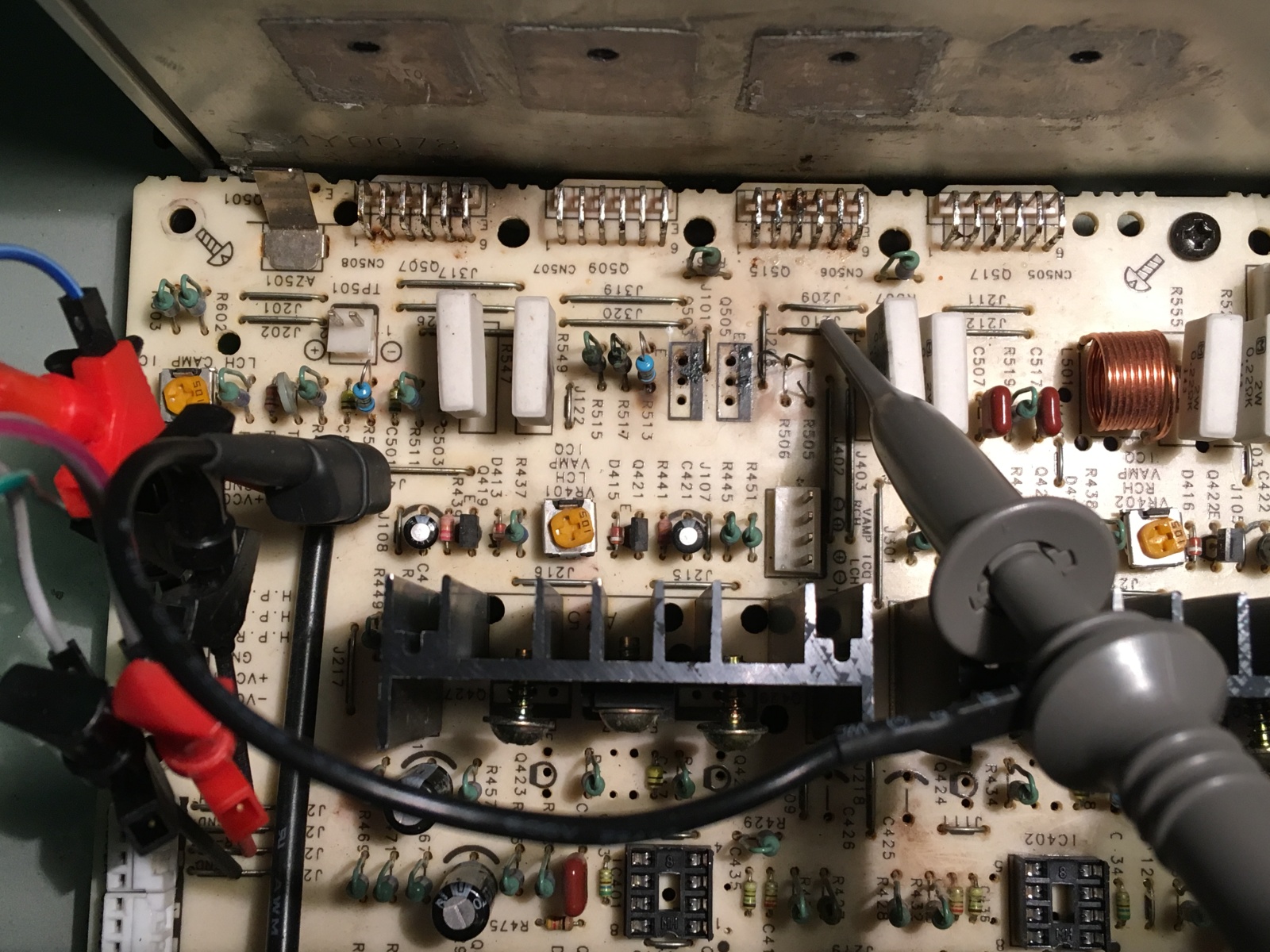
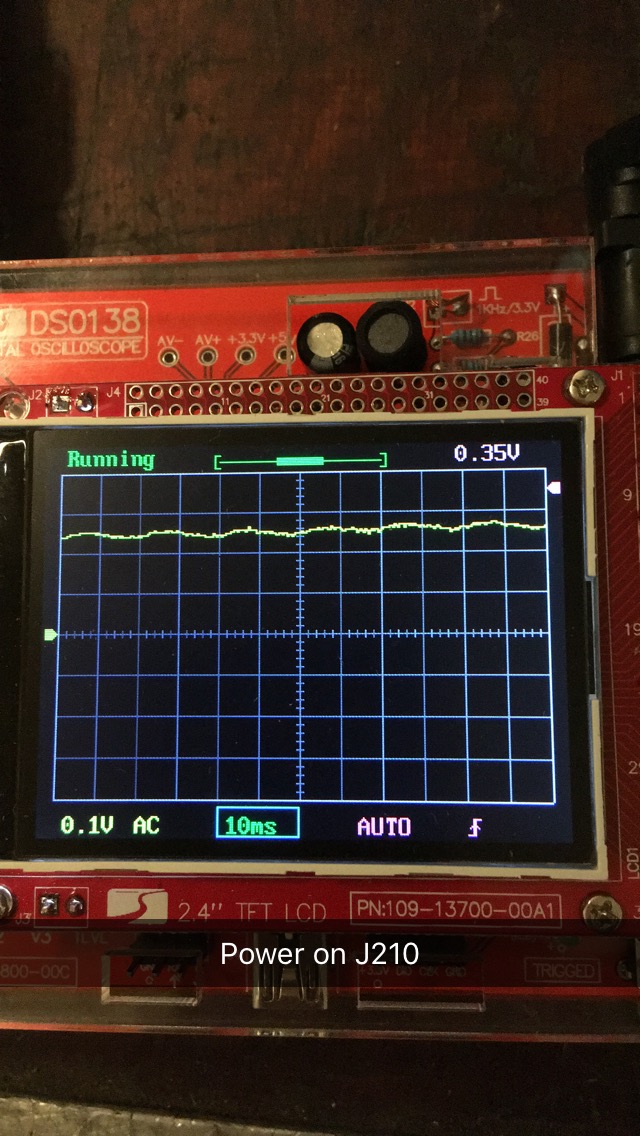
@Marius83 there is nothing you can do about it. The ripple is less than 0.5% with the loads you have attached. The measurements, positive and negatine will be repeated for sure as MrChips directs you to install components.

I'll assume you have the ground clip attached to a good ground on the board.
 

MrChips

Joined Oct 2, 2009
34,839
I looked at the video. I don't have an explanation for what it is showing.
Maybe it has something to do with the DSO138. I will study this in more detail later.
 

JoeJester

Joined Apr 26, 2005
4,390
@Marius83 That speaker output you were showing, it displayed 24V of 50 Hz, which would be a hum, a loud hum. I beginning to think you don't have the little ground clip attached to the probe.

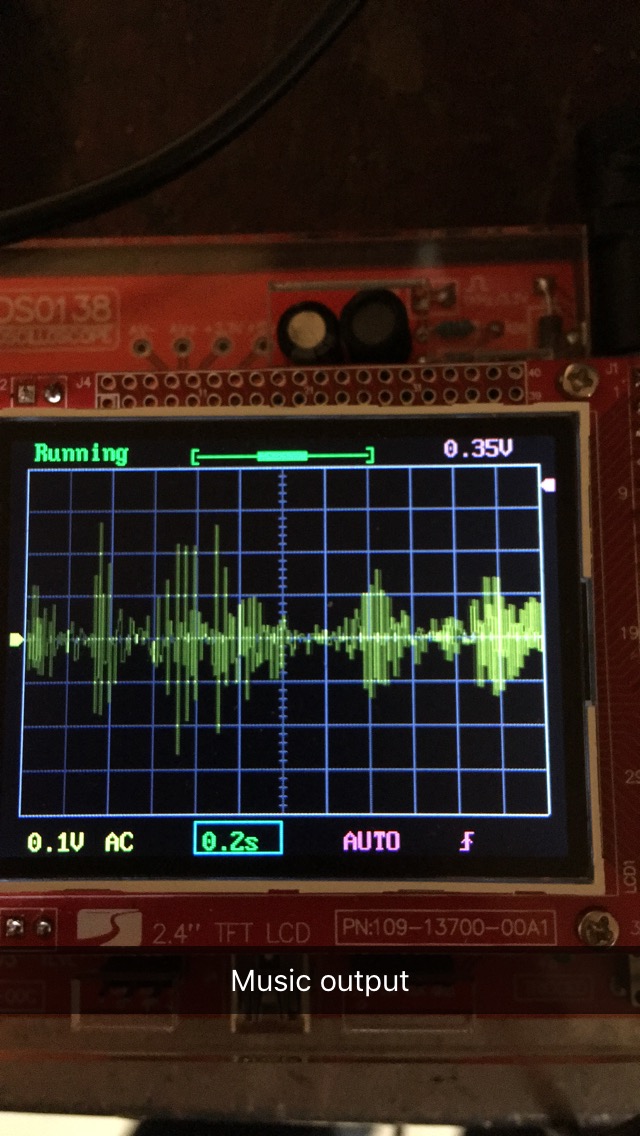
Here is 20 seconds of the Van Morrison tune, Brown Eyed Girl as viewed by an oscilloscope, abet a virtual one.


Same music at 20 mS/cm

 
Last edited:

Thread Starter

Marius83

Joined Dec 28, 2017
423
@JoeJester, thanks for the clips, that's more like i thought it should look like too !

I was playing music on that picture i took of speaker output.. but all it showed was a hum as you say...i realized it was something strange first later on when i uploaded the picture...:oops:
And you are right, the probe was not grounded when i took the speaker output... might be the reason then? where to ground it in the speaker i thought...hehe, but maybe in the amp i had the speaker connected to ?

All pictures of measuring J209 and J210, i have the probe grounded in the big heatsink in the amp, which is screwed in the chassi gnd of the amplifier.. should be ok i think..
 

JoeJester

Joined Apr 26, 2005
4,390
Like all meters, you place the probe on one end and the ground clip on the other. If your system has red and black connections, the ground would be black. On shielded cables, the ground would be on the shield.

on edit:
Did you have the ground clip connected to where you had the black lead when you made the voltage measurements on the amplifier?

Disregard the last sentenance.
 
Last edited:

MrChips

Joined Oct 2, 2009
34,839
Here is a test I would like you to do on the DSO138 alone.

Connect the oscilloscope probe to the DSO138 and set the probe to 1X.
Set the DSO138 as follows:
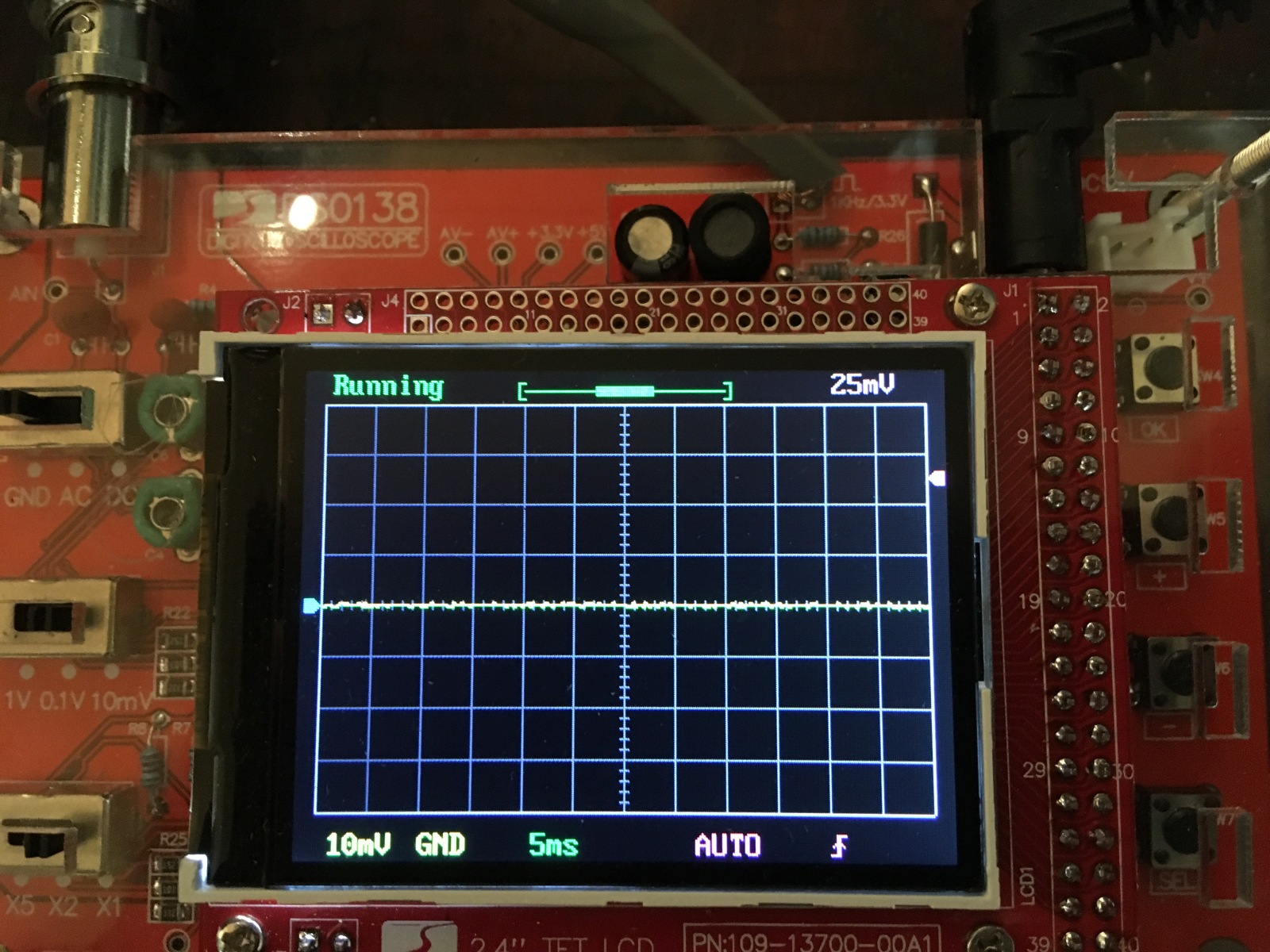
CPL GND
SEN1 10mV
SEN2 x1
TIME/DIV 5ms
Observe that the trace is at the mid-line.
(If not, correct as per instructions in the manual.)

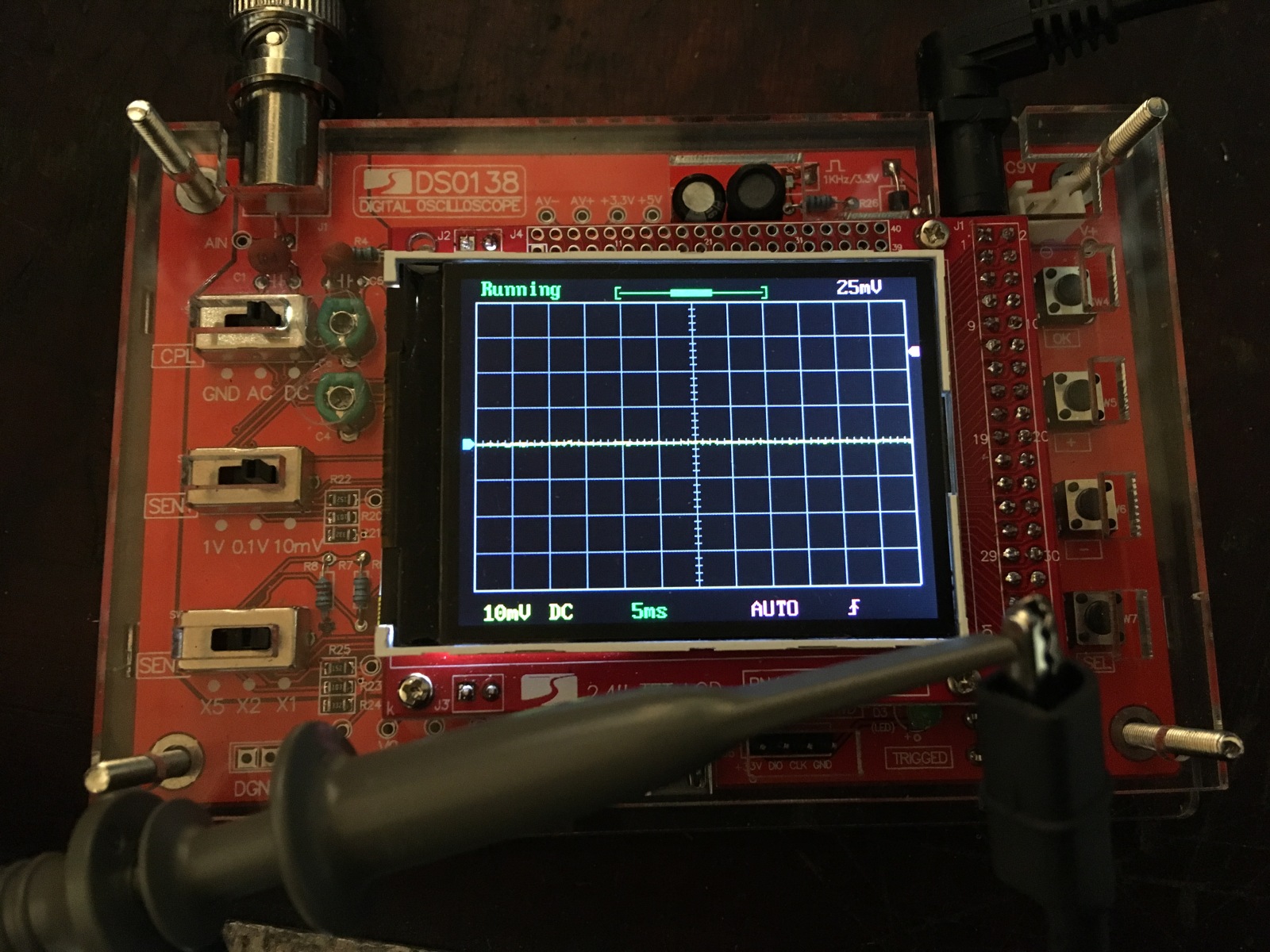
Set CPL to DC.
Connect the probe grounding clip to the tip of the probe.
Observe that the trace is at the mid-line. (No adjustment required.)

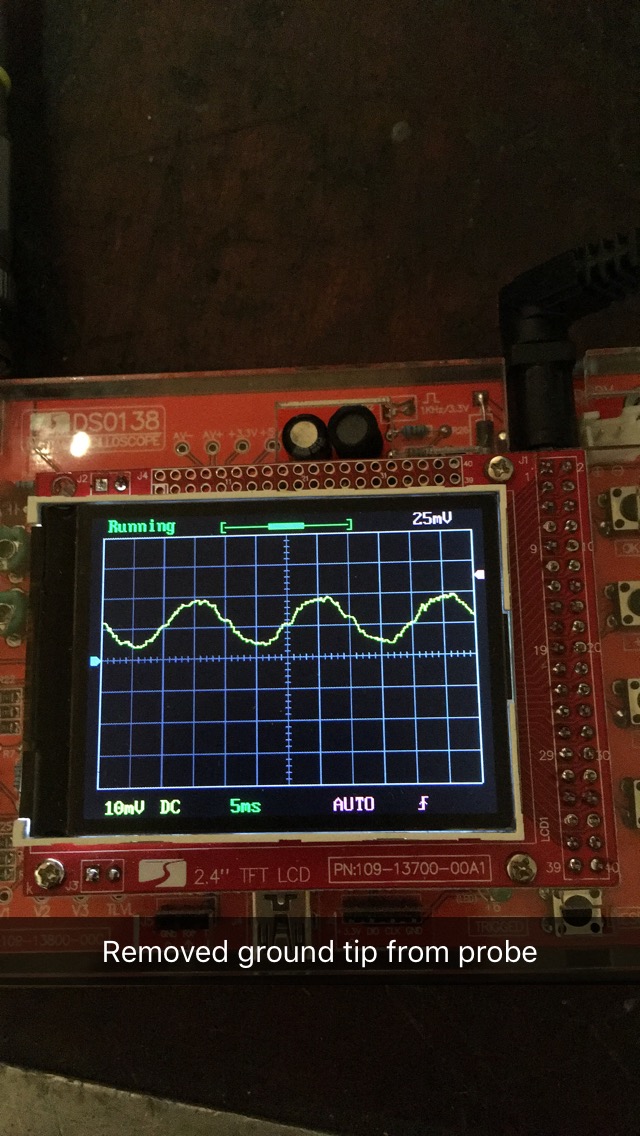
Remove the grounding clip from the tip of the probe.
Does the trace move upwards?
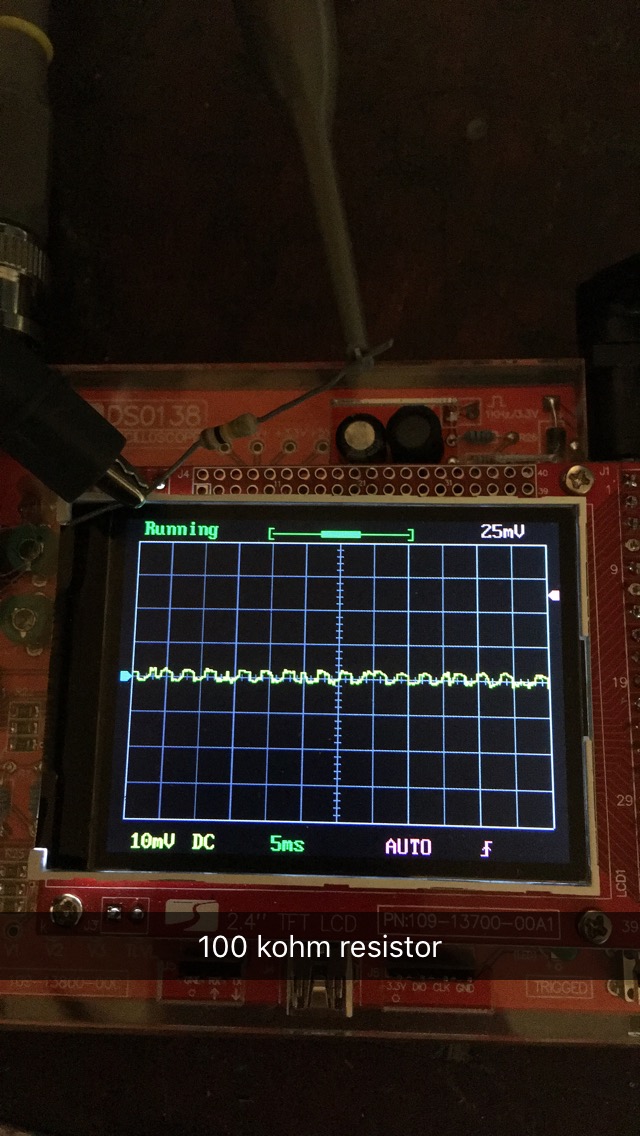
If you happen to have a 1MΩ resistor, connect the resistor from the probe tip to the grounding clip.
Where does the trace lie now?

We may have to find a fix for the DSO138.
 

MrChips

Joined Oct 2, 2009
34,839
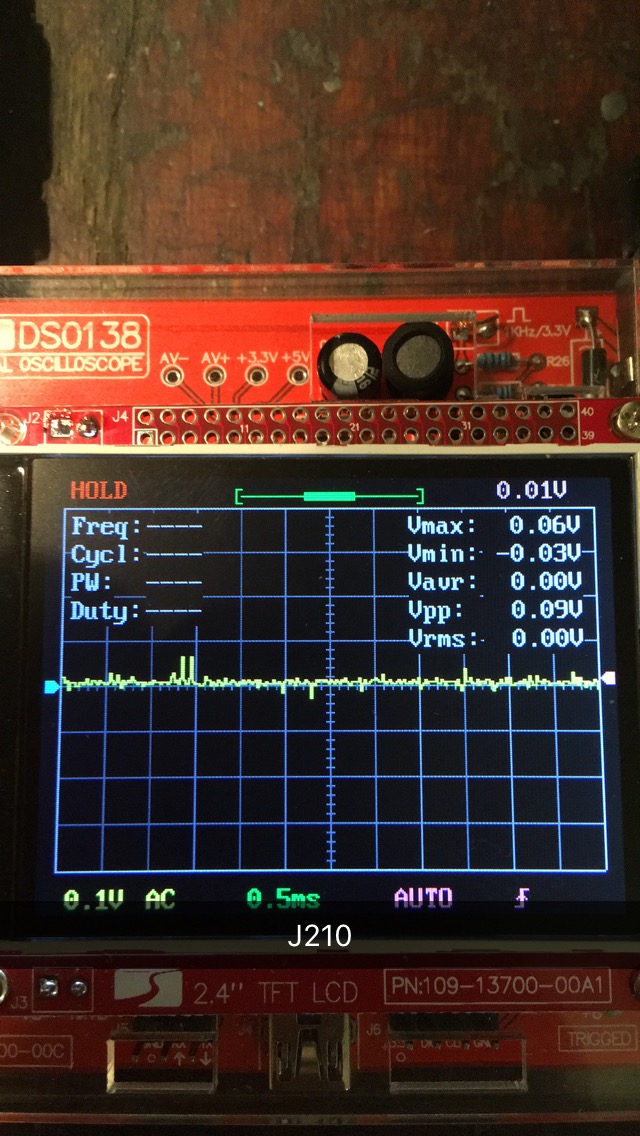
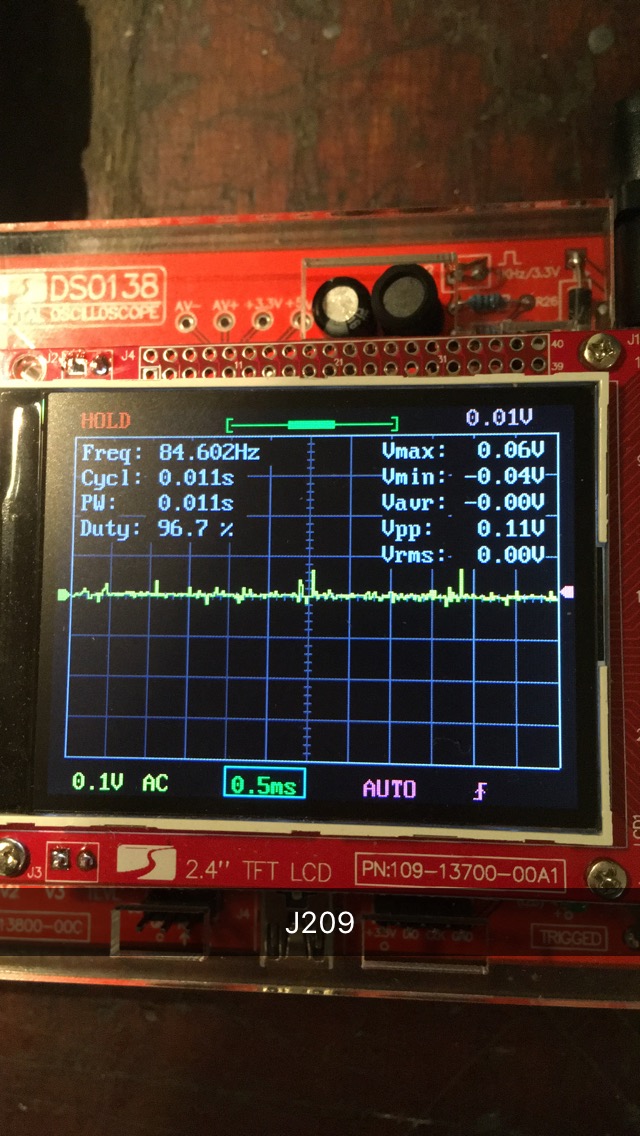
Repeat the power supply measurements at J209 and J210 with

Scope probe at 10X
CPL AC
SEN1 0.1V (don't set to 10mV for now until I find a fix)
SEN2 X5 (X1, X2 and X5 which ever gives a decent trace)
TIME/DIV 5ms nominal (try other ranges from 2ms to 1s)
 

Thread Starter

Marius83

Joined Dec 28, 2017
423
Like all meters, you place the probe on one end and the ground clip on the other. If your system has red and black connections, the ground would be black. On shielded cables, the ground would be on the shield.

on edit:
Did you have the ground clip connected to where you had the black lead when you made the voltage measurements on the amplifier?

Disregard the last sentenance.
Aha...thanks.. I tried to probe the speaker output again.
I took the probe at + and grounded the probe at the - at the speaker
Now it works like it should, showing the ouput the correct way.. !:)


@MrChips, i will try the tests as soon i can, thanks:)
 

Thread Starter

Marius83

Joined Dec 28, 2017
423
So i tried some testing again. first at d DSO138 alone like you have discribed MrChips

Here's the probe at at 1X connected to the DSO138 signal, i corrected the trace only this first time at these testings.


Here's the GND clip from the probe connected to the probe tip, made no difference to the signal


Removed the ground from the tip


Highest value resistor i have is a 1k ohm..... i guess it will be wrong in your test but i did i anyways.. might have to get a larger one. EDIT: i saw i wrote 100kohm in the picture...
 
Last edited:

Thread Starter

Marius83

Joined Dec 28, 2017
423
So to some more testing of the amp....i now grouned the probe at J401 which is my GND point for measuring everything


I tried testing speaker output with the probe grounded as you told me @JoeJester Looks better now :)

 
Last edited:

MrChips

Joined Oct 2, 2009
34,839
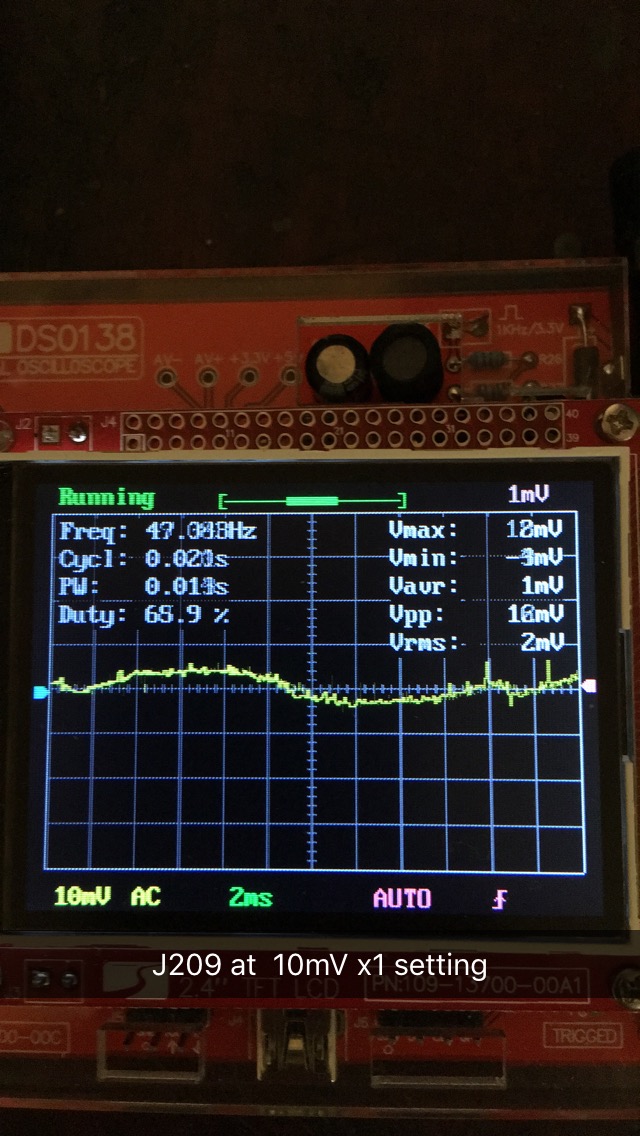
There appears to be a DC offset when SEN1 is set to 10mV, as reported by other DSO138 users.
I am combing through all the posts made by DSO138 users on various forums to see what can be done to fix this.
We will try to come up with a simple fix for you.
 

JoeJester

Joined Apr 26, 2005
4,390
I don't think there is much we can do about the varying offset when measuring DC at such a small sensitivity. There is virtually no load on that supply.

The music test proved there was nothing wrong with the oscilloscope.

I suspect if we added a 1k load to that supply (60 mA load) or 10k load, the oscilloscope would act as normal. That 10M scope impedance contributes to what we see when the load is just that 10M impedance of the oscilloscope.

On edit. I will simulate it tonight when I get home.
 
Last edited:

JoeJester

Joined Apr 26, 2005
4,390
Read the part of the user manual about triggering, auto, normal, and single.

Does the triggered led flash? It's suppose to on every trigger.

Normal is the best for a stable trace.
 

Thread Starter

Marius83

Joined Dec 28, 2017
423
I have not really thought about that little led so much, but i can see on my pictures that i has not lit up always.. don't know what that could mean ?

I don't know if my scoping has given you any info at all so far..
Should i just order a new rectifier so we are rid of that "problem" ?
 

JoeJester

Joined Apr 26, 2005
4,390
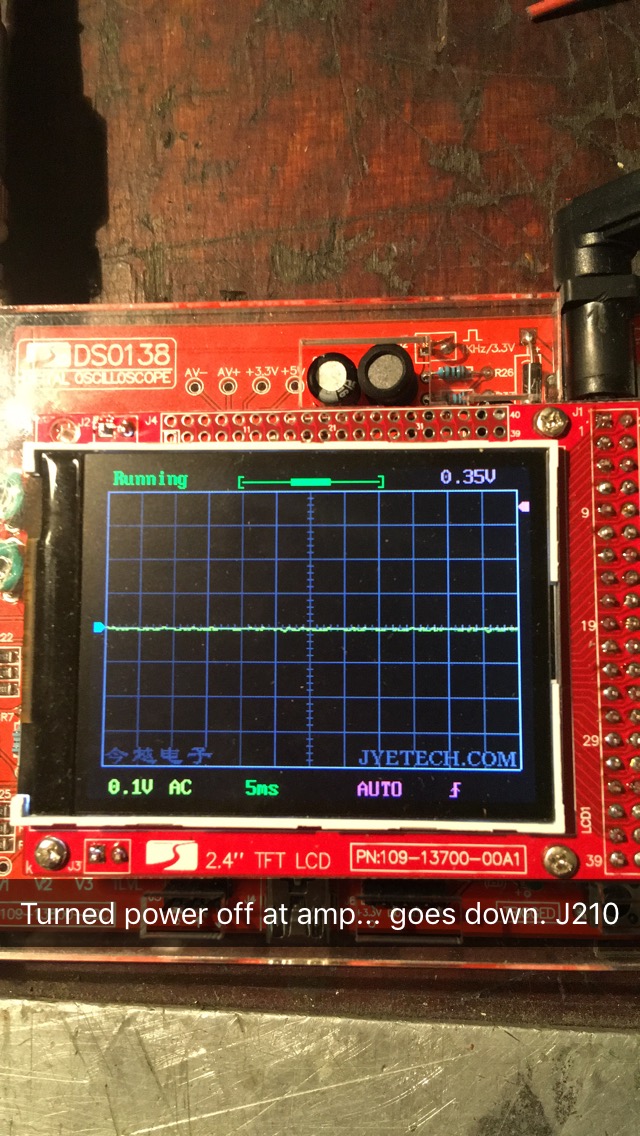
@Marius83 No, not yet. The information is somewhat useful, it's just not exactly what I expected. It did show 60V and the ripple was not excessive. It more of the scope operations, than a problem with the amplifier.

This is what I was expecting, but it is triggered to obtain a stable trace.
expecting.jpg

You observed and reported the traces as you saw them with auto triggering. Even the virtual scope I'm using has the same type of problem in AC mode. You notice your trigger level is 0.35 V as seen on the display. With the x10 probe it's actually 3.5V. The ripple is much lower than that. You could lower the trigger level to 0.01 and it could end up giving you a very good trace. Even 0.00 should trigger on the AC mode. You can see that I needed -4 mV (-40mV as I am using a x10 probe) to see the stable trace in the normal mode.
 

Thread Starter

Marius83

Joined Dec 28, 2017
423
Okey, i tried again, with the trigger level at 0,01
If i put the DSO in "normal" mode, the picture just freezes... like i'm pressing HOLD... i don't know why.. so it has to stay on "auto"

Some testing on the pictures.. i even tried 10mV at one point.. as you can see..


I was thinking about that trigger LED JoeJester, it does only seem to light up when i have a very strong signal..i set the probe to 1X at the video.... and if i flip the switches on the signal in the video to calm the crazy signal down to get a more readable trace it will not light up anymore.. maybe it's just the way it is...:rolleyes:
 

JoeJester

Joined Apr 26, 2005
4,390
If you switch the probe to x1, you are overloading your dso. It can safely measure 50 volts. That was the purpose of the x10 probe purchase, so you can measure the 60V supplies safely without destroying your equipment.

Know what your measuring so you can do it safely.

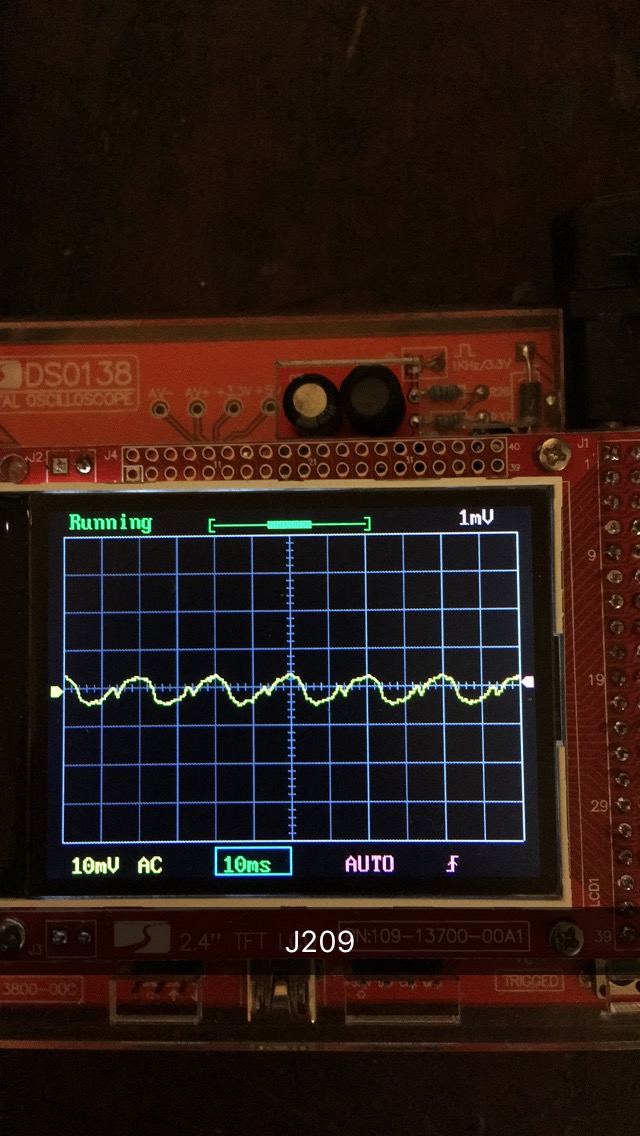
Your mains are 50 Hz so the frequency of the waveform should be 100 Hz. Your trace time should be 10 mS/cm. Then the waveform should be one cm in time. My virtual scope was measuring 60 Hz mains, doubled to 120 Hz by the full wave rectifier. The repetitions are every 8.333 mS.

I don't like the fact yours is more sinewave than sawtooth.

Yes, you can set the Sens switches to X10 mV and x1. With the x 10 probe, that vertical becomes 100 mV per cm.

I have put the equivalent of a x10 probe with my virtual osvilloscope to be closer to your settings.

I'll look closer at your pics when I get home. I'll have to improve the capacitor model to see if I can replicate the sinewave like your seeing.

All in all, your ripple voltage is less than 100 mV, just like the simulation.

There is one issue I will be discussing before I would recommend proceeding.

In the TP40x and TP50x circuits there are resistors labeled as 680 and 1000 ohms connected to the variable resistors. I would like you to confirm the resistor values on your board.

The tests I've done show that you can't meet the published specification, and in fact the current would be much greater. Again, more details when I get home.


On edit ....

Your trigger level on 0.1 mV is really 10 mV. You have to do the multiplication in your head when your in the x10 position
 
Last edited:

Thread Starter

Marius83

Joined Dec 28, 2017
423
If you switch the probe to x1, you are overloading your dso. It can safely measure 50 volts. That was the purpose of the x10 probe purchase, so you can measure the 60V supplies safely without destroying your equipment.

Know what your measuring so you can do it safely.

I'll look closer at your pics when I get home. I'll have to improve the capacitor model to see if I can replicate the sinewave like your seeing.

All in all, your ripple voltage is less than 100 mV, just like the simulation.

There is one issue I will be discussing before I would recommend proceeding.

In the TP40x and TP50x circuits there are resistors labeled as 680 and 1000 ohms connected to the variable resistors. I would like you to confirm the resistor values on your board.

Your trigger level on 0.1 mV is really 10 mV. You have to do the multiplication in your head when your in the x10 position
I wrote x1 at one of the pictures, but what i meant by that was 1x at the DSO settings, not the probe, i guess that made a misunderstanding.
I never had the probe at x1 measuring at the amplifier. Only when i measured the speaker output in the video..

I can check those resistors, but i would need the number to find them i guess..

I understand the x10 probe and what it does.. so if the ripple is under 100mV.. is it ok whitin the specs?
 
Last edited:

JoeJester

Joined Apr 26, 2005
4,390
Under 100 mV is a good number. There typically no spec on ripple voltage, however, in the days of vacuum tubes, we kept it under 5 percent as a rule of thumb. In solid state, it could be detrimental in some circuits if not somewhat minimum so we can tighten up that a bit.

I checked with my circuits, and I have all but one pre-amplifier modeled, but I do know the gain of that amplifier, so the simulation is working as I've seen the specifications with respect to output, and given the ICQs adjusted properly.

I just finished the screen recording of the +60V that is the equivalent measurements you did on J209. The simulation ripple was about 180 mV peak to peak and we know that is less than 1 percent of the supply voltage. Your scope showed something similar if not less.

I know I am using models and not the components you have in front of you. I also expect the values calculated in the simulation would agree within 5 percent or so of what you observe. I've enjoyed working on this problem with you two.

If I seem harsh at times, it's because I can't see what you've done as you take the measurements. If I have a question, I ask. So, bear with this old man, who can get cantankerous at times.
 

MrChips

Joined Oct 2, 2009
34,839
Side tracking just a little, there is an input offset issue on the DSO138 hobby oscilloscope. I have created a thread on this here:

https://forum.allaboutcircuits.com/threads/dc-offset-in-dso138-oscilloscope.151575/

When you get a chance you can apply this fix with a 200k trimmer pot and 22M fixed resistor, though not essential.

In the meantime, always use the oscilloscope probe set to x10 position when measuring any DC voltages that are expected to be greater than 5V.

Don't use the DSO138 set to 10mV input range for now to avoid seeing this input offset.
 
Top