Studer 169 Power Supply Troubleshooting

Thread Starter

octavez

Joined Jun 5, 2019
18
Hi,

I'm currently refurbishing an old Studer 169 mixer console from the 70s. I'm pretty much recapping it as it would not turn on when I tried to power it on recently.

I'm trying to get the power supply to work first. I recapped it and the AC readings are good but the DC readings at the end are too high, I'm reading +48v, +26v, 0v, -26v instead of +48v, +15v, 0v, -15v. This causes the safety circuit to trip the relay and turn off to avoid damaging the console. To get the DC readings I'm bypassing the safety circuit as indicated in the documentation to debug a problem.

I have checked all diodes with a multimeter and they seem fine (diode test on the circuit). I can feel heat in the components at the bottom left of the board (resistors area) but not much elsewhere, when I send current for ~10 sec (then I stop).

I've attached the documentation with schematics and pcb layout for reference. And also a picture of my power supply recapped.

Any tips is on how I could find the issue is welcome!

Thank you,

Octave
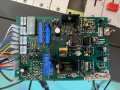
IMG_1137.jpg
 

Attachments

michael8

Joined Jan 11, 2015
472
Sounds like the +48v is working. The +15V and -15V are almost the
same design, with the -15V taking it's reference from the +15V supply.
So if the +15V supply was wrong the -15V supply would follow it.

Looking at the +15V supply:

* input D201-D204, C203
* regulator IC201 uA723

The basic concept here is that the input current is controlled by
Q201 and Q201 is controlled by the uA723 regulator IC201. The IC201
pin 4 supplies an approx 7.15 V reference voltage which is connected
(indirectly) to IC201 pin 3 to be used as a reference. IC201 will try to
adjust things via it's output and Q201 to have the same voltage (7.15V)
at it's input pin 2.

IC201 pin 2 is a sample of the +15V output voltage for some point on
the series string of the resistors R213 6.8K, R214 2.2K, and R215 5.6K.
R214 is adjustable and allows adjusting the output voltage somewhat.
I wouldn't adjust R214, the +15V is to far out to just be a misadjustment.

OK, series resistors, the total resistance of the series
string across the 15V output is:

R213 6.8K + R214 2.2K + R215 5.6K -> 14.6K

So the current in the series string is:

15V / 14.6Kohms -> about 1mA

{IC201 pin 2 shouldn't be taking any significant current}

Guessing R214 is set to the midpoint the voltage at the output of R214
and thus the input to IC201 pin 2 should be:

So the voltage at the tap on R214 would be:

1/2 R214 = 1.1K + R215 5.6K -> 6.7K * 1ma -> about 6.7 V

This is close to the reference of 7.15V so likely R214 isn't set to the
midpoint to get an output of 15V.

What to measure?

Well, how much load does your multimeter add to a circuit when
measuring voltage?

A start might be:

* raw input voltage: between Q201 emitter and ground
* base drive to Q201: across R201
* base drive to Q201: between Q201 base and ground
* sink path for Q201 base current: across D205 7.5V zener diode

These are all low impedance points and your multimeter load should
not affect the readings enough to be a problem.

With a high input impedance DVM/DMM you could measure the voltages
at IC201 pins 4, 3, 2.

Which capacitors in the +15V supply were replaced?
 

Thread Starter

octavez

Joined Jun 5, 2019
18
First of all thank you Michael and Dave for such fast and detailed replies! So I did some testing even though I'm not 100% sure how to properly test things as I'm just starting with electronic repairs.

For those tests if I understood well I just set my DMM to DC V and put the com on the ground pin on the board then I got:

* raw input voltage: between Q201 emitter and ground = +26v
* base drive to Q201: across R201= +26v
* base drive to Q201: between Q201 base and ground = +26v
* sink path for Q201 base current: across D205 7.5V zener diode = it fluctuates a lot, not steady, starts around +10v then goes up to +30v and even more sometimes

"With a high input impedance DVM/DMM you could measure the voltages at IC201 pins 4, 3, 2." = my DMM only goes to 10M Ohms, I tried and values are all over the place, normal?

"Which capacitors in the +15V supply were replaced?" => All electrolytic and tantalum capacitors here is the list:

C103 replaced with 220uf/25v
C203/C303 replaced with 2200uf/40v
C209/C308 replaced with 1000uf/16v
C403 replaced with 100uf/100v
C408 replaced with 10uf/63v
C104 replaced with 1uf/25v (Tantalum)
C207/C404/C406/C407 replaced with 10uf/35v (Tantalum)

Dave: "Check IC204, D205 zener"=> I think you meant IC201 (their 1 looks like 4 :)) and so like I said above D205 gives me fluctuating DC voltage which could be the fault or should I test it differently? I did a diode test on it and it seems fine (read 0.7 not OL).
 
Last edited:

Dodgydave

Joined Jun 22, 2012
11,395
Yes IC201, IC301, must be a German circuit.. Check the zener D205 with a dvm, or replace it.

Sounds like Q201 is probably shorted, test it out of circuit,
 
Last edited:

Thread Starter

octavez

Joined Jun 5, 2019
18
I just got D205 out of circuit. On diode test I get 0.7 one direction OL on the other, I guess correct? Then in a +9v loop, I get a +3.3v DC reading on and +8.7v if I swap leads. Does that sound right?

I will get the Q201 out.
 

Thread Starter

octavez

Joined Jun 5, 2019
18
Got the Q201 out. The only thing potential fault I'm seeing is that Collector to Emitter gives me 0.005v instead of OL correct? Could that be the problem?
 

Dodgydave

Joined Jun 22, 2012
11,395
Q201 test it on Diode, B/E 0.7V, and E/C should be open circuit or high resistance, if it's ok then i would suspect IC201...

As you have two regulators, you could swap the IC201 for IC301,, and transistor with the -15V side to see if they are faulty.
 

Thread Starter

octavez

Joined Jun 5, 2019
18
So positive lead on E negative lead on B gives me 0.6v (if I do B/E I get OL, because it's a PNP right?) and E/C gives me 0.005v. I did the hFE test too and I get 300hFE.
 

Thread Starter

octavez

Joined Jun 5, 2019
18
Hmm ok! Will a 2N6040 or TIP105 work as replacement? I can't find any BD796 that will ship to France...
 
Last edited:

Thread Starter

octavez

Joined Jun 5, 2019
18
After reading more about transistor it seems that this could simply be current leakage when testing E/C which apparently is normal to a certain extent. What do you guys think?
 

Dodgydave

Joined Jun 22, 2012
11,395
Try testing on ohms between Emitter and Collector...On diode test it should read OL, between C/E


Try TIP145/6, 2N0640
 
Last edited:

Thread Starter

octavez

Joined Jun 5, 2019
18
On Q201 I read 1.9 Ohm and on Q301: 1 Ohm

Would 2N6040 work instead of 2N0640? I can't find 2N0640.

Thanks again!
 

michael8

Joined Jan 11, 2015
472
> I just got D205 out of circuit. On diode test I get 0.7 one direction
> OL on the other, I guess correct?

That sounds right for a zener.

> Then in a +9v loop, I get a +3.3v DC reading on and +8.7v if I swap
> leads. Does that sound right?

Can't picture what your doing here. I'd suspect the zener is ok, but if I
wanted to test it I'd put it in series with a 1K resistor and apply 12V
to the series combination.

This should result in about 7.5V across the zener (if you get .7 reverse
the zener!) and 12-7.5 -> 4.5V across the 1K resistor.

> Got the Q201 out. The only thing potential fault I'm seeing is that
> Collector to Emitter gives me 0.005v instead of OL correct? Could that
> be the problem?

> So positive lead on E negative lead on B gives me 0.6v (if I do B/E
> I get OL, because it's a PNP right?)

So the base-emitter junction is still there.

> and E/C gives me 0.005v. I did the hFE test too and I get 300hFE.

Neither of those make "sense" as "real" measurements. The 300 hFe is
higher than I'd expect for a power transistor. Likely your DMM is just
assuming the collector current it sees is caused by the base current
the DMM is supplying and not leakage. And the E/C 0.005V is
the result of leakage (?).

> Hmm ok! Will a 2N6040 or TIP105 work as replacement? I can't find any
> BD796 that will ship to France...

Both 2N6040 and TIP105 are darlingtons so no.

> I also checked Q301 and E/C gives me 0.003v, is it likely that both
> are bad?

Possibly. Both are likely bad if one killed the other but it's not clear to
me that either is bad. As a first assumption I'd guess the E/C
measurements aren't a real check of the transistors status.
 

Thread Starter

octavez

Joined Jun 5, 2019
18
Hi Michael,

Thank you for the update! I'm still figuring out how to properly test those components, it's my first time :)

Would you have any suggestions on what I should try?

Thanks again!
 

michael8

Joined Jan 11, 2015
472
I'd do something like this to test one of those transistors:

pnptest.png

The two resistors on the right add to 12K so 1 mA flows and the voltage
at the base of the PNP should be about 10 V. This is 2V across the PNP
BE junction and the 100 ohm resistor in the emitter. The voltage across
the BE junction should be about 0.7 volts leaving 1.3 volts across the
100 ohm resistor.

So about 13 mA should flow through the 470 ohm collector resistor. So the
voltage cross the 470 ohm resistor should be about .013*470 -> 6.1 volts.
 

michael8

Joined Jan 11, 2015
472
> First of all thank you Michael and Dave for such fast and detailed
> replies! So I did some testing even though I'm not 100% sure how to
> properly test things as I'm just starting with electronic repairs.

You're way above the typical query since you supplied such a good
manual including a schematic along with a clear picture.

> C207/C404/C406/C407 replaced with 10uf/35v (Tantalum)

Is that a typo? Probably C206 instead of C207.

C207 is across IC201 pins 2 and 3 and the schematic says 0.1uF.

> * raw input voltage: between Q201 emitter and ground = +26v

That's what's expected when working so ok.

> * base drive to Q201: across R201= +26v

26V across R201 with R201 being 270 ohm so 26/470 -> 55 mA

55 mA * 26 V -> 1.4 Watts of power, that's way more than that resistor
can take so this voltage isn't normal for correct circuit operation.

Looking at the circuit, the +26 feeds the series path of R201, R201,
R203, then the transistor in IC201 between pins 7 (collector) to 6
(emitter) and then via D205 to ground.

So I'd expect the voltage along that series path to start at +26 at the
top and drop with each element. D205 is a 7.5V zener so the top of D205
should be 7.5V.

Continue on before jumping to conclusions.

> * base drive to Q201: between Q201 base and ground = +26v

Whoo. There's 26V across R201 and also both sides measure +26V to ground?
That can't be real (doesn't mean it can't measure that way).

Perhaps the left side of R201 is constant at +26V (as would be expected)
and the right side of R201 is going up and down and the DMM is confused
by the changing value?

> * sink path for Q201 base current: across D205 7.5V zener diode = it
> fluctuates a lot, not steady, starts around +10v then goes up to +30v
> and even more sometimes

Fluctuates = possibly the "regulator" is oscillating?

> "With a high input impedance DVM/DMM you could measure the voltages at
> IC201 pins 4, 3, 2." = my DMM only goes to 10M Ohms, I tried and values
> are all over the place, normal?

> my DMM only goes to 10M Ohms?

when you connect a DMM to a powered up circuit it modifies the circuit
(becomes part of the circuit even though your DMM doesn't show on the
schematic. Adding a very high value resistor to most circuits won't
have a significant effect, but lower values will.

What DMM do you have?

Oh, when the power is on in the circuit you should only be on a voltage
range, never ohms range. "high imput impedance" refers to how much the
DMM loads the circuit when measuring voltage.
 

Thread Starter

octavez

Joined Jun 5, 2019
18
Thanks again Michael for helping!

> I'd do something like this to test one of those transistors:

I will grab some resistors tomorrow to try it.

> Is that a typo? Probably C206 instead of C207.

Yes you're right, I just realized I said that because they swapped them in the part list!

> Whoo. There's 26V across R201 and also both sides measure +26V to ground?

Yes, I just doubled check. All the leads from Q201 and R201 reads +26v, even +27v on my last test.

One note I also checked Q301 and it reads +38v on B and E but C reads 0v.

> What DMM do you have?

I have a Kuman WH5000A, the manual is here: https://d3gqasl9vmjfd8.cloudfront.net/788585cc-f098-4448-b840-a22477ad9b5e.pdf

> Oh, when the power is on in the circuit you should only be on a voltage range, never ohms range.

Yes, what I've been doing.
 
Top