Studer 169 Power Supply Troubleshooting

Thread Starter

octavez

Joined Jun 5, 2019
18
Hi Michael, I just got a chance to do your test suggestion on Q201:

> The two resistors on the right add to 12K so 1 mA flows and the voltage at the base of the PNP should be about 10 V. This is 2V across the PNP BE junction and the 100 ohm resistor in the emitter.

Yes, correct.

> So about 13 mA should flow through the 470 ohm collector resistor. So the voltage cross the 470 ohm resistor should be about .013*470 -> 6.1 volts.

I read 9.5V.

> The voltage across the BE junction should be about 0.7 volts leaving 1.3 volts across the 100 ohm resistor.

Not at all, I read around 88V! Also CE gives me around 35V, doesn't seem right correct?

I went to my local electrical supply shop and ordered replacement for both transistors, 7.5v diodes and voltage regulator (I got the 14-pin version). So on Wednesday I will be able to swap all of those.

Thanks again,

Octave
 

michael8

Joined Jan 11, 2015
472
Power transistor testing: I'm assuming you used the circuit
I provided and an approximate 12 volt power supply.

> Hi Michael, I just got a chance to do your test suggestion on Q201:

>> The two resistors on the right add to 12K so 1 mA flows and the voltage
>> at the base of the PNP should be about 10 V. This is 2V across the PNP
>> BE junction and the 100 ohm resistor in the emitter.

> Yes, correct.

Did you measure the voltages across those resistors and get about
2 volts across the 2K resistor?

>> So about 13 mA should flow through the 470 ohm collector resistor. So
>> the voltage cross the 470 ohm resistor should be about .013*470 ->
>> 6.1 volts.

> I read 9.5V.

Well, the 6.1 volts suggested is an approximation. Let's see what
can be learned from the measurements you got.

9.5 volts across 470 ohms implies 9.5/470 -> about 20 mA of current

This is out of the collector of the transistor and must be entering the
transistor from the emitter since the resistors connected to the base
wouldn't allow this much current from a 12 volt supply.

Also with 20 mA of current flowing the voltage across the 100 ohm resistor
in the emitter should be 2 volts. With a 12 volt supply 12 - 9.5 - 2 ->
only leaves about 0.5 volts across the transistor emitter to collector.

This implies the transistor is acting as a switch and it's on about all
the way (could be normal/working) or else shorted.

>> The voltage across the BE junction should be about 0.7 volts leaving
>> 1.3 volts across the 100 ohm resistor.

> Not at all, I read around 88V! Also CE gives me around 35V, doesn't seem
> right correct?

In such a simple circuit measuring 88V or 35V doesn't seem possible with
only an 12 volt suppy.

Perhaps your DMM autoranged and the 88V is .880 volts or .088 volts?
Where's the decimal point?
 

michael8

Joined Jan 11, 2015
472
> I thought posts 7, 8, 9, and 10 determined the transistor had a E-C
> short. This is another confirmation.

I can't truely see that this far away. At this point I could believe Q201
is working fine or shorted. The test report #21 was a bit inconclusive
and also included some completely impossible measurement results.

Once the transistor was out of circuit it would be only a few minutes
to determine if it was shorted or at least minimally functional but not
for someone's first time.

Also I'm likely a bit off on the biasing I suggested for the transistor
test, if the transistor's not shorted, then I biased it a too high a
current for a good clear test.

If it was here, I'd have dropped the current (say change the base 2K
resistor to 1K suggesting a current of around 3mA).

And I'd have done more measurements including the voltage across the
emitter resistor as well as the collector resistor.

Keep in mind that Q301 tested the same (#12) and while it's possible
both are shorted E-C, they show good emitter base junctions...

I'd lean more toward measure and think rather than replace one thing
after another, especially on a nonintermittent failure and even more on
a learning experience.

A lot of times a few quick measurements and a bit of logic will show
right where the problem is or restrict it to very few parts. Sometimes a
quick trial replacement is better, but knowing when is important and
that takes thinking likely on a previous problem, not the first.
 

JoeJester

Joined Apr 26, 2005
4,390
Keep in mind that Q301 tested the same (#12) and while it's possible
both are shorted E-C, they show good emitter base junctions...

I'd lean more toward measure and think rather than replace one thing
after another, especially on a nonintermittent failure and even more on
a learning experience.
I've seen many transistors with E-C shorts that have good E-B readings. I do like the test you proposed, but it only confirmed what was "discovered" with the diode test in the previous posts. You certainly can do the test again, but, I doubt you would get different results.

I believe in the six step troubleshooting procedure. You know, finding the fault and not easter egging. In today's world, the most prevalent methodology is to change the most common faults and if you can't fix it quickly, it's not worth fixing. No one is going to pay someone to repair something when they can buy new cheaper. Only self-repair will go through the longer troubleshooting times, and even then, some will abandon that repair.

Here is the link for the six-step troubleshooting process.

Keep in mind that Q301 tested the same (#12) and while it's possible
both are shorted E-C, they show good emitter base junctions...
The TS stated in his opening "I'm currently refurbishing an old Studer 169 mixer console from the 70s. I'm pretty much recapping it as it would not turn on when I tried to power it on recently."

Easter egging began without any troubleshooting. I don't blame people when they can fix a high percentage of the problems by replacing the most common failures without testing components. It's fast and cheap. It's just not the way I would do it.
 
Last edited:

michael8

Joined Jan 11, 2015
472
Some other thoughts:

> #1 I'm reading +48v, +26v, 0v, -26v instead of +48v, +15v, 0v, -15v.

> #20 One note I also checked Q301 and it reads +38v on B and E but C reads 0v.

So Q301 has +38v on it's emitter and 0 on it's collector (which makes
sense since the collector is connected to ground!). That high input voltage
suggests that the input source is unloaded and that Q301 is off and
not shorted.

And Q201 and Q301 test the same?

Also the +38V input is higher than the +26V seen at Q201 so perhaps
the postive supply is loaded (where?) and the negative supply has
minimal load.

Keep in mind that the positive and negative supplies are really two
positive supplies with the outputs in series fed from isolated sources
(so the sources don't interact). They are extreemely similar, the
only difference is that the negative supply uses the positive as it's
reference (IC301 pin 3) and there's a positive supply cut off circuit
if the negative supply output doesn't appear (Q202).

Oh, during this failed condition the 16V supply output capacitors C209
and C308 have 26V on them...
 

Thread Starter

octavez

Joined Jun 5, 2019
18
Sorry for the long delay! I finally received replacements BD796 transistors for Q201 and Q301, it worked right away, +15v and -15v! Both transistors were shorted that was why. But as I was tuning the voltage to get it perfectly to 15v on the trimpot R214, I mistakenly touched with my tweezer the +48v (pin 8) and +15v (pin 9) output pins, yes I did that (feel free to make fun of me, I deserve it)... It was only a few milliseconds but I saw a small spark on my tweezer and now the result is +48v is still good but I'm back to +25v, 0v, -25v...

I took the new Q201 transistor out and it's fine. I checked all the diodes and they seem good too. What else could it be?

Thanks everyone for the support.
 
Last edited:

michael8

Joined Jan 11, 2015
472
> I finally received replacements BD796 transistors for Q201 and Q301,
> it worked right away, +15v and -15v! Both transistors were shorted that
> was why.

I'm not there so I can't "see" as well as you so I'm still not 100%
convinced that the power transistors were shorted.

I've seen cases where a connection worked for years, then went bad.
Possibly intermittent or just open. Disturbing the connection could
cause it to open or close so the problem can appear and disappear.

The bad connection(s) could be on the PC board or inside an IC or
other component. Or a short between traces on the circut board.

So, possibly, replacing the transistors bumped the connection
enough to get it working again -- until it didn't. Or there
are multiple problems...

> But as I was tuning the voltage to get it perfectly to 15v on the trimpot
> R214, I mistakenly touched with my tweezer the +48v (pin 8) and +15v
> (pin 9) output pins

Learning comes from experience, experience from mistakes. There's nothing
really critical or not replaceable on that board so it's just a learning
experience, it's still fixable. Just more time and a chance at more
learning...

> but I saw a small spark on my tweezer and now the result is +48v is
> still good but I'm back to +25v, 0v, -25v...
>
> I took the new Q201 transistor out and it's fine. I checked all the
> diodes and they seem good too.

> What else could it be?

I had to reread the thread to refresh my memory. Anything would just be a guess, how about the questions:

What is it doing? Why is it doing that?

Since the problem is back to the begining, let's start over at the
begining.

You have a schematic which represents a model of a circuit and you have a
physical circuit that is supposed to match. The schematic is supposed
to work and the circuit doesn't. There must be some difference between
the two -- find it and you will be a lot closer to really knowning what
the problem is.

How well do you understand how the ua723 IC voltage regulator circuit
is supposed to work? I had a basic description in #2 in the thread.

Things which would be useful to know for this problem (which I can't
tell from here if you know and can use):

* ohms law
  • The voltage across a resistor is the product of the current through the resistor and the resistance:
  • V = I * R (and be able to solve for each given the other two).

* transistor action (simplified)
  • PNP vs NPN (you have both flavors)
  • cutoff: no current flows B->E, nor C->E, open circuit
  • saturation: as on as it can get, C->E voltage low .1 -> 1 or 2 volts depending on the current, B->E .6 to 1 volt or so
  • active region: This is the normal amplifier region of operation, B->E around .7, C->E depends on current and load resistance

* basic opamp with feedback theory (simplified)
  • with feedback the opamp output is driven to whatever voltage it takes to make the + and - inputs be at the same voltage.
  • the + and - inputs take no current.
  • if the + and - inputs are different anything can happen. The output might be pinned hi or low or ...

PS: You had a circuit. I can't see from here if the transistors or other components are currently in or out at this moment. This
constant change makes me dizzy (and I wonder what else is changing).
 

Thread Starter

octavez

Joined Jun 5, 2019
18
@michael8 thanks again for your super detailed answers!

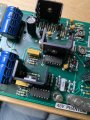
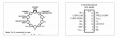
As D205 voltages were good I figured this issue could be coming from the first ua723 IC. Thankfully I had ordered a new 14-pin version of it (Studer had the holes for a 14-pin format version in the pcb), so I used a new LM723 (specs and photos attached) and it worked! +48v, +15v, 0, -15v!

So jumping +48v and +15v pin will fry your IC201 apparently :)

I will put everything back together and let you know if the mixer works as expected!

Thank you so much, I learned a lot thanks to you guys!

Octave

IMG_1298.jpg
 

Attachments

JoeJester

Joined Apr 26, 2005
4,390
LM723pinouts.png

I did find it unusual that the schematic used the 10pin version while the chip is 14 pin as they are NOT pin compatible.

Measure on the IC, pin11 to pin 10. I'm thinking that is a short. causing your problem. A short there will have placed about negative 10V between the base and emitter, causing full saturation of the transistor.
 
Last edited:

Thread Starter

octavez

Joined Jun 5, 2019
18
Hi @JoeJester, thank you for your reply.

As I said above right now it works fine having replaced both with LM723CN (14pin), do you think it will eventually break?

Also I attached the correct specs for the LM723CN that I used.
 

Attachments

JoeJester

Joined Apr 26, 2005
4,390
Everything eventually breaks. We just don't know the time period associated with "eventually".

I don't know the advertised Mean Time Between Failures for the device.

I'm sure your repair person guarantees 90 days.

You may have experienced the first failure since the date of manufacture.
 

Wolframore

Joined Jan 21, 2019
2,619
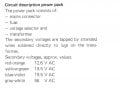
First, I love the old Studer gear and I’m puzzled that you got 15v out. Did you check the secondary out of the transformer? It should not output anything close to 25-26v. Please take a reading on the secondary AC voltage. I think your manual said 19.6v. Always check the entire chain.

My guess is that the regulator can’t keep up with regulating 26 or higher down to 15. Check the secondary. If that’s too high fix that then fix the regulator.
 
Last edited:

Thread Starter

octavez

Joined Jun 5, 2019
18
Hi @JoeJester @Wolframore! As I said in my post above it's now working fine after replacing the LM723 with 14-pin version, I have proper output: +48v, +15v, 0, -15v. But I'm wondering why is it working fine if you say that the pins layout is different compared to the original IC?

Thank you!
 

Wolframore

Joined Jan 21, 2019
2,619
Glad that it's working... I love those old boards, I'm a Trident/Neve guy myself but have a lot of the Charles Putnam gear also... Studer has the best tape machines... love the compression.

OK so I'm guessing that it was getting 26V from the phantom power circuit and not just from the secondary of the 15v transformer? I suppose that's possible...

Which studio is this board for?
 

JoeJester

Joined Apr 26, 2005
4,390
OK so I'm guessing that it was getting 26V from the phantom power circuit and not just from the secondary of the 15v transformer? I suppose that's possible...
It was getting the 26V from the unregulated side of the series pass transistor. The LM723 regulator wasn't regulating. It placed the series pass transistor into full saturation.
 

JoeJester

Joined Apr 26, 2005
4,390
But I'm wondering why is it working fine if you say that the pins layout is different compared to the original IC?
The SCHEMATIC shows the 10 pin version's pin numbers. Look at your first picture and see how the 10 pin version was connected to the 14 pin socket. You can look at the two diagrams above to ensure they were connected the same (by signal names). It would be easy for someone to check an incorrect pin, if they didn't apply due diligence.
 

Wolframore

Joined Jan 21, 2019
2,619
I thought I read it should be 19.6 out of the transformer. Did you check the voltage on the secondary side? If it’s passing 26v your regulator might not last.

725E5264-AB50-4754-BE61-B12DC5B87967.jpeg
 

JoeJester

Joined Apr 26, 2005
4,390
I thought I read it should be 19.6 out of the transformer. Did you check the voltage on the secondary side? If it’s passing 26v your regulator might not last.
19.5 V AC is the rms value and NOT the peak value minus two diode drops output of the bridge.
 
Last edited:

Thread Starter

octavez

Joined Jun 5, 2019
18
@Wolframore yes I love it! This is mine and I will keep it for my studio in Portland, OR!

Regarding the +26v/0/-26v issue was DC at the end of the board. AC voltages from the transformer were all good.

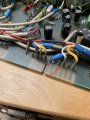
Do any of you guys know which type of crimp connectors are those in the picture attached? I looked at D-Sub but they're different.
 

Attachments

Top