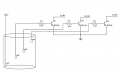
Step level indicator

Thread Starter

Martyk

Joined Jul 23, 2009
69
That's a very different situation than what you describe in your first post.

You don't need your sensing circuit to turn on LEDs at all and it doesn't matter whether more than one is active at the same time. All your sensing circuit has to be able to do is inform your controller which sensors are currently covered. Your remote display then uses this information (which can be processed in between) to turn on the appropriate LED.
That's a very different situation than what you describe in your first post.

You don't need your sensing circuit to turn on LEDs at all and it doesn't matter whether more than one is active at the same time. All your sensing circuit has to be able to do is inform your controller which sensors are currently covered. Your remote display then uses this information (which can be processed in between) to turn on the appropriate LED.
HOLY COW, YOU'RE ABSOLUTLY RIGHT !!!
It's too easy to fixate on the original problem and not see the entire picture. Happens all the time for me.
Well, it's done, so this thread is null and void!!

But it was fun, and I learned about distilled water, etc.
Thank you very much, really appreciate everyone's help.

Regards
Marty
 

ci139

Joined Jul 11, 2016
1,989
\( \href{https://www%2Ereddit.com/r/askscience/comments/64qy6j/why_does_water_conduct_ac_better_than_dc/}{\text{Why does water conduct AC better than DC?}}\ \leftarrow\ \text{This is a}\ \LaTeX\ \text{URL} \)

https://www.boquinstrument.com/ultr...rs-vs-capacitive-sensors-which-is-better.html

incase the time of use is moderate to short AND your liquid chemistry & T° dependence are fairly constant you may consider your initial DC based schematic/approach . . . although i dont see much difference from https://www.glass-product.com/glassproducts/glass-tube-level-indicator.html ???
 
Last edited:

Thread Starter

Martyk

Joined Jul 23, 2009
69
https://www.reddit.com/r/askscience/comments/64qy6j
https://www.boquinstrument.com/ultr...rs-vs-capacitive-sensors-which-is-better.html

incase the time of use is moderate to short AND your liquid chemistry & T° dependence are fairly constant you may consider your initial DC based schematic/approach . . . although i dont see much difference from https://www.glass-product.com/glassproducts/glass-tube-level-indicator.html ???
Hi Ci. I only have DC and my controller inputs are DC binary inputs.
 

MisterBill2

Joined Jan 23, 2018
27,528
ALL of those digital CMOS inputs need to be non-floating to avoid the whole ic DEVELOPING SOME BEHAVIOR PROBLEMS. Since the tank contents are biased positive, the four inputs need pull down resistors of some fairly high value.
 

sghioto

Joined Dec 31, 2017
8,634
Good point. Thanks.
After reading up on the controller the inputs will not work directly connected to the probes.
Will need additional circuity to interface to the controller.
Using the original circuit will work as long as the transistor outputs are saturated.
Other I/O configured as Outputs can drive LEDs or additional relays up to 100ma max.
1760037981281.png
From the PDF page 49:
The same principle applies to the inputs, these are designed to allow you to directly connect a VFC (Volt Free Contact). This could be from other relay contacts, thermostat contacts, alarm contacts etc. When the contacts are closed the input will read as active. In fact anything that pulls the input pin down to 0v will read as active. Do not think of the I/O in terms of a high or low voltage output. Think of it in terms of Active (or on, something is actively driving the I/O), or inactive (or off, nothing is driving the I/O). It's a subtle point but one you need to be clear on.
Manual PDF
 
Last edited:

sparky 1

Joined Nov 3, 2018
1,218
A CD4043 or CD4093 latch, a comparator, 3 thermistors ABC, 3 leds ABC and some resistors.
The thermistor warms out of water the resistance changes the fixed position saves cost. not bad.

side note, good question, using probes AC does not polarize but DC will and algae can mess it up
 
Last edited:

MisterBill2

Joined Jan 23, 2018
27,528
You could use a CD40049 hex inverter for each probe, with a 2.2 meg pull down resistor for each input used. Then forget the 2.2K series resistors because if the bias on the tank is 5 volts then there can be no excess current.
AND! WHAT is "a volt-free" contact???? If it can be "pulled down to zero volts" then OBVIOUSLY it must be biased to some positive voltage. So we are given a meaningless technical sounding phrase.
 

sghioto

Joined Dec 31, 2017
8,634
It means just what it says.
No active voltage as in a dry contact or an open collector transistor.
 
Last edited:

panic mode

Joined Oct 10, 2011
4,985
WHAT is "a volt-free" contact???? If it can be "pulled down to zero volts" then OBVIOUSLY it must be biased to some positive voltage. So we are given a meaningless technical sounding phrase.
no, it is a very common technical term... volt-free, potential-free and dry contact are different ways to describe the exact same thing - a galvanically isolated contact. something that is part of some device but carries no potential on its own. in other words you need to supply power to it. it could be mechanical contact (like relay contact or switch) or output from an SSR or optocoupler.

and yes, if done with cmos input like in post #43, inputs will need pull down resistors of suitable value. something in the range 1-10M should do
 
Last edited:

panic mode

Joined Oct 10, 2011
4,985
I NEVER use that term to describe a connection point or a circuit.
you probably have experience that is more or less focused to one area of EE such as board level circuits for example. such terms are rather frequent when dealing with larger and more complex devices or systems.

you can google each of them or check articles like
https://sonoff.tech/blogs/news/dry-contact-switches-vs-wet-contact-switches-understanding-the-difference-and-choosing-the-right-one#:~:text=A dry contact, also known,external power source to operate.
 
Last edited:

Thread Starter

Martyk

Joined Jul 23, 2009
69
you probably have experience that is more or less focused to one area of EE such as board level circuits for example. such terms are rather frequent when dealing with larger and more complex devices or systems.

you can google each of them or check articles like
https://sonoff.tech/blogs/news/dry-contact-switches-vs-wet-contact-switches-understanding-the-difference-and-choosing-the-right-one#:~:text=A dry contact, also known,external power source to operate.
You should be replying to Mr.Bill directly. No panic.
 

panic mode

Joined Oct 10, 2011
4,985
ok and ...why?

i responded to him in a way i hope is respectful and correct.

and the way i look at things, the whole point of having a forum is to make exchanges public so that everyone can offer opinion or comments. EE is huge and has many areas. nobody knows everything which is why i am here - bounce ideas and see others chime in - specially from people that work in areas that i have not. btw. that works even for the incorrect things - one of the fastest way to get to the root of something is to state something that is not correct. this is how peer review works.
 
Top