Facebook
 Google
 GitHub
 Linkedin
KeepItSimpleStupid
- Joined Mar 4, 2014
- 5,088
A few comments after reading both websites:
1. No load testing is more important than load testing of the amplifier.
2. Q29 in the long run should use some sort of thermal conductive adhesive not grease.
3. There is consumer audio levels and pro audio line levels. https://en.wikipedia.org/wiki/Line_level
4. Audio capacitors. Usually those in the signal path are metalized polyester. 1-10uF is sometimes electrolytic because of the cheaper cost. Different caps might be used in a phono pre-amplifier equalization.
5. A note about polarization. It's not well known, but even a non-polarized capacitor can be installed the wrong way. it's primarily a valve/tube phenomenon. Those vintage capacitors have the outer foil marked with a polarity symbol of sorts. e.g. a band. It's important that the outer foil goto the lower impedance side of the circuit. Detecting which side is the outer foil side is another topic.
6. I'd be interested in knowing what the slew rate of the amplifier is? This is the time from 10% to 90% voltage with a square wave input.
7. Horn speakers driven by tube amplifiers seem louder (it makes sense)
8. There is a lot to be learned in this http://leachlegacy.ece.gatech.edu/lowtim/ artical/
I built an amp based on that design.
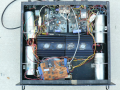
The amp I built: The case was made from scratch and is 2RU (Rack Units) high. A custom 4x35VAC torroidal transformer. Exponential turn-on audio ramp; slow turn-on. Amps can easily be removed for troubleshooting.
1. No load testing is more important than load testing of the amplifier.
2. Q29 in the long run should use some sort of thermal conductive adhesive not grease.
3. There is consumer audio levels and pro audio line levels. https://en.wikipedia.org/wiki/Line_level
4. Audio capacitors. Usually those in the signal path are metalized polyester. 1-10uF is sometimes electrolytic because of the cheaper cost. Different caps might be used in a phono pre-amplifier equalization.
5. A note about polarization. It's not well known, but even a non-polarized capacitor can be installed the wrong way. it's primarily a valve/tube phenomenon. Those vintage capacitors have the outer foil marked with a polarity symbol of sorts. e.g. a band. It's important that the outer foil goto the lower impedance side of the circuit. Detecting which side is the outer foil side is another topic.
6. I'd be interested in knowing what the slew rate of the amplifier is? This is the time from 10% to 90% voltage with a square wave input.
7. Horn speakers driven by tube amplifiers seem louder (it makes sense)
8. There is a lot to be learned in this http://leachlegacy.ece.gatech.edu/lowtim/ artical/
I built an amp based on that design.
The amp I built: The case was made from scratch and is 2RU (Rack Units) high. A custom 4x35VAC torroidal transformer. Exponential turn-on audio ramp; slow turn-on. Amps can easily be removed for troubleshooting.