Solder not reaching hidden pads - solution?

Thread Starter

amundsen

Joined Aug 27, 2015
30
Hello,

With many components, the solder pad on PCB's top side is hidden by the component itself. This is the case for headers, multi-turn cermets or screw terminal blocks for instance. So it's impossible to check if solder reaches the pad.

I have discovered that even when soldering as carefully as possible, letting the solder melt totally and during several seconds, if the connection of the component with the trace is on the hidden side, the connection is not established more often than I would expect.

With a pin header I have soldered lately, I had to push a few pins back and forth several times before each connection could be established.

Apart from the radical and unrealistic solution which would consist in putting all the connections between pads and traces on the soldering (back) side, how would you prevent such an issue to arise?

Thank you in advance.
 

kubeek

Joined Sep 20, 2005
5,796
Solder paste and stencil and reflow / hot air soldering, or careful choice of components. Most components are not anymore made so that they can be easily soldered by hand, so either you take special measures to get good results, or go with the current methods.
 

kubeek

Joined Sep 20, 2005
5,796
That really depends on how many components and how many boards need the special treatment to work when you solder them by hand. Better choice of components would probably be what I´d choose.
 

kubeek

Joined Sep 20, 2005
5,796
I think I am starting to understand your problem. You are using a two sided board without plated through vias, right?
 

mcgyvr

Joined Oct 15, 2009
5,394
I think I am starting to understand your problem. You are using a two sided board without plated through vias, right?
That must be the issue..
With a DIY PCB the traces need to be on the opposite side of the component so that the pins are soldered directly to the pads.. You will never have good luck trying to get the solder to flow when there is no copper through hole for it to follow down..

Thats why I don't mess with diy self-etched PCB's.. You can get real ones with proper through holes for so cheap now its not worth the time/struggle.
 

dl324

Joined Mar 30, 2015
18,326
Apart from the radical and unrealistic solution which would consist in putting all the connections between pads and traces on the soldering (back) side, how would you prevent such an issue to arise?
If the holes are plated through, you don't need the solder to flow on the top pad for connectivity; but correct soldering technique will allow it to flow through the hole.

If the holes aren't plated through, you need to solder pads on both sides if you're expecting the through hole lead to provide connectivity to a trace on the top side.
 

Thread Starter

amundsen

Joined Aug 27, 2015
30
The PCB is not homemade. It's from Fritzing and I've just checked: it's supposed to have plated-through holes. Usually everything's fine but with this specific PCB I have had a strange issue that might be the cause of this : at some points, when soldering, a black liquid appeared. What could be wrong?
 

shortbus

Joined Sep 30, 2009
10,050
You could add some extra soldering flux under the component before soldering. This would help the solder flow to where it needs to be. The flux in the core of your solder doesn't seem to be enough to "wet" the trace under the component, the extra flux would/should change that. Also be sure to abrasively clean the copper of the trace right before soldering, any tarnishing of the copper reduces the ability of the solder flowing.
 

mcgyvr

Joined Oct 15, 2009
5,394
it's supposed to have plated-through holes.
So does it have plated through holes?
I understand its "supposed to" but does it? (so actually look and see if the holes are plated)

Solder applied to plated through holes only needs to fill 75% of the barrel of the through hole.. It does NOT need to flow all the way through to the other side..
Practice and skill will allow you to know when a solder joint is properly wetted and flowing/filling 75%..

You are applying too much solder/heat as I can clearly see that the solder is covering the pad on the component side too.. It does not need to be like that.. Its excessive.. (but not really an issue)

What solder are you using also.. Sounds like you may have some "old" solder or incorrect solder for the application..

black liquid could either be excessive/burnt flux or burnt adhesive from the core material/adhesive used in the production of the board..

and with a board that hasn't exceeded its shelf life and has been stored properly there is NO need to use abrasives to clean the pads prior to soldering.. Thats what the flux does...
 

takao21203

Joined Apr 28, 2012
3,702
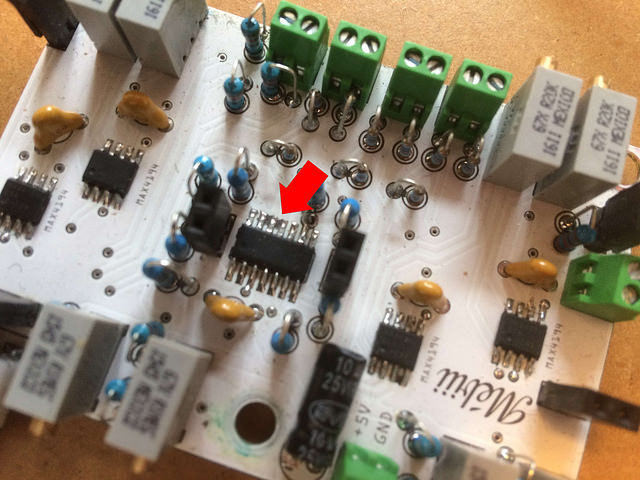
Here's a picture. You can see this in several places near IC legs, but it's most visible under the red arrow.

You need a 50W temp controlled station with broad tip.
Then you can solder SOIC much better.
Even the most careful point soldering will never give same appearance for all pins.
The heat delivery is much better as well.
With lighter gasoline, you can get rid of the residues. Be careful though not to wash it inside terminals or trimmers etc.
 

takao21203

Joined Apr 28, 2012
3,702
You could add some extra soldering flux under the component before soldering. This would help the solder flow to where it needs to be. The flux in the core of your solder doesn't seem to be enough to "wet" the trace under the component, the extra flux would/should change that. Also be sure to abrasively clean the copper of the trace right before soldering, any tarnishing of the copper reduces the ability of the solder flowing.
I guess the temp is too low or the wattage too small.
330 to 350C are good for soldering.
If you only have small joints 330C or 315C will prolong the life of the plated tip, 350C already will cause a shorter service life.

Factory plated PCBs are all tin plated.

Only thing where I really need flux is TQFP ICs. Depends on the quality of the soldering wire of course, some kinds are pretty bad. Not only the flux is weak. There are some kinds which require cooling with no movement for several seconds. While others become plastic at much higher temp which allows some movement.
It beats the purpose of having a hollow core soldering wire with flux.
 

Thread Starter

amundsen

Joined Aug 27, 2015
30
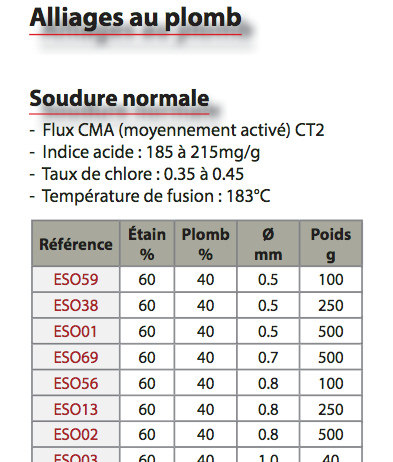
I am using a solder with 60% Sn/40% Pb (no Ag) - size 0.8mm with flux, ref. ES013 from French brand B.M.J.


Translation from the catalogue:
Lead alloys
Regular solder
- CT2 CMA (midly activated) flux
- acic index: 185 to 215mg/g
- level of chlorine:0.35 to 0.45
- meltdown temperature: 183°C
 

shortbus

Joined Sep 30, 2009
10,050
and with a board that hasn't exceeded its shelf life and has been stored properly there is NO need to use abrasives to clean the pads prior to soldering.. Thats what the flux does.
So all of the "electronics kits" instructions are wrong? Any I've built over the years have said to use a 'scotch-brite' or pencil eraser to burnish the pads before soldering.
 

mcgyvr

Joined Oct 15, 2009
5,394
So all of the "electronics kits" instructions are wrong? Any I've built over the years have said to use a 'scotch-brite' or pencil eraser to burnish the pads before soldering.
Not "wrong" but I'll say they state a process that is not necessary when the proper flux is used..
I've soldered a heck of a lot of joints and NEVER needed to go at the traces with any mechanical cleaning methods..

I don't believe its recommended or even mentioned in any IPC standard either..
 

kubeek

Joined Sep 20, 2005
5,796
I´ve had some really old soviet resistors, the 70´s era I´d guess, the leads turned dark and you really had to scrub them with something otherwise the solder would not work. Not sure what kind of coating, but it was like trying to solder aluminium wire untill you cleaned a spot.
 
Top