Solar Power does not Pay Off, An Excellent Indicator

dendad

Joined Feb 20, 2016
4,641
Ideally, I'd like to set up some comparisons between fixed position panels and various tracking methods and take data so that she can evaluate the pros and cons. I think it might make an interesting science fair type of project. The trick is to get her interested.
That sounds like a good idea.
I have only mounted one 250W panel on my shed but I have 2. Having one fixed and the other tracking would be fun. Maybe feed both into a hot water tank each and measure the temperature rise? Then swap the tanks and panels around to do it with all combinations to cancel our the differences. I wonder if the extra effort to move the panels is worth it over just buying a few more panels? Probably not.
 
Last edited:

WBahn

Joined Mar 31, 2012
32,933
That sounds like a good idea.
I have only mounted on 250W panel on my shed but I have 2. Having one fixed and the other tracking would be fun. Maybe feed both into a hot water tank each and measure the temperature rise? Then swap the tanks and panels around to do it with all combinations to cancel our the differences. I wonder if the extra effort to move the panels is worth it over just buying a few more panels? Probably not.
There's all kinds of aspects you could get into as far as good design of experiments -- identifying the variables and then trying to control for them or account for them or at least estimate their potential impact on the results. Some of that is graspable by middle school students, other aspects are well over their heads. The trick will be for me to guide her well enough that she can come up with enough interesting stuff on her own to do the work. I don't want to be one of those dads that takes over the project and the kid ends up turning in something that she had no real involvement in. That's somewhat less of a concern with this particular kid because she's always naturally been willing to do all the work on her projects on her own but been willing to take suggestions and a bit of help on this aspect or that aspect, as well -- and also more than willing to ignore suggestions and plug away with what she had in mind. So IF I can get her interested, I think I can get her to take ownership pretty easily. What I think might work well is if I can work a somewhat similar project in parallel with her.
 

MisterBill2

Joined Jan 23, 2018
27,680
You have a good point there Tony. The bell for the right answer is not too hard but adding the buzzer for any wrong answer makes it a lot more complicated, because I am guessing this was well before the time of microcontrollers, or even PCs.But it could be done with a bunch of relaays.
 

Tonyr1084

Joined Sep 24, 2015
9,744
@MisterBill2 I've been trying to come up with a way of wiring it without a bunch of relays or diodes or anything else that we, as children, would have understood. I may be wrong. It could have been a True / False type question and answer box, which would make wiring it a whole lot easier. The more I think of it - that was probably what he did. Keep in mind this was back in the early 60's So a good 50 plus years ago. Memory, like the hairs on top of my head tend to slide away. Knowing David's father, a fairly smart man, probably gave Dave some guidance, but I also know David was equally as smart (for his age) and with minimal guidance probably came up with the bulk of the project on his own. I think I remember 10 posed questions with (and I'm becoming more convinced of true/false) two possible answers.

But we gotta try and stay on topic.
 

MrAl

Joined Jun 17, 2014
13,722
That sounds like a good idea.
I have only mounted one 250W panel on my shed but I have 2. Having one fixed and the other tracking would be fun. Maybe feed both into a hot water tank each and measure the temperature rise? Then swap the tanks and panels around to do it with all combinations to cancel our the differences. I wonder if the extra effort to move the panels is worth it over just buying a few more panels? Probably not.
Hi,

I was just talking to someone about this the other day.
I think it depends on how many panels you are using and how they are all mounted. For example, if you had 1 panel in one direction and 1 panel in another direction then it might not be too bad, you'd loose 50 percent of the energy probably. But if you had 5 panels all mounted in different directions then you'd have to do some measurements and see if you can stand to have 4 out of 5 panels producing less energy at any given time of day.
Then there is also the issue of 3d tracking vs 2d tracking. You'd have to see how much you loose during some times of the year by using only 2d tracking.
Yeah there's always the issue of sensor cleaning. That's a big pain too. Insects love sensors and cameras :)
 

MrAl

Joined Jun 17, 2014
13,722
Wow. You can track and compensate for the change in distance from the earth to the sun vs. time?

Impressive.
Hi,

At any given time the sun is in a 3d location from any location on earth. Although the distance itself usually isnt a concern, the two angles are. So if you are tracking the sun it's really like tracking a ball thrown overhead where the arc may move throughout the year, thus making it a 3d tracking system.
Another name for this is a "two axis solar tracker".
 

MisterBill2

Joined Jan 23, 2018
27,680
An off-on drive mechanism with a bit of deadband could do well, keeping the pointing within a degree or two. That would not be so very hard to arrange. four photocells and four relays and a quad comparator to sense when the angle had changed beyond the limits. No complex electronics and no code to be written and a quite simple circuit. The hard part being the section that directs it back to the sunrise position after the sun sets. I can see the circuit now.
 

MrAl

Joined Jun 17, 2014
13,722
Two axis == two degrees of freedom == 2D. Not 3D.
Hi,

Well it depends on your viewpoint and my viewpoint was clear.
Two angles suggest a solid angle which is a solid measurement which is 3d.

Also, when we only use one axis that is one angle and one angle sweeps out a 2d surface.

The path of any star is going to be a 3d problem. A solar tracker to track both angles has to track an object in 3d space.

You can call it a 2d problem if you like but that's a superficial view. 2 axis, but 3d space.
 

MisterBill2

Joined Jan 23, 2018
27,680
Even more, that third dimension is distance from the sun, and that is a real challenge to change. In addition, it may be simple to arrange the 2 axis so that one changes in a seasonal manner and only one needs daily motion. I have noticed that the solar path is very repetitive, changing only very slightly from day to day.
 

wayneh

Joined Sep 9, 2010
18,122
In addition, it may be simple to arrange the 2 axis so that one changes in a seasonal manner and only one needs daily motion.
Right, even if you adjust for seasonal declination, it doesn't need to be clock-driven or a continuous adjustment like the daily azimuth axis.

I suspect that it's hard to justify the cost of moving along the 2nd (declination) axis even twice a year. And once it has two positions, the incremental value of adding a 3rd and 4th position gets smaller and smaller.
 

Tonyr1084

Joined Sep 24, 2015
9,744
Sky tracking using an equatorial mount means following an object (the sun) from east to west. In terms of tracking that is a single tracking plane. If the panel is tilted to compensate for the yearly cycle from north to south and back again, you're introducing a second plane of tracking. Tracking (in my opinion) is not a dimension, it's a function. When you sit on the porch and watch a car drive by you see it move from (lets say) left to right. You also focus on its distance. You're tracking it in one plane, unless the road is quite uneven, then you're tracking it in elevation as well (up and down); a second plane of tracking. The focal length is the "Measurement" function (the third factor or plane, even though it's not a true plane). THAT is a true dimensional function - how far away the car is (focus).

Since the sun is so far away, the change in distance (the "third" dimension) will be negligible (or hardly matter at all). Also, the distance from earth to the sun (one AU or Astronomical Unit) is on average 93 million miles away (you can change that to metric if you wish)(I'm a yank). The actual distance varies between 91 and 95 million miles. Still, that big a difference makes virtually no difference from a tracking standpoint.

While solar panels are most effective when facing directly at the sun, the power drop off doesn't start to have any significance until it is some several degrees off angle. So, again, in my opinion, a single tracking system that can be manually adjusted for seasonal variation would be all that is needed, and you'd probably only change the angle once a month during the months closest to the equinox. During the solstice's (summer and winter) you only need to be close to the highest and lowest points and you're still going to get significant results from your panel.

In short - it's not critical to keep the solar panel always pointed directly at the sun. At least not for the purposes of producing full or very near full percentage output. Me? I'd go with the equatorial mounted system and a clock to drive the panel from east to west, and once a month crank in a few degrees up or down. Likely two degrees a month on average should keep me well within peak performance output.
 

wayneh

Joined Sep 9, 2010
18,122
Me? I'd go with the equatorial mounted system and a clock to drive the panel from east to west, and once a month crank in a few degrees up or down. Likely two degrees a month on average should keep me well within peak performance output.
Any idea what the big commercial solar installations do? Just about every panel I've ever seen (which isn't many) has been completely fixed. Tilted, but fixed. But we only have "show" solar around here, no genuine commercial farms.
 

Tonyr1084

Joined Sep 24, 2015
9,744
The BIG commercial solar farms I've seen (via internet) are the ones with an array of mirrors that focus the sun on a tower. Convert the solar energy into heat to boil water and drive a steam turbine. Let me see if I can find a picture of what I speak.

solar tower power plant

Y'know, those wind turbine units kill a lot of birds from bird strikes. Imagine the poor bird who got his goose cooked flying up to the tower to land and have a rest.

[edit] here's more on how they work: https://www.energy.gov/eere/solar/articles/power-tower-system-concentrating-solar-power-basics
 

nsaspook

Joined Aug 27, 2009
16,349
Any idea what the big commercial solar installations do? Just about every panel I've ever seen (which isn't many) has been completely fixed. Tilted, but fixed. But we only have "show" solar around here, no genuine commercial farms.
With the cost of panels so low today it's more economical to just use fixed panels on the ground.

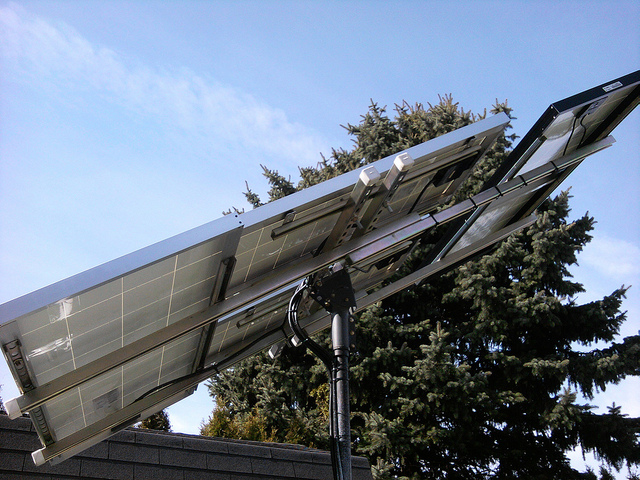
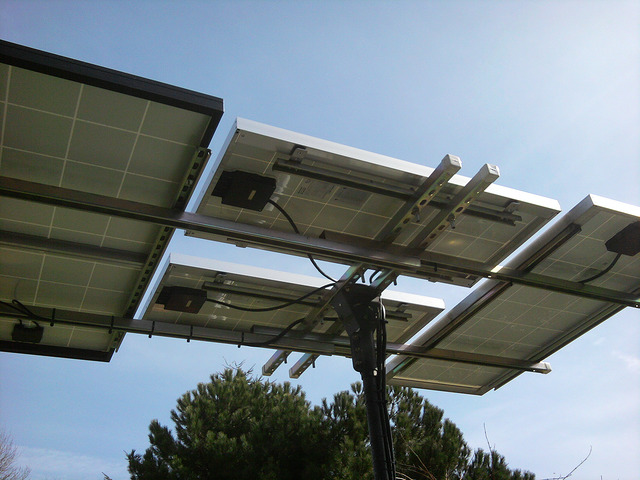
Here is my manual position panel mount.

A one meter KU band dish mount mod. Sched 80 high pressure pipe.

I rarely change the tilt angle because it's a pain and doesn't really change power output much but do rotate it maybe a few times daily in summer to optimize morning and evening power.


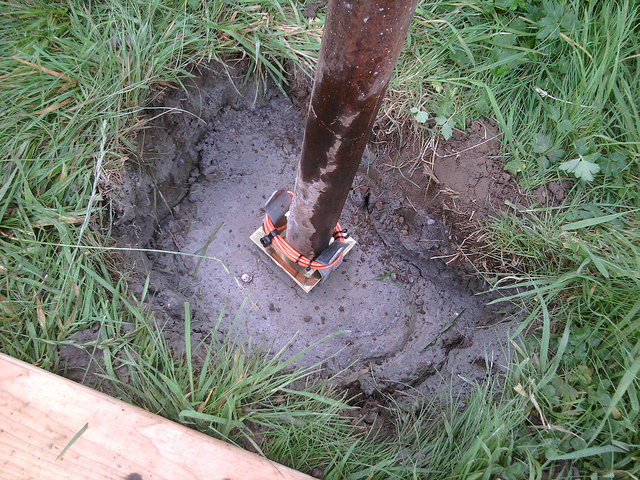
Buried rotation concrete anchor with brass load bearing bushing. You can spin the array with one hand easily.

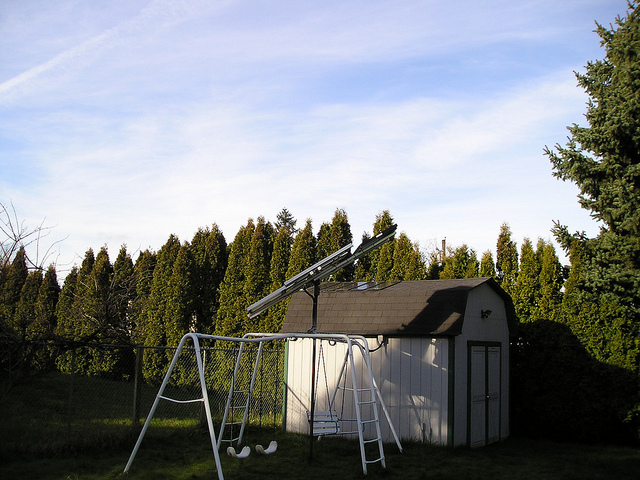
Used the old kids play-set for bracing.:eek:
 
Top