Smoker Circuit Design

shortbus

Joined Sep 30, 2009
10,050
Pretty sure if K type thermocouples are to be used they would need to be in an "well"(inside a metal tube with the end sealed). At least that's how they were in a case hardening furnace at work. The other, standard heat treat furnace had them open to the furnace insides. The case hardening furnace used a type of liquid that was dripped into it that created smoke to penetrate the parts with carbon.
 

Thread Starter

killivolt

Joined Jan 10, 2010
836
Several years ago, I designed a small ADC circuit for k-type thermocouples that has been working quite reliably.
After some reading I think the desired temp is around 225˚F to 300˚F, domestic ovens have a bulb, readily available, they are a bit large but should perform well enough for a prototype. Also I can get them for free and a little labor.

The circuit is interfaced to an AT89LP4052 MCU, and still has a few pins left that could be used to control actuators, RS232, , PWM and even WiFi if there be need. I intend to follow that path, and share all diagrams and pertinent code once I'm finished.
I'm all for it. Sounds like your electrical engineering skills will make it pop. :)

But right now, I'm going to focus on the physical way of feeding the wood chips into the smoker. I have several ideas about that that I'll be sharing in the next few days.
Looking forward to it.

kv
 

cmartinez

Joined Jan 17, 2007
8,768
http://www.smokymtbarbecue.com/store/meadow_creek_bx25_cabinet_smoker-pid-122-3.html#.WEXnGneZPxs

@cmartinez is water what you want to include? I'm not sure how to control the flow, but we should be able to find way.

Plus, those prices are up there for the Trailer Smokers.

kv
Yes, I'll include a water pan, but it will be extremely uncomplicated. Simply a pan being fed water by a cooper tube connected to an upside-down bottle or 10-liter jug. Just like a pet feeder.
 

Thread Starter

killivolt

Joined Jan 10, 2010
836
Yes, I'll include a water pan, but it will be extremely uncomplicated. Simply a pan being fed water by a cooper tube connected to an upside-down bottle or 10-liter jug. Just like a pet feeder.
Yes, that would do it. I would almost bet that's what their doing with the 5 gal water bottle.

kv
 

cmartinez

Joined Jan 17, 2007
8,768
Ok, here are a few ideas for the chip feeder:
  • A helicoidal screw, actuated by a motor. The chips would be placed in a bin, from which the screw would be drawing and dropping them into the smoker. The disadvantage is the mechanical complexity. The advantage is that only rotational motion is needed.
  • A hopper with a double gate at its bottom. The double gate is so that only the chips situated between them would fall into the smoker. Disadvantages: linear motion is required, double actuating. Advantage: simpler to construct than the screw.

But here's my personal favorite, see what you guys think.
  • Use a fat tube (say, something like a 4" diameter conduit pipe) and plug one of its ends. Position the tube open side up, but tilted at about 45 degrees. Fill it (but do not pack it tightly) with chips. Using an electrovalve, slowly fill the tube with water, feeding the water from the bottom of the pipe. The column of chips will begin to float. And as it rises, the chips at the top will start falling into the smoker. This has the advantages of keeping the chips wet (so more smoke is produced). Only a very easy to obtain water electrovalve is needed. And it's extremely simple to build, mechanically wise. Also, it would be almost maintenance free, I think. The only thing I have to think more thoroughly is how to guide the chips into the smoker as they fall from the pipe. It's also an idea that's very easy to test!
 

Thread Starter

killivolt

Joined Jan 10, 2010
836
Ok, here are a few ideas for the chip feeder:
  • A helicoidal screw, actuated by a motor. The chips would be placed in a bin, from which the screw would be drawing and dropping them into the smoker. The disadvantage is the mechanical complexity. The advantage is that only rotational motion is needed.
  • A hopper with a double gate at its bottom. The double gate is so that only the chips situated between them would fall into the smoker. Disadvantages: linear motion is required, double actuating. Advantage: simpler to construct than the screw.

But here's my personal favorite, see what you guys think.
  • Use a fat tube (say, something like a 4" diameter conduit pipe) and plug one of its ends. Position the tube open side up, but tilted at about 45 degrees. Fill it (but do not pack it tightly) with chips. Using an electrovalve, slowly fill the tube with water, feeding the water from the bottom of the pipe. The column of chips will begin to float. And as it rises, the chips at the top will start falling into the smoker. This has the advantages of keeping the chips wet (so more smoke is produced). Only a very easy to obtain water electrovalve is needed. And it's extremely simple to build, mechanically wise. Also, it would be almost maintenance free, I think. The only thing I have to think more thoroughly is how to guide the chips into the smoker as they fall from the pipe. It's also an idea that's very easy to test!

Maybe I'm missing something, but if these are combined. The screw is solid maybe with screen material, the hydrated chips pulled up out of the water at the same angle 45˚ with just enough room around the outside of the screw for water as well as small chunks to pass and return back to the reservoir.

Interesting idea.

kv
 

Thread Starter

killivolt

Joined Jan 10, 2010
836
For the light sensor: I recommend green because smoke takes out the high frequency light before it takes out the red end of the spectrum. Modulate the beam to several kilohertz so it is more immune to ambient light changes, like a TV remote control.
Treat the results like an AM radio. "Detect" the amplitude envelope with a diode or precision rectifier, put a time constant on it, then use the amplitude to make decisions.
Some time ago, about 30 years. I had someone create a circuit for me. I've found a circuit simulation in LTspice that closely match's mine, I'll modify it and I have a prototype left out of a board run of 50 that might apply for this Smoker Stack Control circuit. I was hoping you could extrapolate, about the frequency and how to obtain them just for the light sensors.

Question: Would I use a 555 or something else to obtain the modulation in kilohertz?

Meahwhile, I thought maybe I would use 2 detectors, one at the top and one at the bottom of the stack. Both would need to be satisfied before the auger could run again, while of course having a Temp measurement. It would act like an AND maybe. But, the Temp Probe has final say.
 
Last edited:

#12

Joined Nov 30, 2010
18,224
Question: Would I use a 555 or something else to obtain the modulation in kilohertz?
Sure. A 555 will go to about 1MHz. We're just trying to get something besides a constant beam. A hundred Hz, a thousand...makes little difference as long as the receiver is tuned to the same frequency. TV remotes use 38KHz. Above hearing range and can use small value capacitors for tuning.
 

Thread Starter

killivolt

Joined Jan 10, 2010
836
Sure. A 555 will go to about 1MHz. We're just trying to get something besides a constant beam. A hundred Hz, a thousand...makes little difference as long as the receiver is tuned to the same frequency. TV remotes use 38KHz. Above hearing range and can use small value capacitors for tuning.
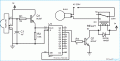
I found this circuit, it relies on a relay but in my case I would send that directly to the base of my 2n222 to power a opto-isolator and then a Triac to Motor.

circuit designer said:
Output of TSOP1738 oscillates at the rate of 38KHz, which is applied to clock pulse of 4017. So we have connected a 1uF capacitor across the output of the TSOP so that this 38KHz pulse train is counted as one clock pulse to the IC 4017.
Remote-Switch-Circuit.gif

kv
 
Last edited:

#12

Joined Nov 30, 2010
18,224
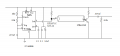
Green costs about 10X infrared, so here's where I'm going right now:
The problem is I don't know squat about IR detectors. Would have to have one in my hand to see how it acts.
Whaddaya mean, "ma/irradiance" in centimeters squared?
Anybody got a handle on what I need for an analog amplitude amplifier/detector?
Get me a slow DC output and I can put a comparator on it.smoke detector.png
 

Attachments

Thread Starter

killivolt

Joined Jan 10, 2010
836
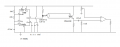
Could it be as simple as this?View attachment 116673
Drop the Mic.

The TSOP1738 is outdated and no longer available, I can get 2 for .99 from china but I want something that will be available, looked up the LTE and LTR good source.

Explain to me why I need an Op-amp? I'm asking because I've never known all you can do with them. Why can't I just drop the LTR output in the Original diagram into my 2n222? or maybe just drop that output into my opto-isolator moc3051.

Thanks for you help @#12

kv
 
Last edited:

#12

Joined Nov 30, 2010
18,224
Why can't I just drop the LTR output in the Original diagram into my 2n222?
I think you can, give or take a gain stage. The CD4017 provides the very high impedance input of an op-amp, but I just drew in an op-amp because I was guessing and asking if anybody knows whether it will work like that. (Though I haven't looked up the 4017 to see what it does exactly.) You also are not required to use the LTR4206 photo-diode. I chose that because it's dirt cheap. A photo-transistor would work better, and there are plenty available.

Basically, everything after the light tube is a guess. I even doubt I got the parts in the right configuration. What I would like to get in there is some frequency limiting in the receiver end so it doesn't respond to ambient light changes or InfraRed fluttering in the hot gasses. That's why the .001 and the 82k. They say, "cut the gain by 50% at 18KHz and ever less below 18KHz".
 

Thread Starter

killivolt

Joined Jan 10, 2010
836
I chose that because it's dirt cheap. A photo-transistor would work better, and there are plenty available.
I guess I would need the price of the Photo-transistor, for a final decision

I think you can, give or take a gain stage. The CD4017 provides the very high impedance input of an op-amp, but I just drew in an op-amp because I was guessing and asking if anybody knows whether it will work like that. (Though I haven't looked up the 4017 to see what it does exactly.) You also are not required to use the LTR4206 photo-diode.
I have a 555 too!

Basically, everything after the light tube is a guess. I even doubt I got the parts in the right configuration. What I would like to get in there is some frequency limiting in the receiver end so it doesn't respond to ambient light changes or InfraRed fluttering in the hot gasses. That's why the .001 and the 82k. They say, "cut the gain by 50% at 18KHz and ever less below 18KHz".
If I have the Photo-transistor I will still need a frequency as you suggested correct? If so, I would still want to cut it in half, correct?

kv
 
Top