Smoker Circuit Design

Thread Starter

killivolt

Joined Jan 10, 2010
836
I can't work with that. There is no information for temperatures or times. There is no spec for what kind of device you want to measure temperature with.

If you can nail down some temperatures, Klixon makes some stupid sensors that might be sufficient.
Damper motors do exist. Some are hard open/hard closed. Some can be modulated.
The hard limit type can be adjusted with microswitches.
I used to work in a TV Repair shop, worked on my fair share of VCR's the Tape loading mechanism used a 12v dc motor as I remember. I think I still have some laying around my Technical Operations Rooms.

I'll tear one apart to see if I can use it, 2 double throw mirco switches open, closed. Now that I know what will detect Temp, using a double throw klixon as the primary I can delete my drop out relay and draw a diagram.

kv
 

Thread Starter

killivolt

Joined Jan 10, 2010
836
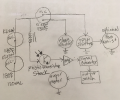
If someone could take a look to see my mistakes. :oops:

I need to put micro-swtiches in front of the Shutters detect open and closed. Light emitting diode circuit would be mechanically easier to do though.

Same with the auger for one revolution.

Thank for all the help.

kv :)
 

Attachments

Last edited:
I agree... but that is more or less the way I usually work. I first conceptualize the most perfect and sophisticated of systems, and then I start hacking it down, simplifying things and disassembling it until I find the simplest, most practical and most reliable configuration... and perhaps keep one bell and whistle then and there just for the fun of it.
Trust me, when we're done deciding what we need (instead of what we want) things are going to look much less complicated.
Finally, someone who understands this weird process of ours. At the same time, I usually throw out what might be absurd ideas or ideas that are way too expensive.

Another way to look at it is to conceptualize the "perfect project" with every bell and whistle you can think of and then minimize it to what do i actually need and even what you would want in the future. Many times you can make early design decisions, that if incorporated,
that won't require a total re-design in the future. It goes for programming too.

Take this example, suppose that you decided that a separate over temperature monitor would be nice, but you can't "afford" it now. Your controller could have enough panel and internal space to accommodate it. You addressed a future enhancement.
 

cmartinez

Joined Jan 17, 2007
8,768
Finally, someone who understands this weird process of ours. At the same time, I usually throw out what might be absurd ideas or ideas that are way too expensive.

Another way to look at it is to conceptualize the "perfect project" with every bell and whistle you can think of and then minimize it to what do i actually need and even what you would want in the future. Many times you can make early design decisions, that if incorporated,
that won't require a total re-design in the future. It goes for programming too.

Take this example, suppose that you decided that a separate over temperature monitor would be nice, but you can't "afford" it now. Your controller could have enough panel and internal space to accommodate it. You addressed a future enhancement.
That's exactly my point. I normally try to make my projects as open ended as possible, while also maintaining a balance of practicality and simplicity... The downside, in my case, is that I tend to be a perfectionist, and so it sometimes takes me a long time to make decisions. But's that's one of the issues of my personality that I've been addressing lately (watching @#12 's reasoning process has been a good influence in that regard) and I'm beginning to experience small, but positive changes, both personally and professionally.
 

Thread Starter

killivolt

Joined Jan 10, 2010
836
That's exactly my point. I normally try to make my projects as open ended as possible, while also maintaining a balance of practicality and simplicity... The downside, in my case, is that I tend to be a perfectionist, and so it sometimes takes me a long time to make decisions. But's that's one of the issues of my personality that I've been addressing lately (watching @#12 's reasoning process has been a good influence in that regard) and I'm beginning to experience small, but positive changes, both personally and professionally.
I always enjoy @ericgibbs signature, "Good enough is Perfect" to mean it meets clients expectations.

kv
 

#12

Joined Nov 30, 2010
18,224
I tend to be a perfectionist, and so it sometimes takes me a long time to make decisions.
While the essence of my success has been, "details, details, details", I have a few rules for that aspect.
1) Attack the obvious problem first. By the time you get done with that, your mind will have sorted out most of the rest.
2) When the job is too big to encompass all of it in your mind, it's time for pencil and paper.

You can pencil quite a lot of design, but the process will help you sort out what's important. The best part is that the pencil design will allow you to condense functions so what started out as a dozen parts now requires 5 parts and does two jobs. Right now, we're in the pencil stage.;)
 

Thread Starter

killivolt

Joined Jan 10, 2010
836
While the essence of my success has been, "details, details, details", I have a few rules for that aspect.
1) Attack the obvious problem first. By the time you get done with that, your mind will have sorted out most of the rest.
2) When the job is too big to encompass all of it in your mind, it's time for pencil and paper.

You can pencil quite a lot of design, but the process will help you sort out what's important. The best part is that the pencil design will allow you to condense functions so what started out as a dozen parts now requires 5 parts and does two jobs. Right now, we're in the pencil stage.;)
I'm fixing the kitchen faucet leak and install a new sprayer, while driving my best ideas seem to pop. I was looking for a heat source to ignite the sawdust, when it hit me.

What about 12vdc powering 3 car cigaret lighters, I mount a platform maybe lid and drill 3 holes and mount and weld them to the lid, put the ground on the lid and run 3 conductors spot welded for the supply, then measure the resistance or amperage to shut off?

what do you think?

kv
 
Last edited:

#12

Joined Nov 30, 2010
18,224
If someone could take a look to see my mistakes. :oops:
You aren't done yet. There is a huge time lag between, "add fuel" and "temperature accomplished". You have nothing about time in there.
Then there is the option:
Auger finished
If time > x, run auger again
(otherwise) the temperature switch just shut off the auger subroutine.

This is crazy!:D
Me speaking in programming language and you trying to convert it into physical parts.:p

For the light sensor: I recommend green because smoke takes out the high frequency light before it takes out the red end of the spectrum. Modulate the beam to several kilohertz so it is more immune to ambient light changes, like a TV remote control.
Treat the results like an AM radio. "Detect" the amplitude envelope with a diode or precision rectifier, put a time constant on it, then use the amplitude to make decisions.
 

Thread Starter

killivolt

Joined Jan 10, 2010
836
You aren't done yet. There is a huge time lag between, "add fuel" and "temperature accomplished". You have nothing about time in there.
Then there is the option:
Auger finished
If time > x, run auger again
(otherwise) the temperature switch just shut off the auger subroutine.
Ya, thats why my diagram is marked version 1 :oops:

Thanks for suggestions.

kv
 

Thread Starter

killivolt

Joined Jan 10, 2010
836
You aren't done yet. There is a huge time lag between, "add fuel" and "temperature accomplished". You have nothing about time in there.
Then there is the option:
Auger finished
If time > x, run auger again
(otherwise) the temperature switch just shut off the auger subroutine.
I have a 15 degree differential to set temp range, the stack sensor should act as my time delay, either stop the auger or run it, if the temp doesn't exceed 145˚F while burning through the sawdust it will activate the evacuation and the replenishment of the cycle.

As @Kermit2 said, most of the time the stack will be pumping smoke, there would be heat loss I'm expecting, sawdust will produce smoke but not a lot of heat I suspect. If I burn through it, it will activate the evacuation of carbon and load the bin again.

kv
 
That's exactly my point. I normally try to make my projects as open ended as possible, while also maintaining a balance of practicality and simplicity... The downside, in my case, is that I tend to be a perfectionist, and so it sometimes takes me a long time to make decisions.
Sometimes, it takes a long time to make decisions. When i was working, the stuff I designed for in-house use had to be easily trouble-shootable and appliance-like if possible. I had stuff still around 25 years later.

Since this thread is somewhat about temperature, the temperature controller boxes, could be 120/ 240, Power fail drop-out or not, optional over-temperature, Analog/digital communication, place to tap a signal, use of On/zero, remote/local setpoints, Relay heater disconnect or big switch and current limit stuff. I saw some my designs "multiply".

One electro-mechanical design of magnetic Kelvin probes went from a proof of concept stage to various refinements that led to a very elegant design in the end. Lot's of nuances as well along with simple special tools that were made for the assembly and construction. There were details everywhere. That was one project that never started with the "ultimate design". It started with a "concept" and over time, each glitch got solved and it would be really expensive if you wanted to make just one from scratch.

They multiplied in various forms.

The high temperature, high vibration environment was the most stringent. The room temp design was the nicest. An offshoot was the low-profile design.

There was one design (a safety system), similar to mine that it had to interface to, that I was not involved in and I refused to fix theirs when it broke. Eventually, though, a few things got better.


Then, when I repaired stuff, I never wanted to see the same problem again.

I just hate when a manufacturer did something stupid and put O-rings around miniature lamps, so I had about 100 lamp holders at $15.00 each to eventually change to another manufacturer.
 

cmartinez

Joined Jan 17, 2007
8,768
@killivolt, I like your idea about using wood chips as the source for smoke. Question, what amount of chips would you consider enough to keep the smoker that you have in mind going for up to 10 hours?
 

Thread Starter

killivolt

Joined Jan 10, 2010
836
@killivolt, I like your idea about using wood chips as the source for smoke. Question, what amount of chips would you consider enough to keep the smoker that you have in mind going for up to 10 hours?
All depends on the damper control, and re-ignition. It may rely on the "Stack sensor" it all depends on if you can make the chips smoke vs burning them. Burning is much faster.

kv
 

cmartinez

Joined Jan 17, 2007
8,768
All depends on the damper control, and re-ignition. It may rely on the "Stack sensor" it all depends on if you can make the chips smoke vs burning them. Burning is much faster.

kv
My question is more in the line of "how big must the chip reservoir be in order to fill it just once for the entire smoking process?"
 

ericgibbs

Joined Jan 29, 2010
21,448
For me, it depends on the application... that approach is very valid for a project like this one. But I wouldn't use it if I ever were to design an airplane!
hi cmartinez,
If you ever did design an airplane, you would be the person writing the specification, so I would expect that your airplane would meet the clients [your] specification.
Because a finished project/product meets a clients specification does not mean it will be without errors/omissions or flaws.

If you refer to technical articles of some of the Worlds best known engineers/designers, you will see that they all agree that engineering is not an exact science but a close approximation.

In fact, everything we do as humans in all our activities is an approximation, 'close enough' gets us by just fine.

I have never seen a meaningful definition for 'perfection', that applies to an engineering project/product specification.

Eric
 

Thread Starter

killivolt

Joined Jan 10, 2010
836
My question is more in the line of "how big must the chip reservoir be in order to fill it just once for the entire smoking process?"
Thats just it, we won't know until we get a working smoke box, system. It might be easier to setup a test and hand feed, monitor the process. It's a good question to begin with, it might exceed a desired bin size. Based on Alton browns small unit, 4 hrs later he dumped 6 large handfuls of sawdust, that's (1.5 * 10hrs = 15 handfuls.) it shouldn't exceed a small bag that I purchase at the local Grocery Store.

But, chips and sawdust burn at different speeds, e.g. the need to put together test system without automation to see quantities of chips.

kv
 

Thread Starter

killivolt

Joined Jan 10, 2010
836
or the Calrod out of a toaster oven, which runs on 120 VAC.
Sturdier.
I didn't put the burner in on purpose, I also see the ignition or the re-ignition of (Chips/Sawdust) the auger circuit needs to be after the N.C. 130˚F Thermostat, but I also need something to override if no smoke is sensed after ignition or re-ignition which would indicate the source material is used up and the auger needs to replenish. So, an additional circuit would need to be added, some logic (If/else/then) as it waits for smoke maybe window of time as you suggested earlier. If no smoke in 10 min, else clear chip bin, and ignite.

kv
 
Top