Simpleton newbie question

Thread Starter

helgew

Joined Jan 30, 2017
3
I would like to "hijack" measurements from a thermistor for a little side project and am looking for example circuits. Basically, I have a commercial pool equipment controller that measures temperatures using two-wire thermistors. I want to add a ESP8266 microcontroller to the controller that will report those temperatures to a monitoring website periodically without interfering with the pool equipment controller's reading of temperatures. While there are plenty of examples of circuits that show stand-alone measurements via various sensors, I haven't found anything that piggy-backs on an existing circuit.

Any advice or pointers would be greatly appreciated!
 

MrChips

Joined Oct 2, 2009
34,812
I would like to "hijack" measurements from a thermistor for a little side project and am looking for example circuits. Basically, I have a commercial pool equipment controller that measures temperatures using two-wire thermistors. I want to add a ESP8266 microcontroller to the controller that will report those temperatures to a monitoring website periodically without interfering with the pool equipment controller's reading of temperatures. While there are plenty of examples of circuits that show stand-alone measurements via various sensors, I haven't found anything that piggy-backs on an existing circuit.

Any advice or pointers would be greatly appreciated!
That is going to be very difficult to do. When you tap into the current or voltage of the thermistor you are going to disturb the existing temperature measurement.

Can you use your own additional thermistor?
 

wayneh

Joined Sep 9, 2010
18,104
You need a high impedance meter to measure the voltage across the thermistor. I think just about any modern multimeter will have an input impedance of st least 1M, and 10M or more for an expensive one. Putting that in parallel with the thermistor (to measure the voltage across it) will have very little impact on that voltage drop. Check the specs of that micro. Worst case, you may need to add an op-amp to buffer from the thermistor to the micro.
 

crutschow

Joined Mar 14, 2008
38,507
You just need to monitor the voltage across the two thermistor wires with a high impedance amplifier (such as an op amp follower).
Do you know if you need signal isolation between the pool circuit and your measurement circuit or can they share a ground?

You would then need to calibrate the measured voltage at a couple of different known pool water temperatures (as far apart as feasible).
Do you know anything about the thermistor characteristics?

It might be simpler to just add a separate, calibrated temperature sensor, such as one of these, that's independent of the pool circuit.
To keep it dry when immersed, you could put in in a heavy-duty plastic bag.
 

Thread Starter

helgew

Joined Jan 30, 2017
3
You need a high impedance meter to measure the voltage across the thermistor. I think just about any modern multimeter will have an input impedance of st least 1M, and 10M or more for an expensive one. Putting that in parallel with the thermistor (to measure the voltage across it) will have very little impact on that voltage drop. Check the specs of that micro. Worst case, you may need to add an op-amp to buffer from the thermistor to the micro.
I was planning on using the GPIO pins of the micro to do the measurements, maybe based on the time it takes to charge a capacitor. The micro I had in mind is the HUZZAH ESP8266 breakout board, which I recently used in another project. The pins have 50 nA leakage, which I interpret to mean 66kΩ at max voltage (3.3V... no idea what the pool controller uses, another question there!!).

Using my own thermistors would definitely be easier, but they are not cheap as they are meant to be inserted into pressurized PVC pipes. Additionally, one is on the roof to measure the temperature of the solar heating mats and I don't really want to run another 50ft of wire through the yard.
 

DickCappels

Joined Aug 21, 2008
10,661
Do you know for sure that it is a thermistor and not some other kind of temperature sensor (such as thermocouple)?

You might be able to use a non-inverting buffer to pick off the voltage with its high impedance input as crutschow suggests then use it to drive a voltage divider that scales the maximum voltage to 1 volt to drive the A input on the ESP8266 module.

If you can supply a schematic of the circuit you want to tap into that would help to get you a more detailed solution. Lacking a schematic knowing the range of voltages you expect from the monitoring point to ground, the power supplies available available and the resistance of the circuit at the measuring point would be almost as good as a schematic.

To find the resistance at the monitoring point (which will vary with temperature but we don't need to know it exactly) measure the voltage at that point, connect a resistor from the monitoring point to ground and measure the voltage again, report the two voltages and the resistance that was use to load down that point in the circuit and we can figure it out from that.
 

Thread Starter

helgew

Joined Jan 30, 2017
3
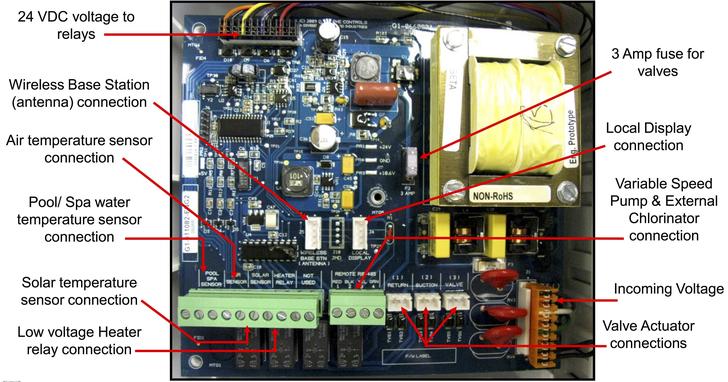
The pool controller is a Hayward OnCommand unit with several additional functions (heater and pump controls, relays for lights, etc.) and I do not have a circuit diagram but have a picture of it:


The thermistors are 10 kΩ NTCs and I have calculated the Steinhart-Hart coefficients based on a data table in the diagnostics manual (page 13). This morning, I measured the voltage across two of the sensors (the roof-mounted was moving up and down too much). Apparently, the way the controller measures the resistance of the thermistors does not involve a voltage splitter as I had assumed: one of the two poles is at GND while the other measures at 2.843 V @ 66 °F or 3.447 V @ 46 °F. At those temperatures, the thermistors should have 13136 Ω and 22156 Ω respectively. I believe the controller board has both 10.6 V and 24 V rails (see center of the board to the left of the beefy transformer).

As for my own project, I think something like is outlined in this post might work if I can work out a high impedance version of it.
 
Top