Simplest way to observe resonant frequency

MrChips

Joined Oct 2, 2009
34,903
Why are you attempting to drive this with 1.5 kV?

With a spark gap firing, you are producing RF noise over a very wide frequency spectrum. What the oscilloscope is going to detect is anyone's guess.

So you have found a resonant frequency at 900 kHz. Isn't that not enough for this experiment and demonstration?
 

Thread Starter

Tutor88

Joined Feb 8, 2023
306
I wanted to see how a higher voltage would affect the experiment. Are you saying that the fundamental frequency is completely masked and overpowered by the random noise?
 

MisterBill2

Joined Jan 23, 2018
27,684
Not 6H.
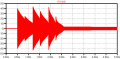
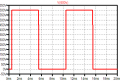
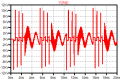
I took a signal generator that has 50 ohms internal resistance (square wave) and drive the LC at a low frequency. The wave form is across the coil. See the ring.
View attachment 349837
The other choice is to sweep the generator's frequency from 100khz to 10mhz and see that here is a real bump at 500khz.
The scope picture shows a ringing at close to the resonant frequency. The resonant circuit is being shock excited and is ringing at about the resonant frequency. Add a 1K resistor in series with the scope and drive the circuit with a square wave. At resonance the amplitude will be much greater and the wave will approach a nice sine wave. The exact frequency of resonance will produce a very obvious peak.
 

Thread Starter

Tutor88

Joined Feb 8, 2023
306
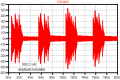
Yes I can show the resonant frequency in the first of the latest slides. That’s not the latest query, which is why when I raise the voltage to 1.5kV as a sine wave, instead of the square wave at 20V, do I see a frequency of over 40MHz? Is this due to an overwhelming amount of noise that masks the approx 900kHz of the earlier experiment or something else like a harmonic? Has the ~40MHz nothing to do with the 900kHz resonance?
 

MrChips

Joined Oct 2, 2009
34,903
Yes I can show the resonant frequency in the first of the latest slides. That’s not the latest query, which is why when I raise the voltage to 1.5kV as a sine wave, instead of the square wave at 20V, do I see a frequency of over 40MHz? Is this due to an overwhelming amount of noise that masks the approx 900kHz of the earlier experiment or something else like a harmonic? Has the ~40MHz nothing to do with the 900kHz resonance?
Correct.
 

Thread Starter

Tutor88

Joined Feb 8, 2023
306
So if I were to use a spectrum analyser (with an H field probe) I should still see my original 900kHz as a spike, of the same amplitude as before, in a sweep from 0.5-50MHz but also a lot of other noise. The scope has just responded to the largest signal and isn’t showing the original resonance?

There is another possibility maybe and that is that the ceramic capacitors I’m using are not stable at 1.5kV and are changing their value significantly compared to 20V. I’ve read that, unlike film capacitors, their value may drop significantly with voltage, so is it possible that the 40MHz is in fact real due to the capacitance dropping from 4.8nF to 0.003nF? Does sound rather too much of a change though.

Also, the spark frequency appears as much greater than the NST driving frequency perhaps because of cascade breakdown in the air gap where secondary discharges of an higher frequency are occurring?

As for the lack of readings when a GDT is used instead of the spark gap, I’m guessing that inside the GDT there is an almost continuous discharge taking place that may act like a short thereby ‘draining’ the LC circuit of energy. How does all that sound?
 
Last edited:

Beau Schwabe

Joined Nov 7, 2019
186
Use an oscilloscope and sweep your frequency. Place your L and C in series and inject the square wave into the capacitor. Connect L to GND and connect your oscilloscope input to the common node between L and C. At resonant frequency, the oscilloscope display should show an obvious increase in voltage.
 

Thread Starter

Tutor88

Joined Feb 8, 2023
306
Use an oscilloscope and sweep your frequency. Place your L and C in series and inject the square wave into the capacitor. Connect L to GND and connect your oscilloscope input to the common node between L and C. At resonant frequency, the oscilloscope display should show an obvious increase in voltage.
Ok, but what was wrong with my method above with the components in parallel and using the square wave and which gave a very reasonable figure of 899kHz? I presume the voltage increase is due to the minimum impedance of a series LC at f res.

Any thoughts of the high voltage observations?
 

Thread Starter

Tutor88

Joined Feb 8, 2023
306
That’s very good of you to go to the trouble of doing a Spice sim; I hadn’t thought to do that and my sim skills are only a shadow of yours.

A couple of comments and queries before I find time towards the end of this week to explore it in more depth.

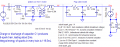
I take it L2-L4 are for the NST equivalent circuit. I have added 425pF of parallel capacitance to L6 and it brings the frequency to 896kHz which is close to what my scope said it was.

What determines the values you used for the plug cable model, which is the the two wires connecting the NST to the parallel LC?

C1 is a decoupling cap for the 600V supply? C6 is my parallel capacitor.

Does your sim explain the 1.3MHz spark repetition rate I observed on the scope compared to the NST output frequency of ~35kHz? It seems many sparks are occurring in between the NST peaks so where did 6 sparks come from? Is that based on my 1.3MHz observation?

I don’t recognise most of the subckt statements for the spark gap but that shouldn’t make a difference so long as they are part of the attachment.

Towards the end of this week I will have time to explore this model and play with it. Thanks again.
 
Last edited:

Ya’akov

Joined Jan 27, 2019
10,259
You might consider putting an LED across the tank so that it would become bright (or even just turn on) when resonance occurs.
 

Thread Starter

Tutor88

Joined Feb 8, 2023
306
You might consider putting an LED across the tank so that it would become bright (or even just turn on) when resonance occurs.
Good idea. Any type and with no series resistor? If the impedance is maximum at resonance, then why would that be the time it comes on? Possible because the supply voltage (1.5kV) can’t pass through the inductor so it has to go through the LED. If so won’t that blow it?
 

Ya’akov

Joined Jan 27, 2019
10,259
Good idea. Any type and with no series resistor? If the impedance is maximum at resonance, then why would that be the time it comes on? Possible because the supply voltage (1.5kV) can’t pass through the inductor so it has to go through the LED. If so won’t that blow it?
Resonance is an interaction between the inductor and cap. Yes, the maximum impedance of the cois will be at resonance, but there is still voltage moving back and forth between L and C. The voltage at that point will be at maximum, and the LED should light (for half a wave, since it is a diode.)

You can put a pair of polarity-reversed parallel LEDs to get a brighter indication. The higher the Q of the tank the brighter but narrower the range of lighting. You should measure the peak voltage to decide if you need current limiting for the LED(s)—or, you could just try it and if you let out the smoke, it died for science.

You could also use a small filament lamp which has the advantage of being non-polar but if might be harder to find than LEDs which I suspect you have on hand.
 

Thread Starter

Tutor88

Joined Feb 8, 2023
306
Resonance is an interaction between the inductor and cap. Yes, the maximum impedance of the cois will be at resonance, but there is still voltage moving back and forth between L and C. The voltage at that point will be at maximum, and the LED should light (for half a wave, since it is a diode.)

You can put a pair of polarity-reversed parallel LEDs to get a brighter indication. The higher the Q of the tank the brighter but narrower the range of lighting. You should measure the peak voltage to decide if you need current limiting for the LED(s)—or, you could just try it and if you let out the smoke, it died for science.

You could also use a small filament lamp which has the advantage of being non-polar but if might be harder to find than LEDs which I suspect you have on hand.
Thanks. I have a 75V or 95V little Neon bulb. Could I use that across the tank instead?
 

MrChips

Joined Oct 2, 2009
34,903
You need to learn about something called the Fourier Transform.

When we examine a signal on an oscilloscope, we are viewing a voltage signal over time.
Every time series, such as a voltage vs time signal, has a frequency spectrum.
You can convert from time space to frequency space and back again. That is what the Fourier Transform allows us to do.

When you play a musical note on a piano or guitar, you hear a tone at a fundamental frequency. If you were to examine the frequency spectrum, you would observe many more frequencies besides the fundamental. That is what makes a guitar sound different from a piano.

A very short signal, such as the signal from a HV spark generator, is something we call an impulse function.
The Fourier Transform, i.e. the frequency spectrum, of an impulse function is very wide band, i.e. infinite frequencies.
Thus the oscilloscope could be showing some random information that is not related to the LC resonance frequency.

When you strike a clock bell with a hammer, you are exciting a resonant oscillator with an impulse function. We hear the tone of the bell.
Unfortunately, when you apply an impulse function to an electrical circuit, there are many different paths for signals to reach the amplifiers within the oscilloscope. Hence, measuring the response of the circuit requires careful setup of the measuring environment.
 

Thread Starter

Tutor88

Joined Feb 8, 2023
306
You need to learn about something called the Fourier Transform.

When we examine a signal on an oscilloscope, we are viewing a voltage signal over time.
Every time series, such as a voltage vs time signal, has a frequency spectrum.
You can convert from time space to frequency space and back again. That is what the Fourier Transform allows us to do.

When you play a musical note on a piano or guitar, you hear a tone at a fundamental frequency. If you were to examine the frequency spectrum, you would observe many more frequencies besides the fundamental. That is what makes a guitar sound different from a piano.

A very short signal, such as the signal from a HV spark generator, is something we call an impulse function.
The Fourier Transform, i.e. the frequency spectrum, of an impulse function is very wide band, i.e. infinite frequencies.
Thus the oscilloscope could be showing some random information that is not related to the LC resonance frequency.

When you strike a clock bell with a hammer, you are exciting a resonant oscillator with an impulse function. We hear the tone of the bell.
Unfortunately, when you apply an impulse function to an electrical circuit, there are many different paths for signals to reach the amplifiers within the oscilloscope. Hence, measuring the response of the circuit requires careful setup of the measuring environment.
Yes, this does sound familiar from way back.

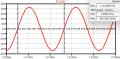
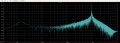
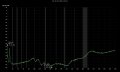
I attach a grab of the sim now with added parasitic capacitance of 450pF for the coil. I get the exact reading I got with my 3Hz square wave. The noise from the spark gap is indeed substantial, as you can see from the spectrum analysis trace. At 40MHz the level compares with the resonant peak!

Resonance peak (897.9kHz).jpg


0.5-40M Sweep with Res peak.jpeg
 

MrChips

Joined Oct 2, 2009
34,903
It gets worse than anyone can imagine.

In sampling theory, there is something known as Nyquist frequency or Nyquist limit.
The Nyquist frequency is one-half of the sampling frequency. If you attempt to sample any frequency that is above the Nyquist limit, the signal frequency is folded back as a lower frequency and we call this aliasing.

Since the frequency spectrum of an impulse function contains infinite frequencies, signals above the Nyquist limit get reflected back at a lower frequency and appears as a false frequency, i.e. an alias.

You have to know the limitations and consequences when attempting to examine random signals.
 

Thread Starter

Tutor88

Joined Feb 8, 2023
306
It gets worse than anyone can imagine.

In sampling theory, there is something known as Nyquist frequency or Nyquist limit.
The Nyquist frequency is one-half of the sampling frequency. If you attempt to sample any frequency that is above the Nyquist limit, the signal frequency is folded back as a lower frequency and we call this aliasing.

Since the frequency spectrum of an impulse function contains infinite frequencies, signals above the Nyquist limit get reflected back at a lower frequency and appears as a false frequency, i.e. an alias.

You have to know the limitations and consequences when attempting to examine random signals.
All worth knowing in the labyrinth of RF!
 
Top