Simplest way to observe resonant frequency

Thread Starter

Tutor88

Joined Feb 8, 2023
272
I have a few experiments planned for my students this coming half term, and one of them is to show how a coil and a capacitor in parallel will resonate at a specific frequency.

So I have an inductor made from 16 turns of plastic-coated wire on a plastic tube with a measured L = 6H. The capacitor in parallel measures 4.8nF, made from 2x10nF in series. The attached photo shows the planned arrangement.

The parasitic L and C will naturally drop the resonant frequency, and I'm not getting into that aspect in this demo, but I just want to show that a resonant response occurs somewhere and to note its value. Is the simplest way to drive the circuit with a signal generator set to square wave, 20V amplitude, 50% duty and sweep the frequency between 2 -10MHz? I would scope off the top and bottom of the capacitor.

Will that show anything, or do I need a more powerful stimulus, or another arrangement? I'm hoping that the signal generator input will make it 'ring' to some degree.

Thanks
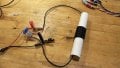
Parallel Tank Circuit.jpg
 

MrChips

Joined Oct 2, 2009
34,628
That will work, except your value of 6 henries is wrong. If you had said 6 μH that might have been closer.

I would try just a DC power supply and a push button switch. An impulse function alone (DC voltage spike) would cause the LC circuit to resonate (ring). You need a digital oscilloscope that is able to capture a "one-shot" single event.
 

nsaspook

Joined Aug 27, 2009
16,250
I have a few experiments planned for my students this coming half term, and one of them is to show how a coil and a capacitor in parallel will resonate at a specific frequency.

So I have an inductor made from 16 turns of plastic-coated wire on a plastic tube with a measured L = 6H. The capacitor in parallel measures 4.8nF, made from 2x10nF in series. The attached photo shows the planned arrangement.

The parasitic L and C will naturally drop the resonant frequency, and I'm not getting into that aspect in this demo, but I just want to show that a resonant response occurs somewhere and to note its value. Is the simplest way to drive the circuit with a signal generator set to square wave, 20V amplitude, 50% duty and sweep the frequency between 2 -10MHz? I would scope off the top and bottom of the capacitor.

Will that show anything, or do I need a more powerful stimulus, or another arrangement? I'm hoping that the signal generator input will make it 'ring' to some degree.

Thanks

View attachment 349836
I don't think the inductance of that coil is 6H. ;)

Sure, it will work as a demo but a typical signal generator is a low power measurement tool, not a coil driver that can switch sizable current into a low impedance.
 

ronsimpson

Joined Oct 7, 2019
4,646
Not 6H.
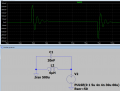
I took a signal generator that has 50 ohms internal resistance (square wave) and drive the LC at a low frequency. The wave form is across the coil. See the ring.
1748100046857.png
The other choice is to sweep the generator's frequency from 100khz to 10mhz and see that here is a real bump at 500khz.
 

MrChips

Joined Oct 2, 2009
34,628

MrChips

Joined Oct 2, 2009
34,628
Again, rather than using a sweep generator, a simple square wave at a very low frequency (1Hz) would work fine.
I prefer the simplicity of a PSU and a pushbutton.

But you want to lower the resonance frequency by increasing the values of L and C.

Ask your students to repeat the experiment using different combinations of L and C.
 

Thread Starter

Tutor88

Joined Feb 8, 2023
272
That will work, except your value of 6 henries is wrong. If you had said 6 μH that might have been closer.

I would try just a DC power supply and a push button switch. An impulse function alone (DC voltage spike) would cause the LC circuit to resonate (ring). You need a digital oscilloscope that is able to capture a "one-shot" single event.
Yes, it is 6uH and I did insert a 'Mu' from my character set but clearly it didn't appear.

Won' the rising edge of each square wave produce the 'ringing' and be captured on the scope?
 

Thread Starter

Tutor88

Joined Feb 8, 2023
272
Not 6H.
I took a signal generator that has 50 ohms internal resistance (square wave) and drive the LC at a low frequency. The wave form is across the coil. See the ring.
View attachment 349837
The other choice is to sweep the generator's frequency from 100khz to 10mhz and see that here is a real bump at 500khz.
Yes, I can sweept the frequency but I'm not sure what the 'bump' would look like. How can I capture the ring showing in your sim so that I can observe and measure the frequency? I guess it is too damped with only 20V, so I need a bigger kick from a 100V supply (with a momentary switch)?
 

Thread Starter

Tutor88

Joined Feb 8, 2023
272
Again, rather than using a sweep generator, a simple square wave at a very low frequency (1Hz) would work fine.
I prefer the simplicity of a PSU and a pushbutton.

But you want to lower the resonance frequency by increasing the values of L and C.

Ask your students to repeat the experiment using different combinations of L and C.
What voltage would give a clearer 'ring'?
 

crutschow

Joined Mar 14, 2008
38,316
I took a signal generator that has 50 ohms internal resistance (square wave) and drive the LC at a low frequency. The wave form is across the coil
For a longer ringing time of the tank, increase the Q by adding a few hundred ohms in series with the generator output.
(At the expense of a reduced output voltage, of course).
 

Thread Starter

Tutor88

Joined Feb 8, 2023
272
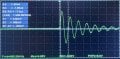
I had better luck this time with the attached. I used 20V at 3Hz and got a nice ring where the cursors indicate a frequency of 909kHz. Or maybe the figure at the bottom of 899.28 kHz is more accurate?

This suggests that the total C, including parasitic, is 5.1nF, so an extra 300pF of capacitance is coming from the coil (not that the students will explore that).


SFR.jpeg
 

ronsimpson

Joined Oct 7, 2019
4,646
video Here is a video. At about 45 minutes he shows how to measure resonant using a Grid dip meter. Then he shows how to do that using a Nano Vector Newtwork Analyzer. I paid about $100 usd for mine. I also have one that cost $24,000. He shows how to measure the frequency using Smith chart.

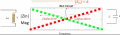
I use a different method. The Newtwork Analyzer will give this graph. I added a red line for L and a green line for C. The LC is the blue line.
1748109060118.png
Read up on Vector Newtwork Analyzer and Grid dip meter.
 

MrChips

Joined Oct 2, 2009
34,628
You don't need 20 V.
Any voltage will do. The resonant oscillation will be a percentage of the input voltage.

Don't worry about accuracy of the frequency measurement. Even 10% accuracy will be sufficient to demonstrate the resonance effect.
 

MrChips

Joined Oct 2, 2009
34,628
Yes, I can sweept the frequency but I'm not sure what the 'bump' would look like. How can I capture the ring showing in your sim so that I can observe and measure the frequency? I guess it is too damped with only 20V, so I need a bigger kick from a 100V supply (with a momentary switch)?
If you want to manually sweep across the frequency range with a sinewave generator, the "bump" will be recognized as a maximum amplitude of the signal across the LC circuit.

Since you can determine by calculation the expected resonance frequency, manually sweep the frequency across a predetermined range. For example, if you have calculated that the resonance frequency is around 900 kHz, set the function generator to a range that outputs a maximum of 1000 kHz (or 3 MHz or whatever range that allows you to scan through the target frequency). Turn the frequency dial by hand and search for the maximum signal amplitude across the LC circuit.
 

Jon Chandler

Joined Jun 12, 2008
1,560
An impulse function alone (DC voltage spike) would cause the LC circuit to resonate (ring).
An impulse is the way we determined resonance frequencies of machines and structures – a "bump test" to monitor the resulting vibration. I've used a roll of duct tape to hit a machine in a pinch, but our standard tool was a 16 pound no-bounce sledge hammer.

Mechanics were complaining that we were damaging machinery with "that giant sledge hammer" to the point that the chief design engineer came with us to observe one of our "destructive tests".

We got the instrumentation set up (including a Nagra IV SJ tape recorder for those in the know), picked up our "giant sledge hammer" and gave the machine a gentle tap with about a 6" swing. Bump.

The chief design engineer looked incredulous. "That's it? That's all you do with the sledge hammer????. Geez oh grief." I wish I could have heard his phone call with the mechanics general foreman!

To excite an entire ship's structure, a similar test is done – an anchor drop test. The anchor and its heavy chain is let free and paid out a few hundred feet (the chain is flying by at this point) and snubbed suddenly. This excites all the natural frequencies of the hull.
 

Thread Starter

Tutor88

Joined Feb 8, 2023
272
video Here is a video. At about 45 minutes he shows how to measure resonant using a Grid dip meter. Then he shows how to do that using a Nano Vector Newtwork Analyzer. I paid about $100 usd for mine. I also have one that cost $24,000. He shows how to measure the frequency using Smith chart.

I use a different method. The Newtwork Analyzer will give this graph. I added a red line for L and a green line for C. The LC is the blue line.
View attachment 349844
Read up on Vector Newtwork Analyzer and Grid dip meter.
I know of the NanoVNA but that is far too complicated for my application re this query.
 

Thread Starter

Tutor88

Joined Feb 8, 2023
272
Yes, these examples of acoustic resonance are good, but way beyond school budgets. They are the sort of thing one relies on YouTube for :)

While I have this circuit set up, I wanted to do some experiments of my own, which have produced some further queries.

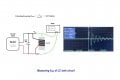
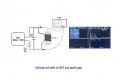
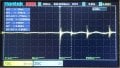
Having measured the f(sr) of the 6H coil and a 4.8nF cap in parallel (as in the first attachment), I have tried to drive/excite this tank circuit with a small NST at 1.5kV, at approx 35kHz and with a spark gap set to 100m. I can see ringing on the scope with each irregularly spaced spark, but the frequency indicated is around 48MHz, as in the second attachment.

Is this just a harmonic of the fundamental frequency shown in the first slide, or something else? Also, perhaps relevant is the pic of what I take to be the sparking interval, which suggests around 1.3MHz, compared to the approx 35kHz of the NST, and somewhat random, as in the last attachment. Perhaps increasing the gap to 200m might produce less chaotic arcing?

Lastly, substituting the spark gap for a 1kV GDT gives no trace at all. I thought that a GDT might produce more regular sparking/arcing and so make the spark interval more regular. However, no trace appears.

I would appreciate any comments on what is going on, in particular:

1: Why does the fundamental f(sr) not appear when the NST is driving the circuit?

2: Why is the apparent spark frequency so much higher than the NST output?

3: Why does using a GDT appear to stop the resonance and output?
 

Attachments

Top