Simplest way to observe resonant frequency

Beau Schwabe

Joined Nov 7, 2019
186
To answer a question in the simplest terms ... If the LC are in parallel you form a "notch filter" at resonance and the signal may be harder to detect. In series, you form a "pass filter" where at resonant frequency, the voltage can climb with orders of magnitude over the input voltage making it easier to detect.
 

Thread Starter

Tutor88

Joined Feb 8, 2023
306
It happens at AF also!
Try recording a signal at increasing audio frequencies.
Given the behaviour of a spark gap, why is there no resonance at all, in fact no recognisable scope trace, when using a 1kV GDT? The device glows purple so is clearly discharging. Is the discharge acting as a short perhaps?
 

Thread Starter

Tutor88

Joined Feb 8, 2023
306
To answer a question in the simplest terms ... If the LC are in parallel you form a "notch filter" at resonance and the signal may be harder to detect. In series, you form a "pass filter" where at resonant frequency, the voltage can climb with orders of magnitude over the input voltage making it easier to detect.
I did try the series configuration but couldn’t see any changes in amplitude or voltage. Guess I was lucky with the 3Hz injection approach. In addition, as described above, the spectrum analysis clearly shows the resonant spike and Danko’s sim model also reveals a sharp spike at the predicted frequency.
 

Thread Starter

Tutor88

Joined Feb 8, 2023
306
Resonance is an interaction between the inductor and cap. Yes, the maximum impedance of the cois will be at resonance, but there is still voltage moving back and forth between L and C. The voltage at that point will be at maximum, and the LED should light (for half a wave, since it is a diode.)

You can put a pair of polarity-reversed parallel LEDs to get a brighter indication. The higher the Q of the tank the brighter but narrower the range of lighting. You should measure the peak voltage to decide if you need current limiting for the LED(s)—or, you could just try it and if you let out the smoke, it died for science.

You could also use a small filament lamp which has the advantage of being non-polar but if might be harder to find than LEDs which I suspect you have on hand.
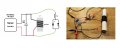
I have had a go at the LED technique, as in the photo, but they remain on all the time, whatever the sine wave input frequency.

At the moment, it's all held together with crocodile clips but that shouldn't make any difference.

I’m now thinking that the LEDs should be in series between the capacitor and the coil. Will try that later.

Testing Resonance.jpeg
 
Last edited:

Thread Starter

Tutor88

Joined Feb 8, 2023
306
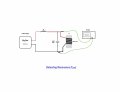
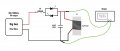
What I have now done is to put the two LEDs in series with the sig gen supply to the parallel L and C, and scope across the circuit as in the revised diagram.

What happened this time is that the LEDs still remained on all the time, but the scope amplitude drops to a minimum at 933 kHz. I'm not sure how to get the LEDs to show brightest at resonance and little or nothing on either side, but this method does at least give a good reading.
 

Attachments

MrChips

Joined Oct 2, 2009
34,924
LEDs driven by signals greater than 25 Hz will either show lit or not lit.
The pulse interval is too short to indicate anything besides on, off, or dim.
 

Thread Starter

Tutor88

Joined Feb 8, 2023
306
LEDs driven by signals greater than 25 Hz will either show lit or not lit.
The pulse interval is too short to indicate anything besides on, off, or dim.
So if I dispensed with the LEDs would I just keep the 1k resistor and use the scope amplitude to determine the resonant point?
 

MrChips

Joined Oct 2, 2009
34,924
Yes, eliminate the LEDs.

The LC load represents a resistive load of close to 0Ω which will make the signal generator not too amused.
Put a 100 - 1000 Ω resistor in series with the output of the signal generator. Then manually rotate the frequency dial to find the resonant frequency at the LC circuit.
 

MisterBill2

Joined Jan 23, 2018
27,714
Yes, eliminate the LEDs.

The LC load represents a resistive load of close to 0Ω which will make the signal generator not too amused.
Put a 100 - 1000 Ω resistor in series with the output of the signal generator. Then manually rotate the frequency dial to find the resonant frequency at the LC circuit.
CERTAINLY, with 15 volts applied, the LEDs will be lighted constantly.
Reduce the generator output to three volts and see what happens. Very few experiments are so robust that vastly over driving them will not produce inconclusive results.
 

Thread Starter

Tutor88

Joined Feb 8, 2023
306
CERTAINLY, with 15 volts applied, the LEDs will be lighted constantly.
Reduce the generator output to three volts and see what happens. Very few experiments are so robust that vastly over driving them will not produce inconclusive results.
Is there a straightforward way to get a visual indication of resonance when dealing with much higher voltages, perhaps using neon bulbs that operate at a higher breakdown voltage? This could be either a setup in direct contact with the LC circuit or non-contact.
 

Thread Starter

Tutor88

Joined Feb 8, 2023
306
This isn’t to demonstrate resonance, that was for my students. As I said a while back, I have an interest is RF/HV circuits. This is for my own interests and hobby experiments.
 

sparky 1

Joined Nov 3, 2018
1,218
In an RF circuit the feed point to an antenna has a 1:1 ratio between the forward and reverse standing waves, as the antenna is brought into resonance.
An SWR meter will become toast with very high voltage RF. There may be another way to measure this? A background summary of Tesla resonance effect :

In 1892 Nikola Tesla demonstrated a single wire electrical transmission stating that it worked on the resonance effect.
He let the cat out of the bag allowing others with investment potential and clout to quickly jump in and patent wireless.
It is still argued that Tesla's approach was not sufficient that his Colorado experiment was too odd for those days, making claims of tower producing energy.
It is common in electrical science to find multiple patents and have to untangle each company's research. This dilemma led to court case and included weighing in
other research on various projects with telegraph and transatlantic cable added to argue experimental theory and mathematical correctness.
The mathematical data of the Maxwell LC bridge equations along with Steinmetz electrical transmission equations had become useful and strengthened conclusion
that because Hertzian waves analysis were sufficient in resolving electrical power transmission that safety was proven using quantitative analysis.
This allowed improvement in the modern step down transformers. The court decided that for the newer developments that Tesla wave was new but not as useful
and Tesla's prior art could not cover what Steinmetz and others had shown using Hertzian waves had less harmonics as radio listeners agreed.

The Tesla transformer still has a place in the history and development of both wireless and electrical power transmission and can be observed.
The intense noise of the spark gap and it's harmonic content were obstacles that existed in comparison to what industry wanted to use and meter
whereas Tesla's continued on a course that wireless power should be free did not influence investors as being practical.
 
Last edited:

Thread Starter

Tutor88

Joined Feb 8, 2023
306
.
In an RF circuit the feed point to an antenna has a 1:1 ratio between the forward and reverse standing waves, as the antenna is brought into resonance.
An SWR meter will become toast with very high voltage RF and possible remedy to safely detect. A Background summary:

In 1892 Nikola Tesla demonstrated a single wire electrical transmission stating that it worked on the resonance effect.
He let the cat out of the bag allowing others with investment potential and clout to quickly jump in and patent wireless.
It is still argued that Tesla's approach was not sufficient that his Colorado experiment was too odd for those days.
It is common in electrical science to have to untangle company secrets and agendas until it can be addressed years later.

The various projects with telegraph and transatlantic cable added to the experimental theory.
The mathematical data of the Maxwell LC bridge equations along with Steinmetz electrical transmission were useful
in resolving electrical power transmission safety using quantitative analysis. This allowed improvement in the modern step down transformers.

The Tesla transformer still has a place in the history and development of both wireless and electrical power transmission and can be observed
with the necessary caution. Simple ha
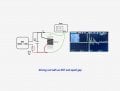
Here is the test circuit again driven by an NST. The frequency indicated by the scope trace is in fact from the spark gap and not the LC resonance itself, as discussed previously in this thread. A spectrum analysis showed the actual resonance value at around 950kHz.
Yes , there are ‘resonances’ with Tesla coils and related phenomena.

So I know how to find the self-resonant frequency of the circuit, but wanted a quick visual indication (a non contact form probably) that indicated when either or both coils were in resonance so that fine tuning (with an air capacitor) could be quickly and easily done. I envisaged some form of illuminated bulb that shone brightest at resonance, or other methods, such as a single loop aerial, to measure a maximum induced amplitude, may be appropriate.
 

Attachments

Last edited:

MrChips

Joined Oct 2, 2009
34,924
Please note that there are regulations and restrictions governing emission of RF signals in every country around the world.
 

Thread Starter

Tutor88

Joined Feb 8, 2023
306
Hello,

QSLnet has a page about the grid dip meter:
https://www.qsl.net/yo4rlp/wshp/gdo.html
It can be used to determine the resonance frequency of a tuned circuit of a L and C.

Bertus
Thanks, will check it out.

In fact I have just realised that I can use my nanoVNA as a form of dip meter with better functionality in that one can also see the precise resonant frequency. Takes a ‘knock in the head’ sometimes to make the right mental leaps
 
Last edited:

Thread Starter

Tutor88

Joined Feb 8, 2023
306
Please note that there are regulations and restrictions governing emission of RF signals in every country around the world.
Yes, but if needed such experiments can be done inside a form of Faraday cage to minimise such emissions, in part for my health benefit.
 

Thread Starter

Tutor88

Joined Feb 8, 2023
306
Regarding the detection of resonance at low voltage, I have used the previous circuit layout (as below), but with a coil of larger inductance and capacitance (145uH, 72nF) in the hope of confirming a resonance around 50kHz.

However, the trace is very chaotic and not a stable sine wave, like the one at 950kHz, and I wondered if there was any obvious reason for this? As it is, it is hard to find the point of minimum amplitude.
 

Attachments

MrChips

Joined Oct 2, 2009
34,924
I did this with real components that I have on hand, L = 22 μH, C = 10 nF.
I had no problem finding a maximum amplitude at the resonance frequency of 340 kHz.
Function generator sinewave output is 1 V amplitude with 600 Ω output impedance.

Make sure that the triggering on the oscilloscope is setup properly.
 
Top