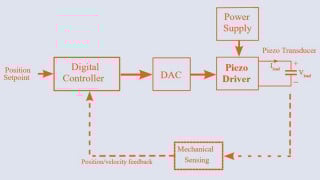
I want to turn a Boost SMPS into the simplest audio power amplifier.

Thread Starter

Motanache

Joined Mar 2, 2015
652
I'm trying to turn a Boost into a Flyback and then into an audio amplifier.
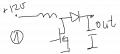
1731078440480.png
1731078588434.png

1731079156873.png


Basically I wanted a simple SMPS modulated with an audio signal.

I know, you will say that the class D amplifier is also an SMPS, but the class D amplifier needs at least 2 power transistors + a large electrolytic capacitor or 4 power transistors without a capacitor. And to that will be added the SMPS Up or Down.

Another idea would be:
To make a Boost SMPS with the old good and famous TL494 and to modulate the reaction with an audio signal.
This would mean dividing the audio signal, theoretically a sine wave into positive and negative alternation.

If I use a microcontroller, the dependence of the duty cycle on Vout is not linear at Boot.
 

crutschow

Joined Mar 14, 2008
38,316
A boost regulator can only supply current in on direction.
To drive a speaker with an AC signal requires the current to go in both directions. hence the minimum two power transistors in a class D amp.
So how will you get the regulator to do that?

Also switching regulators, by design, have a very low frequency response.
This would mean dividing the audio signal, theoretically a sine wave into positive and negative alternation.
How will that help?
 

ronsimpson

Joined Oct 7, 2019
4,646
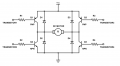
Here is a simplified schematic. It drives a motor but could be a speaker.
At about 1980 I had one working with 24V supply and 50A outputs. It was OK just to probe it could be done. Back then we could not switch fast enough to make a real product out of it. We tried again decades later with a 200khz PWM. The problem was the digital audio sampling rate and the PWM frequency beat together and made a slight 8khz tone.
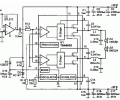
Now days there are IC that make this work very well.
1731086614187.png
Small D amp from TI
1731087780610.png
 
Last edited:

Papabravo

Joined Feb 24, 2006
22,058
I'm trying to turn a Boost into a Flyback and then into an audio amplifier.

View attachment 335401
View attachment 335402

View attachment 335403


Basically I wanted a simple SMPS modulated with an audio signal.

I know, you will say that the class D amplifier is also an SMPS, but the class D amplifier needs at least 2 power transistors + a large electrolytic capacitor or 4 power transistors without a capacitor. And to that will be added the SMPS Up or Down.

Another idea would be:
To make a Boost SMPS with the old good and famous TL494 and to modulate the reaction with an audio signal.
This would mean dividing the audio signal, theoretically a sine wave into positive and negative alternation.

If I use a microcontroller, the dependence of the duty cycle on Vout is not linear at Boot.
Just because you have an idea does not mean that it will work or be practical. Sometimes a sow's ear is just a sow's ear and can never be a purse. If you want purse, then quit messing around: design and build a PURSE.
 

Thread Starter

Motanache

Joined Mar 2, 2015
652
Now days there are IC that make this work very well
I have studied and tested several ICs
The only one that I liked how it sounds is the TDA8920.
It seems simple, it integrates the final transistors, but it needs the differential voltage power supply, other costs.
Best bought as a kit and you have no problems. TDA892X I think similar.

You showed me an H-bridge with bipolar transistors.
It is the simplest method to reverse the polarity or to make a simple voltage power supply audio amplifier.

However, I have read and tested that the MOSFET switches faster than the bipolar transistor.

High power is needed at low frequencies not at high frequencies.
I don't think it would be necessary to reach too high frequencies.
 

DickCappels

Joined Aug 21, 2008
10,661
Feel free to use MOSFETs if you wish. YOU are in control.

I think Papabravo’s main point is that you need an AC signal with an average voltage of close to zero volts so you don’t cook your speaker.
 

Thread Starter

Motanache

Joined Mar 2, 2015
652
I think Papabravo’s main point is that you need an AC signal with an average voltage of close to zero volts so you don’t cook your speaker.
Certainly. That's why I put an electrolytic capacitor in series with the speaker, to cut the continuous component.
When experimenting there is a risk of burning components. We all know that here.

The problem of how to make an simple SMPS to give selectable either positive voltage or negative voltage without H-bridge is the most difficult.
 

ronsimpson

Joined Oct 7, 2019
4,646
The only one that I liked how it sounds is the TDA8920.
I like it. It has the H bridge with MOSFETs.
You showed me an H-bridge with bipolar transistors.
My first one, MOSFETs were new and would not work.
I don't think it would be necessary to reach too high frequencies.
You need to switch 3 or 4x the highest audio frequency. I suggest 100khz to get 20khz audio.
My first try, we only achieved 9khz audio because switching at 20khz was almost impossible.
The next try I could just make 20khz audio.

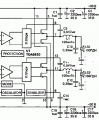
I can show you what is inside the IC or you can find out. It is not easy to build from op-amps.


Full bridge. Coilcraft.com makes a single inductor for L1, L2.
1731159653140.png
Half bridge with caps.
1731159853255.png
 

Thread Starter

Motanache

Joined Mar 2, 2015
652
The first idea is to make a boost smps that can source and sink current.
Boost smps can source current. It is only necessary to create an auxiliary circuit that sinks current.

Then I think of two SMPS placed one after the other. An SMPS Boost that is powered at -12V and provides Vout=+12V....+30V.
After that a Buck-Boost SMPS that will feed from the previous Vout=Vin and will generate Vin,,,,-Vout.
But it's getting too complicated.
 

Thread Starter

Motanache

Joined Mar 2, 2015
652
I will draw the previous attempts with 4 MOSFETs.
I was disappointed with this attempt because distortions appeared at high volume. I didn't have an oscilloscope.


If someone wants to listen to how this test "prototype" sounds, I'll think about how to post a video.
1732268760720.png
 

Thread Starter

Motanache

Joined Mar 2, 2015
652
The transformer in the previous image is a computer ATX power supply transformer
After the Attini85 comes the MOSFET driver with IR2109/2103
The idea is to use as few expensive parts as possible, such as power MOSFETs.

Why am I looking for an audio amplifier with a microcontroller? I have read more that if the assembly contains a programmed microcontroller it cannot be copied,

1732270063556.png
 
Last edited:

Thread Starter

Motanache

Joined Mar 2, 2015
652
I like it. It has the H bridge with MOSFETs.

View attachment 335448
From what I can see in the diagram, the TDA8920 even with the bridged outputs still needs a double voltage source. Example +30V GND -30V
It is worth trying to put a simple voltage source +60V and make a table at half the voltage with resistors. Being in deck, it probably won't consume much on those branches.

TDA8920 5$ but IRFZ44 or IRF640/840 is 0.5$
 

ronsimpson

Joined Oct 7, 2019
4,646
the TDA8920 even with the bridged outputs still needs a double voltage source. Example +30V GND -30V
No.
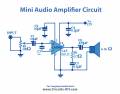
Here is a linear amplifier. C6 blocks the DC. The supply is +12V and 0V. The speaker sees power just like if the amplifier was +/-6V. Just add the capacitor.
Go to post #8 you will see a H-bridge and a half bridge.
1732302000176.png
 

MisterBill2

Joined Jan 23, 2018
27,164
Now that so many have commented about the need to drive both ways, I wonder if any have ever seen the circuit of the audio output stage of the "All American Five" AM receiver, which uses a single output tube feeding a transformer to drive a speaker???The tube plate current is varied in a class "A" amplifier arrangement. No, it is not very efficient, but the distortion at medium levels is less than 3%.

A switcher power supply with a fast response time, of less than 100 microseconds can work fairly well.
 

Thread Starter

Motanache

Joined Mar 2, 2015
652
receiver, which uses a single output tube feeding a transformer to drive a speaker???The tube plate current is varied in a class "A" amplifier arrangement. .
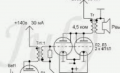
I guess it is something like this schematic

1732786079549.png

The transformer is for audio frequencies.
I assume that the transformer in the diagram is iron cored, large and heavy

I intend to use a ferrite transformer on 50-100KHz, because it is smaller and lighter/

I don't think there is a form of signal that you can give at the input of a transformer so that it outputs a constant voltage at the output. Am I wrong?
For example, a PWM with a 90% duty cycle at the input of a transformer would output all 0V direct current on the output.
Am I wrong?
 
Top