Simplest flip flop

ElectricSpidey

Joined Dec 2, 2017
3,335
I don't think this circuit needs a delay.

We need to figure out why M1 is hanging up on the transition.

My suspicion is due to the Darlington high side output of the 555 causing the gate of M1 to not be discharged quickly enough.

I believe the model for the 555 in LTSpice is ideal and this kind of problem would never show up in the sim.
 
Last edited:

Thread Starter

Icanmakeit67

Joined Sep 23, 2018
210
I don't think this circuit needs a delay.

We need to figure out why M1 is hanging up on the transition.
S
My suspicion is due to the Darlington high side output of the 555 causing the gate of M1 to not be discharged quickly enough.

I believe the model for the 555 in LTSpice is ideal and this kind of problem would never show up in the sim.
Ok. I just need the switch from A to B and back be clean with no overlap
 

ElectricSpidey

Joined Dec 2, 2017
3,335
Well, if A to B is clean (acceptable) then I see no reason why B to A can't also be clean.

Just have to figure the reason why the two transitions are asymmetrical.

And I am assuming you are letting the timer run thru multiple cycles, because a single cycle would explain a lot because M1 gate doesn't charge until B is active.
 

Thread Starter

Icanmakeit67

Joined Sep 23, 2018
210
Well, if A to B is clean (acceptable) then I see no reason why B to A can't also be clean.

Just have to figure the reason why the two transitions are asymmetrical.

And I am assuming you are letting the timer run thru multiple cycles, because a single cycle would explain a lot because M1 gate doesn't charge until B is active.
Totally agree.. I ran the sw circuit 30 minutes or more. Starting stoping. Always the same identical operation. Lean first change A to B. Both stay on for a short bit when B to A? Can’t use it on my project until the switch is a clean break from one load to the other…
 

crutschow

Joined Mar 14, 2008
38,526
Well, if A to B is clean (acceptable) then I see no reason why B to A can't also be clean.
The reason is, because the delay required for non-overlap is different for the two transitions (see below):
Note that Ck1 is delayed on its rise but not fall, and Ck2 is also delayed on its rise but not fall.
And the output rise is delayed, but the transition time is unaffected.
That's why I added the circuit which generates the rise delays needed to guarantee non-overlap on both sets of transitions.

1714745815009.png
 
Last edited:

crutschow

Joined Mar 14, 2008
38,526
I’ll breadboard it here in a few. Appreciate all the help and looking forward to trying it out.
You can adjust the values of R8 and/or C3 to change the value of the non-overlap time, if needed.

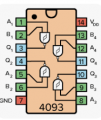
For your info, below are the pin designations for the CD4093 to help with your wiring:

1714754866605.png
 
Last edited:

panic mode

Joined Oct 10, 2011
4,995
9v is a bench supply. The LEDs have current limiting resistors. Can you elaborate a bit on the alterations to Q1?
but what is the current limit set at? did you monitor voltage? what is the LED current? your comments suggested that brightness dropped after two clocks..

the Q1, M1 and M2 need to work like switches. if they do, everything is fine.
the challenge is if they enter linear mode. with Q1 and large value base resistor this is likely the case. using Schmidt triggers ensures steep edges and problem goes away. adding delay between transitions allows for some safety margins too.
 

Thread Starter

Icanmakeit67

Joined Sep 23, 2018
210
You can adjust the values of R8 and/or C3 to change the value of the non-overlap time, if needed.

For your info, below are the pin designations for the CD4093 to help with your wiring:

View attachment 321558
Works fine with no overlap. I’ve played with the resistors/cap and see I can change speed. Is there a way I can get the A or B load to remain on longer than the other? I’d like A or B to be on half as long as the other?
 
Top