Shouldn’t forward bias theoretically increase the depletion region?

Thread Starter

Flamingo90

Joined Aug 5, 2024
12
With a reverse biased diode, the electrons get pushed from the - terminal towards the junction on P side and combine with holes near the junction, making the depletion layer increased on P side simultaneously the + terminal of the battery pulls the electrons into the + terminal leaving the N side of the junction increased as well with a bigger electric field.

My question, shouldn’t the depletion layer also increase in forward bias?

I imagine when - terminal on the N side pushes the electrons from the N side and over the junction into the holes on P side, it would recombine with the holes near the depletion layer and increase the depletion layer as well just like in reverse bias. And the same thing on the P side, + terminal pulling the electrons on P side leaving positive charges near the depletion later, hence increasing it.
 

Thread Starter

Flamingo90

Joined Aug 5, 2024
12
Sorry for late reply. But if I understand correctly, in reverse bias the depletion zone increases because at the P side, the - terminal pushed the batteries electrons towards the junction, and since holes now have acquired electrons the become negatively charged on P side, hence increasing the depletion zone.

My question, why don’t when I apply forward bias, the electrons from N side jump over to the P side and filling holes also increase the depletion zone since now the filled holes have also become negatively charged on the P side just like in reverse bias?
 

dl324

Joined Mar 30, 2015
18,267
My question, why don’t when I apply forward bias, the electrons from N side jump over to the P side and filling holes also increase the depletion zone since now the filled holes have also become negatively charged on the P side just like in reverse bias?
Because there is no region that is depleted of carriers.
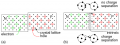
1726843308353.png
 

Thread Starter

Flamingo90

Joined Aug 5, 2024
12
Sorry for late reply. But if I understand correctly, in reverse bias the depletion zone increases because at the P side, the - terminal pushed the batteries electrons towards the junction, and since holes now have acquired electrons the become negatively charged on P side, hence increasing the depletion zone.
Welcome to AAC!

No. The depletion region is depleted of carriers. When the junction is forward biased, there's an abundance of carriers.

https://en.wikipedia.org/wiki/Depletion_region

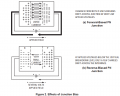
From Motorola Zener Diode Databook:
View attachment 328604
Sorry for late reply. But if I understand correctly, in reverse bias the depletion zone increases because at the P side, the - terminal pushed the battery’s electrons towards the junction, and since holes now have acquired electrons they become negatively charged on P side and since the electrons have been pulled by + terminal, the N side depletion zone also increase as more positive charge are created, hence increasing the depletion zone.

My question, why don’t when I apply a forward bias, the electrons from N side jump over to the P side and when filling holes, should also increase the depletion zone since now the filled holes have also become negatively charged on the P side just like in reverse bias? I’m confused only in this part. Thank you
 

dl324

Joined Mar 30, 2015
18,267
My question, why don’t when I apply a forward bias, the electrons from N side jump over to the P side and when filling holes, should also increase the depletion zone since now the filled holes have also become negatively charged on the P side just like in reverse bias?
You don't need to ask the same questions multiple times. Unless a member is ignoring the posts of certain members, they're visible for all to read.
 

Thread Starter

Flamingo90

Joined Aug 5, 2024
12
You don't need to ask the same questions multiple times. Unless a member is ignoring the posts of certain members, they're visible for all to read.
I apologise it’s my first time here, I tried to delete it but I wasn’t able to, but both time I intended to ask you.
 

dl324

Joined Mar 30, 2015
18,267
what makes in reverse bias depleted of carriers not allowing proper current flow and but not in forward bias?
If the science confuses you, why do you want to know? Understanding the underlying science isn't necessary. Most novices can use diodes just understanding that they conduct well in one direction (with the exception of zeners that are designed to breakdown).
 

panic mode

Joined Oct 10, 2011
4,931
it all comes down on average of all forces acting on that electron... when single electron in is in the middle of the P-region, it will fill the hole... as long as nothing else acts on it. think of it like holding golf ball in a teaspoon - a delicate balance is needed to keep it there. and some measurable effort is needed to move it out of there... but it does not take too much to overcome... so when bias is applied, it really is a storm that easily overcomes this tendency to "nest in one place".
 

nsaspook

Joined Aug 27, 2009
16,272
Im still not following, sorry I’m bit slow lol. But doesn’t a battery supply external electrons into a semiconductor? what makes in reverse bias depleted of carriers not allowing proper current flow and but not in forward bias?
First there is a fundamental thing that must be understood.

The battery really supplies energy into the semiconductor and circuit. The total amount of electrons (charge carriers) in the total circuit remains the same (there is no cache of extra electrons locked in the battery). When we create a PN junction, there is a diode potential barrier. This barrier is an electric field formed from charge separation. So, yes electrons move (mainly very slowly in copper wires but much faster, like 200,000X depending on doping, inside transistors than wires) but it's a circulation of existing charges.


Read this:
https://www.allaboutcircuits.com/textbook/semiconductors/chpt-2/the-p-n-junction/

1726849232903.png

PN Junction Bias
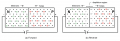
In Figure below(a) the battery is arranged so that the negative terminal supplies electrons to the N-type material. These electrons diffuse toward the junction. The positive terminal removes electrons from the P-type semiconductor, creating holes that diffuse toward the junction. If the battery voltage is great enough to overcome the junction potential (0.6V in Si), the N-type electrons and P-holes combine annihilating each other. This frees up space within the lattice for more carriers to flow toward the junction. Thus, currents of N-type and P-type majority carriers flow toward the junction. The recombination at the junction allows battery current to flow through the PN junction diode. Such a junction is said to be forward-biased.

1726849283809.png
(a) Forward battery bias repels carriers toward the junction, where recombination results in battery current. (b) Reverse battery bias attracts carriers toward battery terminals, away from the junction. Depletion region thickness increases. No sustained battery current flows.

If the battery polarity is reversed as in Figure above(b) majority carriers are attracted away from the junction toward the battery terminals. The positive battery terminal attracts N-type majority carriers, electrons, away from the junction. The negative terminal attracts P-type majority carriers, holes, away from the junction. This increases the thickness of the nonconducting depletion region. There is no recombination of majority carriers; thus, no conduction. This arrangement of battery polarity is called reverse bias.
 
Last edited:

Thread Starter

Flamingo90

Joined Aug 5, 2024
12
First there is a fundamental thing that must be understood.

The battery really supplies energy into the semiconductor and circuit. The total amount of electrons (charge carriers) in the total circuit remains the same (there is no cache of extra electrons locked in the battery). When we create a PN junction, there is a diode potential barrier. This barrier is an electric field formed from charge separation. So, yes electrons move (mainly very slowly in copper wires but much faster, like 200,000X depending on doping, inside transistors than wires) but it's a circulation of existing charges.


Read this:
https://www.allaboutcircuits.com/textbook/semiconductors/chpt-2/the-p-n-junction/

View attachment 332105

PN Junction Bias
In Figure below(a) the battery is arranged so that the negative terminal supplies electrons to the N-type material. These electrons diffuse toward the junction. The positive terminal removes electrons from the P-type semiconductor, creating holes that diffuse toward the junction. If the battery voltage is great enough to overcome the junction potential (0.6V in Si), the N-type electrons and P-holes combine annihilating each other. This frees up space within the lattice for more carriers to flow toward the junction. Thus, currents of N-type and P-type majority carriers flow toward the junction. The recombination at the junction allows battery current to flow through the PN junction diode. Such a junction is said to be forward-biased.

View attachment 332106
(a) Forward battery bias repels carriers toward the junction, where recombination results in battery current. (b) Reverse battery bias attracts carriers toward battery terminals, away from the junction. Depletion region thickness increases. No sustained battery current flows.

If the battery polarity is reversed as in Figure above(b) majority carriers are attracted away from the junction toward the battery terminals. The positive battery terminal attracts N-type majority carriers, electrons, away from the junction. The negative terminal attracts P-type majority carriers, holes, away from the junction. This increases the thickness of the nonconducting depletion region. There is no recombination of majority carriers; thus, no conduction. This arrangement of battery polarity is called reverse bias.
Thank you for the answer. I understand the battery’s electrons remain the same, they are finite. But the diagrams still only speak of the semiconductor alone, I haven’t seen the explanation of what happens to the electrons outside the semiconductors.

Basically what’s bothering me is, since in forward bias the holes in P side carry electrons from N type to P type (electrons within a semiconductor + electrons from the external source such as battery), why shouldn’t they take the electrons coming from the battery source from P type to N type as well in reverse bias instead of causing a depletion layer increasing?
 

nsaspook

Joined Aug 27, 2009
16,272
Thank you for the answer. I understand the battery’s electrons remain the same, they are finite. But the diagrams still only speak of the semiconductor alone, I haven’t seen the explanation of what happens to the electrons outside the semiconductors.

Basically what’s bothering me is, since in forward bias the holes in P side carry electrons from N type to P type (electrons within a semiconductor + electrons from the external source such as battery), why shouldn’t they take the electrons coming from the battery source from P type to N type as well in reverse bias instead of causing a depletion layer increasing?
Charge carriers moving one way cancel the junction e-field barrier, when they move the opposite direction they reinforce the barrier. Stop thinking that remote battery electrons moving in wires are important to the local PN junction physics. It's the localized fields and charge movements that matter.
 
Last edited:
Top