1N5408 doesn't drop voltage when forward biased to a 15V DC output

Thread Starter

sribasu

Joined May 10, 2017
41
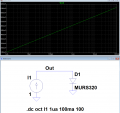
I am trying to drop the output voltage of a Hi-Link AC-DC 15V power supply. I have added a 1N5408 diode forward biased in series with the output of the Hi-Link unit. I haven't added any load to the output yet. Just trying to measure the output voltage. Please see the simple circuit diagram below. To my surprise, I'm reading the output voltage after the diode to be 16.7V! I measured the output voltage of the Hi-Link unit, it is approx 15.1V. But I don't know why would I see an 'increased' output voltage instead of seeing the forward bias voltage drop of the diode. I was expecting to see some 14.xx reading but in this case it is more then the output of the power source! Can someone please explain what is going wrong? Could the kind of Hi-Link power supply be the reason? There was no damaged part, I tested thoroughly.
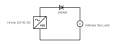
circuit.png
 

Papabravo

Joined Feb 24, 2006
22,058
In order to measure a voltage drop there needs to be a current flowing. As you have already observed the voltmeter presents a very high impedance so little to no current will flow and the diode will not be forward biased. Not familiar with your power supply so I can't comment on your other observations
 

crutschow

Joined Mar 14, 2008
38,319
Can someone please explain what is going wrong?
Nothing is wrong except you're not understanding diode voltage drop.

The forward drop of a diode is a logarithmic function of current so when there is very low current (such as drawn by the voltmeter) the voltage drop is very small.
Below is an example curve for a typical 3A silicon junction diode.

So to see the forward drop, you need to add a load current.

1720379869256.png
 

Thread Starter

sribasu

Joined May 10, 2017
41
Nothing is wrong except you're not understanding diode voltage drop.

The forward drop of a diode is a logarithmic function of current so when there is very low current (such as drawn by the voltmeter) the voltage drop is very small.
Below is an example curve for a typical 3A silicon junction diode.

So to see the forward drop, you need to add a load current.

View attachment 326388
I know the logarithmic nature of voltage drop vs load current. But this doesn't explain why I see a voltage increase. With no load, no voltage drop is still understandable.
 

Thread Starter

sribasu

Joined May 10, 2017
41
In order to measure a voltage drop there needs to be a current flowing. As you have already observed the voltmeter presents a very high impedance so little to no current will flow and the diode will not be forward biased. Not familiar with your power supply so I can't comment on your other observations
Yes, but why would it increase the output voltage. It's a Hi-Link SMPS Power supply
 

Thread Starter

sribasu

Joined May 10, 2017
41
The (switched mode) power supply will have voltage spikes on its output which are being rectified by the diode.
This seems somewhat reasonable and I suspected this. I am not an electronics expert though. Can I add an electrolytic capacitor before the diode (in parallel obviously) to filter out the spikes? Will that work?
 

Ian0

Joined Aug 7, 2020
13,097
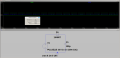
Screenshot from 2024-07-07 20-35-11.pngGreen trace is the output of the switched-mode complete with ripple. Meter will read the average voltage (15.01V)
Blue trace is the voltage after the diode assuming a 100pF input capacitor on the meter.
You can see that the blue voltage is higher than the green, and increasing.
 

MrChips

Joined Oct 2, 2009
34,628
I hope you understand what others have said. There is zero voltage drop measured when there is no load. This has nothing to do with the exponential characteristics of a diode. It is simply Ohm’s Law at play. Zero current gives zero voltage across any resistor.

Add a 1kΩ load and you will be able to measure a voltage across the diode.

As for the apparent voltage increase, put capacitors on both sides of the diode.
 

vu2nan

Joined Sep 11, 2014
357
Hi Sribasu,

I carried out the tests using a low-cost DMM.

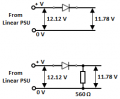
Here are the results.

1.png

Repeating the tests using an SMPS gave the same results ( 12.11 V / 11.77 V).

It's possible that your multimeter is quite sensitive and noise pick-up is causing the erratic reading.

Nandu.
 

MrChips

Joined Oct 2, 2009
34,628
It is not about meter sensitivity.

All multimeters have internal resistance and capacitance. You need to take into account the effect this would have on your measurement.
 

MisterBill2

Joined Jan 23, 2018
27,181
It is also about diode characteristics. A diode current /voltage curve is rather non-linear at very low currents. And certainly a reasonable digital voltmeter or multimeter presents a very low current load.
 

MisterBill2

Joined Jan 23, 2018
27,181
In addition, as has been mentioned, there is definitely noise on the power supply output. The DC meter connected directly reads the average voltage output, while connected thru the diode it reads the peak voltage output. The diode prevents the meter from seeing the average output.
 

WBahn

Joined Mar 31, 2012
32,703
I think the TS might be getting lost in the trees and losing sight of the forest.

You started off saying that you are trying to drop the voltage of your supply. Drop it to what? How much current do you need to deliver at the desired voltage?

Let's focus on solving your actual problem.
 
Top