Facebook
 Google
 GitHub
 Linkedin

Hello,
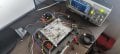
I have built a curve tracer from the Elektor magazine, the January 1996 edition to be specific.
I have two questions:
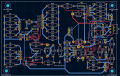
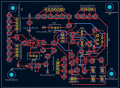
Are my PCB layouts acceptable? I am inclined to go with the SMD version as it is smaller. I know Poly capacitors have better tolerances and better temperature stability. Have I decoupled the power amp OK? I got the capacitance values from the datasheet. I fear oscillation because I initially wanted to use LM1875 but it just kept oscillating. TDA2030 was used instead. Should I go with a ground pour for the board?
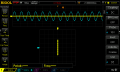
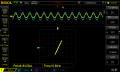
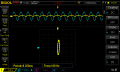
When I leave the leads open, so no component being tested, The curve on the screen is 45 degrees. Can I presume that having built this on a breadboard what I am seeing is the result of the breadboard's capacitive properties? I know building it like this is not a great ideea but I was worried that I might run into issues with the AGC circuit, having substituted the BF245A.
Thank you!
I have built a curve tracer from the Elektor magazine, the January 1996 edition to be specific.
I have two questions:
Are my PCB layouts acceptable? I am inclined to go with the SMD version as it is smaller. I know Poly capacitors have better tolerances and better temperature stability. Have I decoupled the power amp OK? I got the capacitance values from the datasheet. I fear oscillation because I initially wanted to use LM1875 but it just kept oscillating. TDA2030 was used instead. Should I go with a ground pour for the board?
When I leave the leads open, so no component being tested, The curve on the screen is 45 degrees. Can I presume that having built this on a breadboard what I am seeing is the result of the breadboard's capacitive properties? I know building it like this is not a great ideea but I was worried that I might run into issues with the AGC circuit, having substituted the BF245A.
Thank you!
Attachments
-
41.8 KB Views: 19
-
 268.9 KB Views: 22
 -
 250.9 KB Views: 22
 -
 28 KB Views: 14
 -
 31.5 KB Views: 15
 -
 29.7 KB Views: 17
 -
 914.6 KB Views: 18