Facebook
 Google
 GitHub
 Linkedin

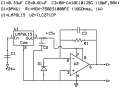
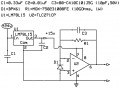
Yes, I am only doing a If/If-Not scenario. I'm not particularly interested in the light's intensity or really the variability of the source as long as it triggers and stays high as long as the light source is present or until I direct otherwise. I've redone the schematic with the LM78L15 device...There is not enough resistance in the ground path on that small, low current board for the current to produce significant voltage changes when the load changes. The LM78L15 has one ground and you will need to give it one or two capacitors to keep it from oscillating. Still, the number of grounds is irrelevant unless you make quite an effort to make the ground traces long and narrow.
If you place the BPX61 directly across pins 2 and 3 of the amplifier, there is no ground circuit involved for an error to be amplified.
MrChips speaks of a, "star" ground where every part which needs a ground has its own conductor to one point, but you have already demonstrated that you have very few problems without knowing of this method. You can re-design it with a star ground shape, but I am hard pressed to understand why you need to fix what is not a problem.
MrChips also speaks of signal to noise ratio. I was under the impression that you are only discovering, "if" or, "if not". Zero or one. You might make this point clear to us.