RMS value calculation

Thread Starter

kalemaxon89

Joined Oct 12, 2022
389
hi k,
Your Inductive load currents are exceeding the d/s rated values

I would suggest as a comparison test that you configure your LTS asc circuit to match the example given in the d/s.
Post when ready and we can compare.

This test circuit has an inductive load, also note the Vboot lower value capacitor.
Also use a PWM frequency as shown in the d/s.

E
View attachment 338082
Shortly hand the .asc file with the replicated circuit.

I notice though one thing in this picture ... the output current generator.
Maybe this is the answer to my question?
That is, to avoid huge values, I put an output current generator of value open to the Imax absorbed by the load.
What do you think?

Thanks
 

Thread Starter

kalemaxon89

Joined Oct 12, 2022
389
hi k,
Your Inductive load currents are exceeding the d/s rated values

I would suggest as a comparison test that you configure your LTS asc circuit to match the example given in the d/s.
Post when ready and we can compare.

This test circuit has an inductive load, also note the Vboot lower value capacitor.
Also use a PWM frequency as shown in the d/s.

E
View attachment 338082
1734345138311.png
 

Attachments

Thread Starter

kalemaxon89

Joined Oct 12, 2022
389
hi k89,
What is the specification of your motor, do you have datasheet?
E
I only know R = 0.022 and L = 46uH.

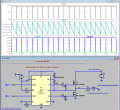
Eventually in the circuit with the EPC2152 I was able to get within the limits of the device by decreasing the duty cycle to 1%:
1734425991568.png

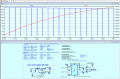
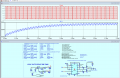
However, this does not happen for example for another gate driver (LTC7061):
This is not "fully integrated" (like the EPC2152) so two external mosfets are needed.
1734426448093.png

I still have doubts about the simulations...
 

Attachments

ericgibbs

Joined Jan 29, 2010
21,455
Hi k,
Your limit of 1% will not give you any control over the motor speed.
It is suggesting that EPC2152 is not suitable for your motor, using the R = 0.022 and L = 46uH. Values.
What exactly is the motor going to drive?

Are you considering the LTC7061 option, also what power supply do you have for these high voltages and currents?

E
 

Thread Starter

kalemaxon89

Joined Oct 12, 2022
389
Hi k,
Your limit of 1% will not give you any control over the motor speed.
It is suggesting that EPC2152 is not suitable for your motor, using the R = 0.022 and L = 46uH. Values.
What exactly is the motor going to drive?

Are you considering the LTC7061 option, also what power supply do you have for these high voltages and currents?

E
The motor (48V, 1kW) does not have to drive anything because I am only interested in simulating the behavior of the gate drivers on one phase of it, and I took as motor specifications what I have at home. By the way R and L were estimated with Texas instrument software and I do not consider it reliable, but that is another matter.

As far as GaN is concerned I found EPC2152 as a goog candidate, but as far as silicon is concerned I could not find (with similar specifications) any gate driver that has already "integrated" also mosfets (as in the casei of EPC2152) .. so I took for example LTC7061.

Therefore I fixed on both the motor resistance and inductance and ran the simulations.

I would like to actually verify in simulation that silicon, as frequency increases, starts to have lower efficiency than GaN
 

nikijones

Joined Dec 16, 2024
2
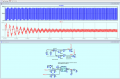
Beyond the whole introduction I made about the project, etc., the question is purely mathematical:
over what interval should I integrate for each frequency?
---------------------------------------------------------LTSpice .asc file------------------------------------------------------------------------------


To determine the interval for integration for each frequency, it depends on the nature of the problem:
  1. For a Continuous Signal: Integrate over one period of the frequency. If the frequency is fff, the period is T=1fT = \frac{1}{f}T=f1, so the interval is [0,T][0, T][0,T].
  2. For Multiple Frequencies: Use the least common multiple (LCM) of all periods to cover a complete cycle where all signals align.
  3. If It’s Fourier Analysis: Integrate over the interval [−π,π][-\pi, \pi][−π,π] or any symmetric interval of length 2π2\pi2π for each frequency component.
Let me know more details if you need further clarification!

Download the model here Spice
 
Last edited by a moderator:

Thread Starter

kalemaxon89

Joined Oct 12, 2022
389
hi k,
I suspect you have the incorrect details for that motor.
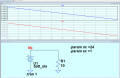
This is a sim with Duty cycle D at 50%
The current in the motor is excessive.
E
View attachment 338177
I suspect that too.

Finally I tried to simulate with the parameters of the Teknic M-2310P-LN-04K synchronous motor: Rs = 0.363 Ω, Ls = 160 µH, Imax = 7 Arms to be sure of a real, existing load.

With duty cycle of 50% the Iout = 64A ... which is obviously too much for the driver

At this point I do not understand, how do I analyze the behavior of the driver if I get these currents despite the fact that I am using a motor that exists. As soon as I increase the Duty Cycle a little bit, the currents are huge.
I don't understand how to proceed in these cases.
 
Last edited:

Thread Starter

kalemaxon89

Joined Oct 12, 2022
389
hi k89,
The results you get with a passive motor equivalent in LTSpice, will not be the same as using an actual dynamic motor load.
Check out this link and other DC motor dynamics
E


https://circuitglobe.com/what-is-back-emf-in-dc-motor.html
I agree, however, it seems strange to me that, for example, I cannot set a threshold (clamp) to the power supply generator in order to prevent it from delivering unrealistic hundreds of amps.

If I wanted to simulate on LTSpice a 48V and 10A battery, how would I do it?
How do I set the current limit?
Maybe on with "if" statement?
 
Top