Hi,
Do you have the datasheet for the EPC, if yes, check the specified device limits.
If you exceed the limits of the device in a real application it would be damaged, LTS simulations will not show any problem.
Redo your simulation to stay within the device limitations, as per the d/s
Yes, I could just rely on the datasheet ... but I also need to simulate on spice this and other drivers at different frequencies and loads. So I'm interested in properly set up a simulation (the .asc file I sent you) at least for one device (EPC2152)
Hi,
Do you have the datasheet for the EPC, if yes, check the specified device limits.
If you exceed the limits of the device in a real application it would be damaged, LTS simulations will not show any problem.
Redo your simulation to stay within the device limitations, as per the d/s
Output is 48V and I want 10A (for example) at the output I could simply put a 4.8 ohm resistor.
Needing also the inductance to simulate the motor, however, things get complicated.
I should then size the impedance (R+jwL) such that I have Iload<15A .. correct?
Because what is not clear to me is how to fit within the limits of the device.
I'm thinking for example to size the load such that for that voltage (48V) it draws a certain current less than the limit on the datasheet. Right?
But the load is not a variable that I can size, it is a constant because it represents the motor I am using.
So I'm not sure how to proceed @MrChips
Don’t add inductance just yet. First solve the discrepancy between LTSpice and Excel.
If you integrate over a very large number of cycles, the error introduced by a partial cycle is minimized. You don’t need to know the number of cycles. Simply divide by the total number of sampled points.
Don’t add inductance just yet. First solve the discrepancy between LTSpice and Excel.
If you integrate over a very large number of cycles, the error introduced by a partial cycle is minimized. You don’t need to know the number of cycles. Simply divide by the total number of sampled points.
hi k89,
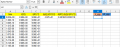
Looking over your spreadsheet equations, could you please explain your logic on how you arrived at these equations, step by step, please, they look a little odd to me.
hi k89,
Looking over your spreadsheet equations, could you please explain your logic on how you arrived at these equations, step by step, please, they look a little odd to me.
You are right, in the Excel I was wrong in taking RMS value of a product.
So I decided now to calculate the RMS of the output current only (out of curiosity)
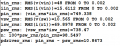
If the formula I used in the Excel is correct, why is I_rms different from I_rms on LTSpice?
I'm sure I must have made a stupid mistake, but I can't find it :/
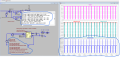
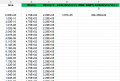
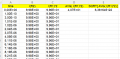
I exported the value of current on load R2, then calculated RMS with excel:
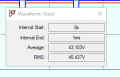
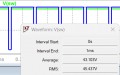
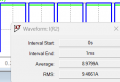
It is different from the one in your screenshot found by LTSpice. I forgot to change the notation from R1 R2 on Excel but it does the same.
hi k,
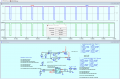
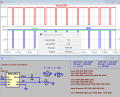
If you are using the LTS plot, pop up label values of V=45.43V * I=9.46A, they give a product of ~430Watts.
Or V^2/4.7R == ( 45.43V ^2)/ 4.7 = 439W
Eff= 430/454 =~ 94.7%
You seem to making the same error as you did on the input Power/Wattage,IE: the values are already in RMS values.
hi k,
If you are using the LTS plot, pop up label values of V=45.43V * I=9.46A, they give a product of ~430Watts.
Or V^2/4.7R == ( 45.43V ^2)/ 4.7 = 439W
Eff= 430/454 =~ 94.7%
You seem to making the same error as you did on the input Power/Wattage,IE: the values are already in RMS values.
Thank you for the clarification, now it's more clear. I will do more testing.
I don't know if I should open another thread or if I can continue here, I would like to take up the discussion we had started in post #44.
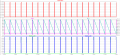
That is, that by adding an inductance to the resistive load, the power increases disproportionately (hundreds of A or even thousands) because of the reactive component.
By the way, the power provided by the power supply (48V dc bus) on LTSpice is also huge because of the infinite current that can be delivered in simulation.
But then how do I truthfully simulate the efficiency of the driver in the case of inductive load like mine?
Is there some kind of clamping that can be done by setting truthful limits?
Are the formulas I used enough? (I attach file below)
..I don't know if I can trust simulated data/plots when there are such unrealistic numbers
I simulated up to 10ms to wait for the end of any intial transients and I start to save data from 8ms to avoid long simulation wait times.
By varying the duty cycle, the situation remains the same
hi k,
Your Inductive load currents are exceeding the d/s rated values
I would suggest as a comparison test that you configure your LTS asc circuit to match the example given in the d/s.
Post when ready and we can compare.
This test circuit has an inductive load, also note the Vboot lower value capacitor.
Also use a PWM frequency as shown in the d/s.

 Facebook
 Google
 GitHub
 Linkedin