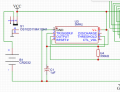
Review Request - CD4017BE and NE555P based LED Chaser

crutschow

Joined Mar 14, 2008
38,322
A few problems:

C1 is upside down.
The (+) polarity goes to the 555 connections.

U2-Pin 8 (Vss) needs to connect to GND.

And I don't think the 555 is operating at 100kHz.

You do know that the circuit will sequentially turn each LED on and then off for one clock-period?
 

Thread Starter

radi8

Joined Oct 18, 2024
24
I am not sure about the 555, but these are the changes I have made. Not exactly sure how vss got disconnected from ground as I remember doing that, but I fixed that. Look better?
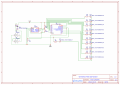
Schematic_Christmas-Tree_2024-10-18.png
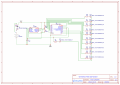
PCB_PCB_Christmas-Tree_2_2024-10-18.png

And yes - I am aware the it'll turn the LEDs on/off one at a time in the sequence.
 

crutschow

Joined Mar 14, 2008
38,322
Look better?
Yes, but I noticed something else.
If you using only one CR2032 battery it will barely light an LED.
Also the battery life will be short.

You need to breadboard this circuit and test it before building a PCB if you haven't already.
A basic design rule is to always breadboard and test a circuit before committing to a PCB design.
Unless you don't mind it being likely that the PCB will require a redesign. :rolleyes:
 

AnalogKid

Joined Aug 1, 2013
12,045
1. Unless I've missed something, there is no path to GND for any of the LEDs. All 11 cathodes are connected together to - nothing.

2. Also, you can eliminate 9 resistors. Because only one 4017 output at a time is high, you can connect the 10 driven LED anodes directly to their 4017 outputs, and have only one resistor from the common cathode net to GND. D9 still needs its own resistor and GND connection. Note that this works for this circuit because Vcc is such a low voltage. If the board were running on 12 V there would be a reverse-breakdown issue.

3. Since the 555 is configured for a nearly 50/50 output duty cycle, there is an alternate astable circuit in the LMC555 datasheet that uses only 1 timing resistor.

4. With a little effort, the layout can be reduced to a single layer. This suggestion comes from back in the day when the difference between single-sided and double-sided was real money.

ak
 
Last edited:

Thread Starter

radi8

Joined Oct 18, 2024
24
Thank you all for the feedback. Changes I've made:
- Switched to 50 Ohms resistors for the LEDs because I realized that they would be pretty dim with 1k (Source)
- Removed the unnecessary resistors + put one between the common cathode & ground
- Connected the cathodes of the LEDs to ground
- Corrected polarity of capacitor
- and
Yes, but I noticed something else.
If you using only one CR2032 battery it will barely light an LED.
Correct me if I'm wrong, but won't the outputs of the 555 timer and CD4017BE be close to supply voltage (3V from the cr2032)? The LEDs I have picked only need a forward voltage of 2V (for the LED on its own) and 2.2V for the sequential LEDs.

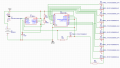
Here's my updated schematic, anyway.
1729284391164.png
 
Last edited:

AnalogKid

Joined Aug 1, 2013
12,045
5. Something else. The R1-R3 timing resistors are such a low value that they are sucking up a constant average current of around 2 mA. You can increase both resistors by 10x or more to get this current way down.

ak
 

Thread Starter

radi8

Joined Oct 18, 2024
24
You can increase both resistors by 10x or more to get this current way down.
If I increase R1 and R3 to 350k and 10k respectively, that would mean the time high would increase to around 2.5 seconds. Are you also suggesting I decrease the capacitor to 1uF?
 

AnalogKid

Joined Aug 1, 2013
12,045
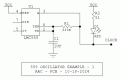
Here is an example of the reduced 555 oscillator circuit. It works with both bipolar and CMOS 555 variants. With a CMOS part, the duty cycle is almost exactly 50/50.

I show the clock LED being driven by the 555 low state because the part can sink much more current when low than it can source when high. This affects how close to the rails the output waveform gets, which can matter sometimes.


Fosc = 1 / ( 1.44 x R1 x C1 )

ak


!!555-Osc-Example-1-c.gif
 

eetech00

Joined Jun 8, 2013
4,704
In addition to using a CMOS timer, you should consider using a 9V battery and low current (2mA), high efficiency LED's.
Then the LEDs can be driven directly by the CD4017B. A 3V supply is very limiting for this application.
You haven't written how fast the LEDs should flash.
 

AnalogKid

Joined Aug 1, 2013
12,045
It is not clear from the layouts which color is the front and which is the back. The board is large enough that you could have a 9 V battery on the back side (opposite the side with the LEDs).

What are the outside dimensions of the board?

ak
 

Thread Starter

radi8

Joined Oct 18, 2024
24
In addition to using a CMOS timer, you should consider using a 9V battery and low current (2mA), high efficiency LED's.
Then the LEDs can be driven directly by the CD4017B. A 3V supply is very limiting for this application.
You haven't written how fast the LEDs should flash.
- That is a potential, but I'm worried about space + price.
- I can certainly choose lower current LEDs, but that means lower brightness, from what I've seen when looking.
- The timing for the 555 should be ~250ms, or as close to it as possible.

The board is large enough that you could have a 9 V battery on the back side (opposite the side with the LEDs).
It's a potential, but like I said, I'm worried about space constraints. What would the cons of 3V (1 coin cell) or 6V (2 coin cells in series) be?

What are the outside dimensions of the board?
70.247 * 149.740mm
 

AnalogKid

Joined Aug 1, 2013
12,045
A single 3 V cell won't last long because the LEDs stop emitting around 1.5 V and will be pretty dim before that. Figure that the LEDs will be too dim to matter for Vcc between 1.5 V and 2.0 V. That leaves an operating battery voltage range of about 1 V:

3.0 Vbat - 1.5 Vf - 0.5 V too dim = 1.0 V

With 2 cells, the "real" operating range of the circuit increases from about 1 V to 4 V.

ak
 

Thread Starter

radi8

Joined Oct 18, 2024
24
Good to know. Also I forgot to say earlier - but the red and blue traces on the PCB images I sent earlier correspond to the top and bottom layers respectively.
On a side note, I have not been able to find any reasonably bright LEDs for anything under 10mA so I think I'm going to stick with the current ones, just choose a slightly different model.
 

eetech00

Joined Jun 8, 2013
4,704
- That is a potential, but I'm worried about space + price.
That is the result of using low voltages....components get more expensive, because they need to be more efficient, with less losses.

- I can certainly choose lower current LEDs, but that means lower brightness, from what I've seen when looking.
Not necessarily....there are high intensity, low current LEDs.
Are the LED's viewed thru a plastic diffuser that covers the "tree"?

- The timing for the 555 should be ~250ms, or as close to it as possible.
250ms? is that between flashes?
Be aware that if you choose 3V supply, then a NE555 won't work. You'll have to use a CMOS timer.
 
Top