Reverse relay? On when off?

ThePanMan

Joined Mar 13, 2020
950
Are AC coils rectified (I've assumed a diode and a smoothing capacitor)?
No, they're not rectified. Nor would you need a diode or cap. Only when using a DC relay should you use a diode. The purpose of the diode is to capture the inductive kickback when DC drops out. The drawing I gave you is horribly basic, but accurate nonetheless. As for voltage sensing - with brown-outs (when power drops but doesn't go completely out) the relay may or may not drop out and switch on the emergency lights. It's been years since I've seen emergency lighting systems but that's pretty basic - power drops completely and the lights come on. In America the standard is that the lights should burn for a minimum of 90 minutes providing sufficient light for someone to find the exit. As for UK standards - I can say nothing on that subject.

Having a transistorized switching system is possible (I would imagine). Would have to give it some thought, but I don't really feel so inclined to do so. Sorry, I'm too busy flying about these days trying to get a business of my own up and running.
 

Thread Starter

BernardCribbins

Joined Jul 12, 2022
28
Ah, then I'm baffled (my ground state). With an AC coil, won't the magnetic flux drop through zero, releasing the trigger, every time the current alternates?
Good point about the diode absorbing any back emf from the coil, I'd forgotten that.
Cheers for your input Man of the Pan, I may try mocking the circuit and seeing how it works, the tranny solution is just beyond me.
 

ThePanMan

Joined Mar 13, 2020
950
Is this an improvement? R1 keeps the coil voltage and current down, and makes the coil more sensitive to a brown-out voltage.
A resistor will improve the sensitivity to voltage but most of the relay's I've messed with seem to have a 70% pull in and a 30% drop out. So if you're using a 240V relay and want it to drop out at - say - 190V (I have no idea if that's a realistic number) and the relay used drops out at 30% of 190V then the resistor has to drop 118 volts. In theory the relay will drop out at 72V, and if you want to drop out when voltage drops to my theoretical 190V you need to drop the other 118 volts through a resistor. To know what resistor you would need you'd first need to know the coil resistance (or reactance, not sure which term is right - if either is right). Once we know the relay's coil current (more confident in that term) then we can determine the proper resistance both in ohms and in watts. If the wattage is up there then getting a variable resistor to dial in the exact drop-out point may be fairly large and not necessarily so cheap.

Do you have brown-outs?
 

ThePanMan

Joined Mar 13, 2020
950
With an AC coil, won't the magnetic flux drop through zero, releasing the trigger, every time the current alternates?
No. For one thing the alternating current changes too rapidly for the relay to drop out. Another point is that the current through an inductor lags the voltage by 90˚ (or precedes it - I often get those two things backwards. Um, current precedes voltage in a cap, so I think in a coil the current lags behind the voltage by 90˚).
 

Thread Starter

BernardCribbins

Joined Jul 12, 2022
28
" Do you have brown-outs? " that is a question for my laundress, and none of your business!!
Oh, I see. No, not usually. Once in a bluey the lights here will flicker and fade slightly, but apart from a telly going haywire nothing has ever stopped working during one of these. I would not want the LEDs kicking in for this, especially if the reset needs to be pressed, as when the light come back on no-one will think of resetting the emergency system!
 

ThePanMan

Joined Mar 13, 2020
950
Transistor: Um - you'd want it to block DC from the lamps, so the transistor would need a rectified current on its base so that it holds the lamp circuit open. When current (mains voltage) drops the base of the transistor needs to be pulled to ground to switch on. So I'm thinking a PNP transistor with the emitter following the battery and the collector connected to the lamps.
 

Thread Starter

BernardCribbins

Joined Jul 12, 2022
28
I take it AC relay coils are designed for unrectified current? I can imagine an annoying 100HZ hum and premature failure (hence the diode cap thingy). Good point about the lagging voltage (or current) though.
 

ThePanMan

Joined Mar 13, 2020
950
" Do you have brown-outs? " that is a question for my laundress, and none of your business!!
Oh, I see. No, not usually. Once in a bluey the lights here will flicker and fade slightly, but apart from a telly going haywire nothing has ever stopped working during one of these. I would not want the LEDs kicking in for this, especially if the reset needs to be pressed, as when the light come back on no-one will think of resetting the emergency system!
Then just using the relay without voltage sensing should work. I don't know if that's a violation of code - so take that with a grain of salt. But flickering would just perhaps cause the emergency lighting to flicker momentarily. But during a full power outage the lights will either burn till the battery is drained (which should become a consideration in the design as well). When power is restored the relay will again pull in and turn the lights off and the charger will recharge the battery.

I don't recall any discussion about the battery you're going to be using, so that's another subject that should be discussed here. Different batteries tolerate different conditions. A lithium based battery doesn't like to be fully drained. Lead acid batteries also don't like being fully drained, but there are some types of batteries called "Deep Cycle" batteries that can tolerate being deeply discharged. However, there are trade-offs in differing batteries. One can tolerate more cycles than the other. So that also needs consideration.
 

ThePanMan

Joined Mar 13, 2020
950
I take it AC relay coils are designed for unrectified current? I can imagine an annoying 100HZ hum and premature failure
AC coils are designed for unrectified current. That's why they're AC coils (Alternating Current). As for hum (60Hz in US) they don't hum. They're quiet. Only if they start to go bad they might chatter or make noise. But I don't think you need to be concerned about that.
 

Thread Starter

BernardCribbins

Joined Jul 12, 2022
28
Is the electricity supply unreliable in the US? We had loads of black-outs in the 1970s but apparently that was the fault of the unions. I'm not sure I've ever experienced a brown out (trousers notwithstanding) before except for brief, occasional lights flickering, but nothing apart from the telly noticed.
 

ThePanMan

Joined Mar 13, 2020
950
US electrical grid can be reliable in some states but unreliable in others. Our infrastructure is in need of serious upgrades. Don't know if you heard about the power outage in Texas during a severe cold snap in Texas. The grid down there was not robust enough to withstand the extreme cold. Senator Ted Cruise was caught trying to sneak off to Cancun during the power failure. Made big news in the states.

Personally I've seen a few blackouts due to wind storms toppling trees on wires. Few years back I lost half the power in my house. US grid in my area supplies 7KVAC single phase power to a split transformer that provides 240VAC with a center tap neutral. Between either leg to neutral we get our 120VAC and from leg to leg we get 240VAC. One of the wires burned completely off the transformer leaving just 120VAC on one of the two legs that feed the house. The power company had to come out and replace the leader wire from the transformer to the line. Several houses were affected.

So if we have severe weather - or in particular, my neighborhood, if the homes use too much power the transformer on the pole that provides power to 16 homes may run hot. In fact, speaking to the linesman who did the repair, he said the tub (transformer) was running on the hot side. That the power company knew they needed to upgrade the transformer. This part of the grid was installed back in the 1960's. Since then homes are using far more power than they did some 80 years ago. And the grid has never been upgraded.

Brown-outs? Don't think I've seen one of those in a very long time. California is known to experience them. Like I said, it depends on where you are for what kind of service you can expect.
 

MisterBill2

Joined Jan 23, 2018
28,126
Yets, a series resistor will work, and also improve the efficiency a bit. If there is a tendency for the relay to buzz the simple fix is another diode across the coil in the opposite direction from the external diode. That works better than a capacitor at stopping the buzz, because during the half cycle when the supply is cut off it allows current to keep flowing, keeping up the magnetism. It is an old trick of mine, it works well, but many people do not believe it.
Now a question: is this emergency lighting package for your personal use? Or in a place with public access? For that there are rules and standards and obnoxious government inspectors who do not think, but only follow a script.
 
Last edited:

Tonyr1084

Joined Sep 24, 2015
9,744
If there is a tendency for the relay to buzz the simple fix is another diode across the coil in the opposite direction from the external diode
Not sure I'm following you Mr Bill. An AC relay should never have a diode across the coil. You DO mention an external diode - but that would rectify the current from AC to DC. I can see a diode across the coil used in that case. And the need for the capacitor to hold the relay during the chopped half cycle. But if the TS is using an AC coil relay then there should be no need for diodes or caps. No need for snubbers if the coil is directly connected to the mains, in this case the 240VAC.

The relay coil as shown by @ThePanMan is how it's done in many professional systems. It works when power fails. When the power goes out the relay drops out and conducts battery voltage to the lights, regardless of LED's or Halogen floods, or whatever light source you're working with. Note: The battery will not power fluorescent lamps.

Pan also has a good point about batteries. Since you said you're using a Lead Acid type battery, choosing a deep cycle battery has the advantage that it can be deeply discharged. However, it's limited in how many times it can be recharged. A simple SLA (Sealed Lead Acid) battery isn't designed for deep discharge but can be recharged more times than a deep cycle battery. The draw back with SLA is that discharging it excessively can lead to battery plate sulfating, which will reduce the batterie's capability to deliver its full current. If you're using LED's then that shouldn't be too big a concern because the LED's draw such low current. But if you're using Halogens then the battery will need to be capable of delivering its full current. Halogens draw more current and will drain the battery faster.

I've had batteries that sulfated but could still light an LED with no issues. But put a heavy load on them and the battery just can't handle the load.

If you choose Lithium Ion (Li-Ion) batteries you'll need a battery management system (BMS) to both control how fast they charge and how deep they can be discharged before the BMS shuts the batteries off. With LED's I'd opt for Li-Ion batteries with the appropriate BMS.
 

MisterBill2

Joined Jan 23, 2018
28,126
With that series diode the relay is no longer getting AC, it is getting half-cycle DC, and operating on unfiltered DC. The second diode, that I suggested, and as I mentioned, allows a current to flow in the other half of the cycle. That is exactly the same thing that happens with a DC relay that has a diode across it, which is a religion among many individuals.
 

MaxHeadRoom

Joined Jul 18, 2013
30,784
The problem I can see is the AC relay will no longer posses the inductive reactance that a AC operated relay does which implies the current may be unpredictable and higher than normal.
Limited by DC resistance only?
 

nsaspook

Joined Aug 27, 2009
16,473
https://forum.allaboutcircuits.com/threads/ac-relay-run-on-dc.85382/post-612731
https://forum.allaboutcircuits.com/attachments/relays-on-the-wrong-ac-dc-pdf.55946/
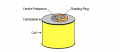
In order to operate a relay from AC, relay manufacturers use a device
known as a shader ring (or shader coil) on top of the core. (See Fig. 2).
Because of the shader ring, the magnetism developed in part of the
core lags somewhat the magnetism of the remainder of the core. That
is, there is a slight phase displacement between the magnetism of part
of the core and the remainder of the core.
1657735434929.png
The AC relay generates a two-phase magnetic field with rotational torque instead of simply alternating.

AC relays are designed to be run efficiently directly from AC, no need for external components.
 
Last edited:

MisterBill2

Joined Jan 23, 2018
28,126
The problem I can see is the AC relay will no longer posses the inductive reactance that a AC operated relay does which implies the current may be unpredictable and higher than normal.
Limited by DC resistance only?
The power will be a bit less, because the magnetic flux collapsing generates the current less effectively than it it were supplied by the mains..My experience has been that the coil still gets warm, but not quite as warm. That is because it is still AC But if a capacitor isused to provide filtered DC, then the power dissipated is more than with AC, just from a different supply. So it is not "an AC relay running on DC."
 

MaxHeadRoom

Joined Jul 18, 2013
30,784
The power will be a bit less, because the magnetic flux collapsing generates the current less effectively than it it were supplied by the mains..My experience has been that the coil still gets warm, but not quite as warm. That is because it is still AC But if a capacitor isused to provide filtered DC, then the power dissipated is more than with AC, just from a different supply. So it is not "an AC relay running on DC."
According to my teaching, AC is present when the current reverses or 'Alternates' every half cycle, a diode prevents this??
Also none, or virtually none, Inductive reactance.
Hence heating.
 

MisterBill2

Joined Jan 23, 2018
28,126
There is ALWAYS heating in relay coils when there is current flow. But consider now that the TS has also added a series resistor to reduce the coil voltage. In addition, the current flowing through that shunt diode will be less than the current if it were connected to the mains. And consider that while the voltage is not alternating it is still changing. AND practical experience has found slightly less temperature rise.
And exactly like Imentioned when I first suggested this, a lot of people will not believe it.
 
Last edited:
Top