Resonance in an electromagnetic circuit

Thread Starter

dinushadil

Joined Nov 20, 2023
12
Hi guys,
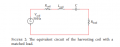
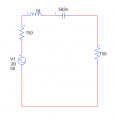
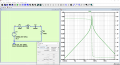
I'm new year and I'm really stuck. I'm doing research about electromagnetic energy harvesting. I have a wound coil and I'm trying to compensate its inductance using a capacitor. The inductance is around 18 H. The coil resistance fluctuates from 150-190 ohms. I tried adding a 562 nF in a 50Hz frequency and connected a load (165 ohms) in series while supplying 20 volts (Diagram attached). According to simulations and calculations, the capacitor should compensate the inductance of the coil and the load resistance should get at least a 10 volt drop if the load matches the coil resistance. However, I can only get a 2-volt output. Any help on this regard would be highly appreciated.
1725556786307.png
1725556862879.png
 

Thread Starter

dinushadil

Joined Nov 20, 2023
12
Hi thanks for the reply. I measured it using an LCR meter. It's huge, I know. It is supposed to, actually, since I'm trying to harvest electromagnetic energy.
 

Papabravo

Joined Feb 24, 2006
22,066
Hi thanks for the reply. I measured it using an LCR meter. It's huge, I know. It is supposed to, actually, since I'm trying to harvest electromagnetic energy.
The values you have chosen are not unique, there are many possible choices for L & C. The square root of 2*π*f, where f is the resonant frequency, may not be the best choice.

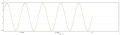
Since, your actual results do not correspond to the simulation or the calculations so I'm guessing you made a mistake in the wiring or the fabrication of the inductor since the capacitors and the resistors are not likely to be home made. NOTE: unlikely is not the same as impossible. With equal resistors your response should be 6 dB down as shown by the simulation below. You have chosen values which will produce a very high Q. That means you have a large reactance at 50 Hz. of 5.65KΩ with respect to the resistance of 150Ω.

How will this configuration help you harvest energy?

1725558871531.png
 

Thread Starter

dinushadil

Joined Nov 20, 2023
12
The inductor is more like a coupler. I wound it myself. When it is in a varying magnetic field (produced by a varying AC current at 50Hz), a voltage is induced between the ends of the coil. I have tested this experimentally and the max open circuit voltage in my case is 25VAC at 50Hz. So I wanted to rectify this voltage. But first I needed to get rid of the reactance. So I used a capacitor in series.

May I know what is the desired db level normally? and how this affects my experiment. Any advice or any literature that might help me is highly appreciated. and thank you so much taking an interest on my problem. Really stuck at a place atm.
 

Papabravo

Joined Feb 24, 2006
22,066
The dB level is set by the two 150Ω resistors. 150Ω is one half of 300Ω. Converting 0.5 to dB we get:

\( 20\times log(1/2)\;=\;20 \times -0.301030\;=\;-6.021\;\text{ dB} \)

What you have described does not match the circuit in your original diagram. That circuit just consumes power and there is none left to harvest. So why don't we start with the actual circuit you want to use and see if there is anything useful about it. How much power is used to create the varying magnetic field? How much coupling is there between that field and your alleged 18H inductor? I hope you are not looking to get something for nothing.
 
Last edited:

Thread Starter

dinushadil

Joined Nov 20, 2023
12
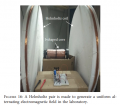
The voltage source in the circuit diagram represents the open circuit-induced voltage. I cannot control the power in the varying magnetic field. It is supposed to be a transmission wire or a any current carrying conductor. Hence, depending on the position of the coupler (The inductor in the circuit) the coupling changes. Attached is a similar setup taken from literature. The Helmholtz coil is used to generate the varying magnetic field in this laboratory setup. However, in reality, the varying magnetic fields cannot be controlled. Only the position of the coil.

1725564735187.png1725564847579.png
 

Papabravo

Joined Feb 24, 2006
22,066
The operation of that setup escapes me. Your schematic should show two inductors. One of them connected to an AC source. The two inductors should be linked by the magnetic field. There seems to be a good deal of difference between your schematic and the actual setup. I don't know how any of this will enable the harvesting of energy. Furthermore, I have no idea how to help you because I can't see much in the way of connections between what you say is your purpose and what you are showing us. I'll give you credit for having some considerable skill as a fabricator.
 

nsaspook

Joined Aug 27, 2009
16,275
The inductor is more like a coupler. I wound it myself. When it is in a varying magnetic field (produced by a varying AC current at 50Hz), a voltage is induced between the ends of the coil. I have tested this experimentally and the max open circuit voltage in my case is 25VAC at 50Hz. So I wanted to rectify this voltage. But first I needed to get rid of the reactance. So I used a capacitor in series.

May I know what is the desired db level normally? and how this affects my experiment. Any advice or any literature that might help me is highly appreciated. and thank you so much taking an interest on my problem. Really stuck at a place atm.
The most you will get will be in the order of a 1mW if you're lucky with this type of Inductive energy receiver. Resonance really does nothing to improve power transfer with line frequency 'energy' harvesting.
https://www.diva-portal.org/smash/get/diva2:931356/FULLTEXT01.pdf

Power Line Induction Energy Harvesting Powering Small Sensor Nodes
 

Thread Starter

dinushadil

Joined Nov 20, 2023
12
The operation of that setup escapes me. Your schematic should show two inductors. One of them connected to an AC source. The two inductors should be linked by the magnetic field. There seems to be a good deal of difference between your schematic and the actual setup. I don't know how any of this will enable the harvesting of energy. Furthermore, I have no idea how to help you because I can't see much in the way of connections between what you say is your purpose and what you are showing us. I'll give you credit for having some considerable skill as a fabricator.
I understand what you are saying. But the other inductor is not required in this circuit to acheive resonance right? I just want achieve resonance in the circuit that I have mentioned and get a 10V output. That's my target. Anyway thank you very much for your suggestions and concern.
 

Thread Starter

dinushadil

Joined Nov 20, 2023
12
The most you will get will be in the order of a 1mW if you're lucky with this type of Inductive energy receiver. Resonance really does nothing to improve power transfer with line frequency 'energy' harvesting.
https://www.diva-portal.org/smash/get/diva2:931356/FULLTEXT01.pdf

Power Line Induction Energy Harvesting Powering Small Sensor Nodes
Thank you for your reply. Actually resonance will help me reduce the circuit's reactance and improve the power output. There are several research that have achieved more than 500mW from the setup I mentioned.
 

Papabravo

Joined Feb 24, 2006
22,066
Thank you for your reply. Actually resonance will help me reduce the circuit's reactance and improve the power output. There are several research that have achieved more than 500mW from the setup I mentioned.
I'm glad you think you are on to something, but you have totally failed to explain what it is you are doing or why. You cite research papers and others cite alternate viewpoints. I'm not sufficiently persuaded that there is anything worthwhile in what y'all are doing to delve further.
 

nsaspook

Joined Aug 27, 2009
16,275
Thank you for your reply. Actually resonance will help me reduce the circuit's reactance and improve the power output. There are several research that have achieved more than 500mW from the setup I mentioned.
Sure, I can get 500mW of free (stolen) power from the utility line from a tuned coil on my desk. Just keep adding coils until it runs the entire house.

Good luck with that. ;)
 
Last edited:

MrAl

Joined Jun 17, 2014
13,686
Hi guys,
I'm new year and I'm really stuck. I'm doing research about electromagnetic energy harvesting. I have a wound coil and I'm trying to compensate its inductance using a capacitor. The inductance is around 18 H. The coil resistance fluctuates from 150-190 ohms. I tried adding a 562 nF in a 50Hz frequency and connected a load (165 ohms) in series while supplying 20 volts (Diagram attached). According to simulations and calculations, the capacitor should compensate the inductance of the coil and the load resistance should get at least a 10 volt drop if the load matches the coil resistance. However, I can only get a 2-volt output. Any help on this regard would be highly appreciated.

View attachment 331009
View attachment 331010
Hi,

The more accurate cap value is 562.895nf which would round to 563nf.
That's not much, but since you are only seeing one-tenth of the output (2v from 20v in) the inductor may be larger than you think.
To see 2 volts on the output the inductor would have to be 22.678 Henries. That means maybe the inductor measurement was not right.

Did you mention what kind of core you are using? That could easily be affecting the readings.
You might try a different method to read the coil also. You should measure it at 50Hz, which could also be tricky.

Funny thing is, in a manner of speaking, this setup already measured the inductor value to be around 22.7 Henries, provided the cap value is accurate (another point to check out). The cap ESR could also have an adverse effect on the measurements.
 
Last edited:

sparky 1

Joined Nov 3, 2018
1,218
Looks correct.
When the Gauss is equal in both the positive and negative current directions and is linear as the current increases
the alignment of a compass placed between the coil pairs will be parallel.

Since the resistance is relative to current the L and C form a series resonant circuit at 50 Hertz
the field at a plane parallel to the coils is also parallel without deflection which is uniform.
 

Thread Starter

dinushadil

Joined Nov 20, 2023
12
Hi,

The more accurate cap value is 562.895nf which would round to 563nf.
That's not much, but since you are only seeing one-tenth of the output (2v from 20v in) the inductor may be larger than you think.
To see 2 volts on the output the inductor would have to be 22.678 Henries. That means maybe the inductor measurement was not right.

Did you mention what kind of core you are using? That could easily be affecting the readings.
You might try a different method to read the coil also. You should measure it at 50Hz, which could also be tricky.

Funny thing is, in a manner of speaking, this setup already measured the inductor value to be around 22.7 Henries, provided the cap value is accurate (another point to check out). The cap ESR could also have an adverse effect on the measurements.
Thank you for the reply. I'm using a MnZn ferrite core which has high relative permeability (3000). I used several LCR meters to measure the coil inductance at 50Hz. But the inductance was similar. Slight changes of a few milli henries.
 

Thread Starter

dinushadil

Joined Nov 20, 2023
12
Looks correct.
When the Gauss is equal in both the positive and negative current directions and is linear as the current increases
the alignment of a compass placed between the coil pairs will be parallel.

Since the resistance is relative to current the L and C form a series resonant circuit at 50 Hertz
the field at a plane parallel to the coils is also parallel without deflection which is uniform.
Thanks for the reply. Do you meant the output voltage of 2 volts is correct in my case?
 

Papabravo

Joined Feb 24, 2006
22,066
I think his goal is to extract power from a transmission line.

Possibly, that is because he is trying to steal power from power transmission lines.
AFAIK, there is nothing wrong with that, but it is fairly well known that the efficiency of the process is really poor. So a whole lot of effort for a vanishinly small return. Sounds like the same business opportunity as selling shovels to miners on the way to the Klondike.
 

MrAl

Joined Jun 17, 2014
13,686
Thank you for the reply. I'm using a MnZn ferrite core which has high relative permeability (3000). I used several LCR meters to measure the coil inductance at 50Hz. But the inductance was similar. Slight changes of a few milli henries.
Ok then it could be that the excitation currents are different for the LCR meters than in the actual circuit. You 'might' be able to apply a DC offset to the inductor to see if you can get the inductance to change.
The only thing that is hard to understand is what the core is doing for each type of test. It's such a huge inductance too. Cores that are not air have some unusual characteristics. The permeability could change quite a bit as you go from 1ma AC to 10 amps AC for example, and if you vary the DC offset it will change with that also.

Is there any easy way you could reduce the inductance in your inductor? You could try reducing it anyway. I assume you double checked the cap value also.
 
Top