resonance causes peak in transfer function question

Thread Starter

yef smith

Joined Aug 2, 2020
1,445
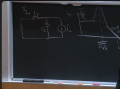
Hello, given the situation described in the photo at 12:48 is when we in the filter LC resonance then we get a huge spike in the transfer function.
Why is that? tha formal definition is shown below.
How can I know intuitivly that resonance causes a spike?

A spike can be when Ix is much larger then Iy?why I happened?

"Resonance in electronics occurs in circuits containing inductors (L) and capacitors (C) when inductive reactance equals capacitive reactance
at a specific frequency, forcing the imaginary impedance component to zero.
1773606232269.png
 

Papabravo

Joined Feb 24, 2006
22,058
It is because the expression for capacitive reactance introduces a negative sign, and when the reactances add up to near zero the "AC" load load falls to a very small value producing a large, frequency dependent gain in the transfer function.

\( X_C\;=\;\cfrac{1}{j \omega C}\times\cfrac{j}{j}\;=\;\cfrac{j}{j^2 \omega C}\;=\;-\cfrac{j}{\omega C} \)
 

crutschow

Joined Mar 14, 2008
38,316
Basically at the LC resonance frequency, the the sum of the two reactive impedances drops to zero so the only thing determining the current is any series resistance in the circuit.
 

LvW

Joined Jun 13, 2013
1,994
I think, the video does explain the situation - in particular the peak - not very well.
He is mentioning the term "resonance" - and draws a peak. Thats all.
But the explanation sis very simple when we analyse the current division between both parts.
The current from the current source Io is divided between the L- and the C-path.
And he considers the L-Path with the current Iy ony.

Therefore, current division:
Iy=Io*(1/jwC) / [(1/jwc) + jwL]=Io / jwC*[(1/jwc) + jwL]=Io / (1-w²LC).

As we see, around the frequency of resonance (wo=SQRT(1/LC) the denominator becomes very small - in this ideal circuit without any damping it becomes even zero. That explains the peak.
 

MisterBill2

Joined Jan 23, 2018
27,159
It is because the expression for capacitive reactance introduces a negative sign, and when the reactances add up to near zero the "AC" load load falls to a very small value producing a large, frequency dependent gain in the transfer function.

\( X_C\;=\;\cfrac{1}{j \omega C}\times\cfrac{j}{j}\;=\;\cfrac{j}{j^2 \omega C}\;=\;-\cfrac{j}{\omega C} \)
What is shown is a SERIES RESONANT CIRCUIT, with the reactances being out of phase and thus cancelling. The action of a PARALLEL resonant circuit is quite different. THAT is the reason I mentioned it.
 

Thread Starter

yef smith

Joined Aug 2, 2020
1,445
what about the intution the both L and C are open circuit in resonance and we are drawing current from open circuit, does it sound familiar?
why is that?
Thanks.
 

MisterBill2

Joined Jan 23, 2018
27,159
L and C in series: Short circuit at w=wo
L and C in parallel: Open circuit at w=wo.
Not quite "shorted circuit", because the resistive elemen is still present. Always! "Resonance" implies that the inductive reactance and the capacitive reactance terms (portions) cancel. THAT is quite different than an actual "short" circuit, which to me implies a zero resistance. But certainly other opinions and uses may not agree.
In any tuned circuit, tghe "Q" factor is also relevent. But that term is seldom discussed in any detail in the first, or even second "A.C. CIRCUIT THEORY" classes. BUT it does matter quite a bit.
 

LvW

Joined Jun 13, 2013
1,994
Not quite "shorted circuit", because the resistive elemen is still present. Always!
Yes - I know that some resistive losses are always present.
However, while using the symbols "L" and "C" I assume, of course, ideal elements.
I think, these abbreviations are reserved for ideal quantities.
Remember - "L" is given in Henry and "C" is given in Farad.
Both units contain no loss resistancs.

Otherwise, I should use the words for the real parts "coil" or "capacitor".
 

Thread Starter

yef smith

Joined Aug 2, 2020
1,445
Hello, given they words below how can we know that there going to be a peak physically?
Thanks.

"
L and C in series: Short circuit at w=wo
L and C in parallel: Open circuit at w=wo. "
 

crutschow

Joined Mar 14, 2008
38,316
Hello, given they words below how can we know that there going to be a peak physically?
Thanks.

"
L and C in series: Short circuit at w=wo
L and C in parallel: Open circuit at w=wo. "
Your questions are approaching troll level.

If you understood Ohm's law, then the answer would be apparent.
 

Thread Starter

yef smith

Joined Aug 2, 2020
1,445
Hello crutshow sorry I just wanted to know why drawing current from open circuit is equivalent to spike.
mathematickally I understand why its happening.
Thanks again you are very helpfull.
 

LvW

Joined Jun 13, 2013
1,994
Hello, given they words below how can we know that there going to be a peak physically?
Thanks.

"
L and C in series: Short circuit at w=wo
L and C in parallel: Open circuit at w=wo. "
The answer is simple.
It depens which kind of"peak" we are speaking of:
Which voltage or which current ?
(By the way - in the video (post#1) there is a loss resistor. See the horizontal line for very low frequencies)
 

LvW

Joined Jun 13, 2013
1,994
... I just wanted to know why drawing current from open circuit is equivalent to spike.
mathematickally I understand why its happening.
yef smith - here is my recommendation: Forget the video.
It is unrealistic and misleading (as your problems show).
Why unrealistic?
The video shows the ratio of two currents vs. frequency:
The current through one of the (idealized) parts referenced to a constant current source.
Such a current source does not exist in reality.
And therefore your question:
What happens when a constant current source is connected to a circuit which has an infinite input resistance at f=fo ?

There are only voltage sources with a large source resistance (Rs) which can be treated as a nearly constant current source - as long as the load RL is small against Rs (RS>>RL).
And this is NOT the case for this circuit (L||C) at f=fo,

When you want to understand whats happening during resonance, it is best to imagine the following system:
A voltage source Vin is connected to a series combination of an ohmic resistor Rs and an ideal tank circuit (that is a L||C combination). This resembles a classical passive bandpass flter.

* For very low and very high frequencies, the voltage Vout across the tank circuit is low (nearly zero);
* At f=fo the total resistance of the L||C combination approaches infinity (ideal case) and there will be no current into the whole circuit. As the result, the voltage Vout is identical to Vin showing the resonant peak at f=fo.

Comment: Of course, there are no ideal parts like L and C because - in reality - we always have losses.
These losses can be modelled as a small resistor Rx in series with L and a large resistor Ry in parallel to C.
However, for demonstrating the resonance effect ii is sufficient to consider the idealized situation without Rx and ry.
 
Last edited:

MrAl

Joined Jun 17, 2014
13,667
Not quite "shorted circuit", because the resistive elemen is still present. Always! "Resonance" implies that the inductive reactance and the capacitive reactance terms (portions) cancel. THAT is quite different than an actual "short" circuit, which to me implies a zero resistance. But certainly other opinions and uses may not agree.
In any tuned circuit, tghe "Q" factor is also relevent. But that term is seldom discussed in any detail in the first, or even second "A.C. CIRCUIT THEORY" classes. BUT it does matter quite a bit.
Hi,

When we do a calculation like that we take L and C to be ideal, and because there is no "R" there is no resistance. At physical resonance, the L and C become equal to a resistance of zero Ohms. In real life that would probably be rare, but in theory it is always taken just like that, zero. That's so that it makes it simpler to understand the underlying mechanism.

For a series L and C we end up with:
Z=j*w*L-j/(w*C)

and when we set w=1/sqrt(L*C) we get exactly:
Z=0

It might not be true in real life, but in theory it is exactly zero.

This makes it easier to understand so that when we DO add resistance:
Z=j*w*L-j/(w*C)+R

we can quickly understand that since the two imaginary terms cancel, we end up with:
Z=R

which is then considered an ideal resistance.

The other way of looking at it is that the two imaginary terms cancel, so we set the imaginary terms to zero and we again get Z=R.
 

MrAl

Joined Jun 17, 2014
13,667
Hello, given the situation described in the photo at 12:48 is when we in the filter LC resonance then we get a huge spike in the transfer function.
Why is that? tha formal definition is shown below.
How can I know intuitivly that resonance causes a spike?

A spike can be when Ix is much larger then Iy?why I happened?

"Resonance in electronics occurs in circuits containing inductors (L) and capacitors (C) when inductive reactance equals capacitive reactance
at a specific frequency, forcing the imaginary impedance component to zero.

View attachment 364692
Hi,

To get an intuitive idea how this works I would suggest looking at the response in the complex plane. You may or may not like that route but that's about what it comes down to. Each case will be different, and sometimes you will see a 'valley' not a 'spike', and depending on other circuit elements it could be a low or high spike, or a deep or shallow valley.

The way a lot of folks do this is they calculate the transfer function, then set the imaginary part to zero, then solve for the amplitude. However, that usually brings out just the physical resonance. There is also the possibility of a 'spike' or 'valley' without seeing physical resonance. To see that, you have to play with the transfer function a little. One way is to take the derivative with respect to 'w' (or 'f') and set that equal to zero and then solve for 'w' (or 'f'). That gives you the possible peak points, which may or may not be when the circuit is in physical resonance. It's considered physical resonance if the imaginary part is zero when the peak occurs.

So you solve for the transfer function T(w), then take the derivative and set it to zero:
dT(w)/dw=0

then solve that, then check for peaks or valleys using all solutions, then you can check if the imaginary part is zero or not for each solution.

We could look at an example if you like.
 

LvW

Joined Jun 13, 2013
1,994
Hi,

When we do a calculation like that we take L and C to be ideal, and because there is no "R" there is no resistance. At physical resonance, the L and C become equal to a resistance of zero Ohms.
Zero Ohms?
Looking into the circuit (shwon in the video) I see a PARALLEL connection of both elements (L and C), am I wrong?
 
Top