Cancel generator counter magnetic torque by adding series capacitor in resonance to rotor coil

Thread Starter

Stoyan.Nikolov.2Induction

Joined Nov 26, 2023
44
Hello,
Is it convenient to ask a question about this article:

----------------------------------------------------------------------------
https://sciencedemonstrations.fas.harva ... ive-phases
More speciffic :
Case 1:
-------------------------------------------------------------------------
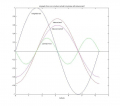
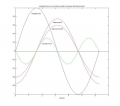
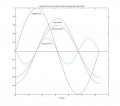
1) At resonance, the phasor representations of the inductive and capacitive reactances are equal in magnitude and 180˚ out of phase with each other. Thus the total impedance of the circuit is purely resistive and the current is in phase with the emf. The following graphic depicts the phase relationships between the various parameters, including the Lorentz force on the current in the coil. Since the Lorentz force is equal to the cross product of the current and magnetic field, the graph was generated by simply taking the product of the induced current graph and the magnetic flux graph. [Note that the magnetic field from the iron core actually diverges and the interaction responsible for pushing the coil longitudinally is with the radial component of the magnetic field through the coil; the longitudinal component generates the emf.]


The vertical scale is arbitrary, but nevertheless, one can see that the net force on the coil is zero in one complete cycle of the magnetic flux—it is as much negative as it is positive. When an appropriate capacitor is connected across the coil to make the circuit's resonance frequency equal to 60 Hz, the current is in phase with the emf and the coil is neither attracted to nor repelled by the magnetic field. [As a side note, this is exactly the reason why simply invoking Lenz's Law is not enough to explain the action of the Ring Flinger demonstration.]
-------------------------------------------------------------------------
----------------------------------------------------------------------------


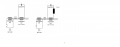
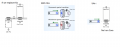
If we replace the primary coil with AC source from this picture :

09082025 -1.png (27.7KiB)
With permanent magnet like linear generator configuration:

Does it means that there is no repulsive force :


I mean if we approach and move away the magnet to secondary coil in resonance state (so that the frequency dPhi/dt is with the frequency F and LC of the scondary coil is at resonance with that frequency).

Thank you.
09082025 -2.png (145.58KiB)


I mean if we oscilate the magnet back and forth at resonant frequency.
 

MrAl

Joined Jun 17, 2014
13,680
Hello,
Is it convenient to ask a question about this article:

----------------------------------------------------------------------------
https://sciencedemonstrations.fas.harva ... ive-phases
More speciffic :
Case 1:
-------------------------------------------------------------------------
1) At resonance, the phasor representations of the inductive and capacitive reactances are equal in magnitude and 180˚ out of phase with each other. Thus the total impedance of the circuit is purely resistive and the current is in phase with the emf. The following graphic depicts the phase relationships between the various parameters, including the Lorentz force on the current in the coil. Since the Lorentz force is equal to the cross product of the current and magnetic field, the graph was generated by simply taking the product of the induced current graph and the magnetic flux graph. [Note that the magnetic field from the iron core actually diverges and the interaction responsible for pushing the coil longitudinally is with the radial component of the magnetic field through the coil; the longitudinal component generates the emf.]


The vertical scale is arbitrary, but nevertheless, one can see that the net force on the coil is zero in one complete cycle of the magnetic flux—it is as much negative as it is positive. When an appropriate capacitor is connected across the coil to make the circuit's resonance frequency equal to 60 Hz, the current is in phase with the emf and the coil is neither attracted to nor repelled by the magnetic field. [As a side note, this is exactly the reason why simply invoking Lenz's Law is not enough to explain the action of the Ring Flinger demonstration.]
-------------------------------------------------------------------------
----------------------------------------------------------------------------


If we replace the primary coil with AC source from this picture :

09082025 -1.png (27.7KiB)
With permanent magnet like linear generator configuration:

Does it means that there is no repulsive force :


I mean if we approach and move away the magnet to secondary coil in resonance state (so that the frequency dPhi/dt is with the frequency F and LC of the scondary coil is at resonance with that frequency).

Thank you.
09082025 -2.png (145.58KiB)


I mean if we oscilate the magnet back and forth at resonant frequency.
Doesn't it depend on how you move the magnet? If you move it back and forth in antiphase, you can probably cancel the other force, provided it's the same strength and the amplitude of the force exactly opposes the original force. If you move it in phase, it will increase the force both pushing and pulling.
If you keep the magnetic steady, you can get the force to stay either one way or the other if the magnet is strong enough.
This also assumes you can get good coupling between the magnet and the core, and the core does not saturate.

This is if I understand what you are doing correctly.
 

Thread Starter

Stoyan.Nikolov.2Induction

Joined Nov 26, 2023
44
Doesn't it depend on how you move the magnet? If you move it back and forth in antiphase, you can probably cancel the other force, provided it's the same strength and the amplitude of the force exactly opposes the original force. If you move it in phase, it will increase the force both pushing and pulling.
If you keep the magnetic steady, you can get the force to stay either one way or the other if the magnet is strong enough.
This also assumes you can get good coupling between the magnet and the core, and the core does not saturate.

This is if I understand what you are doing correctly.
Thank you.
I mean if we replace the AC source with Permanent magnet that moves back and forth (Linear generator configuration )
Can we cancel opposing (to magnet moving back and forth) force to magnet movement.
If the movement of the magnet (back and forth) is at resonance frequency of the secondary coil.

CoilPMLenz.png
 

MrAl

Joined Jun 17, 2014
13,680
Thank you.
I mean if we replace the AC source with Permanent magnet that moves back and forth (Linear generator configuration )
Can we cancel opposing (to magnet moving back and forth) force to magnet movement.
If the movement of the magnet (back and forth) is at resonance frequency of the secondary coil.

View attachment 354139
Well in theory I would think it would work, but in practice it may be very hard to get it coupled to the core well enough. I don't know, maybe a cylindrical magnet riding in and out of tube at the end. You'd have to figure out how the motion should be done. It may have t be something other than a sine wave. Another idea might be to spin a magnet at the end and that may generate a sine wave, but it may have to be modified also to get a perfect sine. In short, you'd have to figure out the movement function given some magnet shape and mounting scheme. You should get something out of it though.
Is this for a hand generator or something else?
 

Thread Starter

Stoyan.Nikolov.2Induction

Joined Nov 26, 2023
44
Well in theory I would think it would work, but in practice it may be very hard to get it coupled to the core well enough. I don't know, maybe a cylindrical magnet riding in and out of tube at the end. You'd have to figure out how the motion should be done. It may have t be something other than a sine wave. Another idea might be to spin a magnet at the end and that may generate a sine wave, but it may have to be modified also. In short, you'd have to figure out the movement function given some magnet shape and mounting scheme. You should get something out of it though.
Is this for a hand generator or something else?
Thank you again. Lets consider only theoretical/concept side of the question. Only concept/basic side. Ideal situation/setup and so on. Perhaps the real setup will be much different and complicated. So thats why lets consider only concept/basic/ideal setup.
The movement of the magnet back and forth has sinewave like distance/time distribution.
 
Last edited:

MrAl

Joined Jun 17, 2014
13,680
Thank you again. Lets consider only theoretical/concept side of the question. Only concept/basic side. Ideal situation/setup and so on. Perhaps the real setup will be much different and complicated. So thats why lets consider only concept/basic/ideal setup.
The movement of the magnet back and forth has sinewave like distance/time distribution.
Well in theory that sounds right. In practice it would require investigating the actual function from the physical movement to the desired magnetic effect. This is still theory until you go to do it and I don't think it can be ignored except in the case of a possible allowable low accuracy and higher harmonics.

If you apply a forcing function f(t) and you get a response of g(t), then you have to map f(t) to g(t) so you can create a new forcing function so it will compensate for the irregularities.
For example, if we move the magnet back and forth in a sinewave fashion, that does not mean that the magnetic effect will vary in a sine wave fashion. In fact, there could be a squared or cubed dependency in the denominator. This would require compensation with a mapping function to get from the distorted field to a sinusoidal varying field with a square or cube in the numerator, for one.

If you don't mind the higher harmonics though then you may get away without any corrective movement function.

A 'possible' fix would be to measure the field and use feedback to correct the motion rather than use a forward feed compensator. You'd have to deal with physical compliance and issues like that, meaning you may need a very robust mechanical motion system.

Is it possible for you to elaborate on why you want to do this? It might be interesting for others too.
 
Last edited:

Danko

Joined Nov 22, 2017
2,153
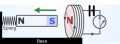
1. Spring compensates constant force between magnet and coil's magnetic core (if exist).
2. Mechanical resonance frequency of system magnet + spring equal to resonance frequency
of coil + capacitor and is tuned by selecting mass of magnet.
1755087672286.png

ADDED:
1. Capacitor-assisted excitation of permanent-magnet generators
"Abstract
Voltage regulation can restrict the useful capacity of permanent-magnet generators. Wind power applications are acutely affected because of the cubic variation of power with speed. The solution adopted for a new form of modular permanent-magnet wind turbine generator was to employ a capacitor connected across the generator AC terminals providing additional excitation due to the capacitive current flowing in the stator coils. The resulting circuit displays unusual characteristics and its analysis must take account of nonlinearities introduced by rectifier loading, magnetic saturation and saliency of the permanent-magnet excitation system. The paper describes the circuit configuration adopted and its analysis by methods ranging from a linearised first approximation to a complete numerical simulation. The theoretical studies are supported by experimental results. Part of the analysis is arranged to assist the designer in the selection of capacitance."


2. A VERY HIGH SPEED SWITCHED RELUCTANCE GENERATOR
"When capacitors are connected to the machine, a resonance circuit is formed due to continuous energy exchange between the electric field (capacitor) and the magnetic field (machine). As the load varies randomly, the capacitor and control resistances must be varied to obtain the desired voltage and frequency regulation. Self regulation may be possible using an auxiliary stator winding with a shunt capacitor and a series capacitor with the main winding [100]. However, all the above solutions require an additional network. For aerospace applications, in particular, cascade connected induction machines were considered for aircraft generation due to their reliability."
 
Last edited:

Thread Starter

Stoyan.Nikolov.2Induction

Joined Nov 26, 2023
44
Well in theory that sounds right. In practice it would require investigating the actual function from the physical movement to the desired magnetic effect. This is still theory until you go to do it and I don't think it can be ignored except in the case of a possible allowable low accuracy and higher harmonics.

If you apply a forcing function f(t) and you get a response of g(t), then you have to map f(t) to g(t) so you can create a new forcing function so it will compensate for the irregularities.
For example, if we move the magnet back and forth in a sinewave fashion, that does not mean that the magnetic effect will vary in a sine wave fashion. In fact, there could be a squared or cubed dependency in the denominator. This would require compensation with a mapping function to get from the distorted field to a sinusoidal varying field with a square or cube in the numerator, for one.

If you don't mind the higher harmonics though then you may get away without any corrective movement function.

A 'possible' fix would be to measure the field and use feedback to correct the motion rather than use a forward feed compensator. You'd have to deal with physical compliance and issues like that, meaning you may need a very robust mechanical motion system.

Is it possible for you to elaborate on why you want to do this? It might be interesting for others too.
Lets say that the magnet is moving back and forth in such a way, that the varying magnetic field through secondary coil (with resonance capacitor in series) is of sinewave waveform. The frequency of this sinewaveform , match the resonance frequency of secondary coil (with capacitor(s)).

Only in theory please. Simplified case. Maybe the real device will be discussed in other topic. I dont want to end with over forty pages of conceptual designs proposals and (unclear/uncertain) discussions whether they are going to work or not..
 
Last edited:

MrAl

Joined Jun 17, 2014
13,680
Lets say that the magnet is moving back and forth in such a way, that the varying magnetic field through secondary coil (with resonance capacitor in series) is of sinewave waveform. The frequency of this sinewaveform , match the resonance frequency of secondary coil (with capacitor(s)).

Only in theory please. Simplified case. Maybe the real device will be discussed in other topic. I dont want to end with over forty pages of conceptual designs proposals and (unclear/uncertain) discussions whether they are going to work or not..
Oh ok I see what you mean now. You mean that you have already attained the means to move the magnetic back and forth such that you actually do get the flux function exactly correct so you get a sine wave in the secondary coil.

I did not address this because I have to say I thought that would be too simple of a 'problem'. If your frequency generator can generate a sine wave in the secondary coil through a flux generated by a primary coil, then what do you expect to change if 'something else' generates the same flux.
If the changing gravitational pull of the moon was conditioned by the right transformation to the correct flux change, then we'd also get a sine wave in the secondary coil (if the frequency was very low and the core was of the right dimensions, etc.). In other words, if you can get a sine wave in the secondary coil then you've already gotten what you want, so there seem to be nothing to figure out.
It's almost like saying, "If I get a sine wave in my secondary coil then how do I get a sine wave in my secondary coil".
Maybe you meant something else? Maybe I do not understand your question yet.
 

Thread Starter

Stoyan.Nikolov.2Induction

Joined Nov 26, 2023
44
Oh ok I see what you mean now. You mean that you have already attained the means to move the magnetic back and forth such that you actually do get the flux function exactly correct so you get a sine wave in the secondary coil.

I did not address this because I have to say I thought that would be too simple of a 'problem'. If your frequency generator can generate a sine wave in the secondary coil through a flux generated by a primary coil, then what do you expect to change if 'something else' generates the same flux.
If the changing gravitational pull of the moon was conditioned by the right transformation to the correct flux change, then we'd also get a sine wave in the secondary coil (if the frequency was very low and the core was of the right dimensions, etc.). In other words, if you can get a sine wave in the secondary coil then you've already gotten what you want, so there seem to be nothing to figure out.
It's almost like saying, "If I get a sine wave in my secondary coil then how do I get a sine wave in my secondary coil".
Maybe you meant something else? Maybe I do not understand your question yet.
GeneratorLoad.png

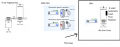
The point of my question was . Is it possible (in ideal situation) to achieve in the case shown with arrow in the above picture
Same situation with no repulsive/attractive forces as original situation with 120 V Ac Source?

-------------------------------------------------------------------------------------------------------------------------------
the magnet is moving back and forth in such a way, that the varying magnetic field through secondary coil (with resonance capacitor in series) is of sinewave waveform. The frequency of this sinewaveform , match the resonance frequency of secondary coil (with capacitor(s)).
 

Amay123

Joined Aug 14, 2025
1
Hello,
Is it convenient to ask a question about this article:

----------------------------------------------------------------------------
https://sciencedemonstrations.fas.harva ... ive-phases
More speciffic :
Case 1:
-------------------------------------------------------------------------
1) At resonance, the phasor representations of the inductive and capacitive reactances are equal in magnitude and 180˚ out of phase with each other. Thus the total impedance of the circuit is purely resistive and the current is in phase with the emf. The following graphic depicts the phase relationships between the various parameters, including the Lorentz force on the current in the coil. Since the Lorentz force is equal to the cross product of the current and magnetic field, the graph was generated by simply taking the product of the induced current graph and the magnetic flux graph. [Note that the magnetic field from the iron core actually diverges and the interaction responsible for pushing the coil longitudinally is with the radial component of the magnetic field through the coil; the longitudinal component generates the emf.]


The vertical scale is arbitrary, but nevertheless, one can see that the net force on the coil is zero in one complete cycle of the magnetic flux—it is as much negative as it is positive. When an appropriate capacitor is connected across the coil to make the circuit's resonance frequency equal to 60 Hz, the current is in phase with the emf and the coil is neither attracted to nor repelled by the magnetic field. [As a side note, this is exactly the reason why simply invoking Lenz's Law is not enough to explain the action of the Ring Flinger demonstration.]
-------------------------------------------------------------------------
----------------------------------------------------------------------------


If we replace the primary coil with AC source from this picture :

09082025 -1.png (27.7KiB)
With permanent magnet like linear generator configuration:

Does it means that there is no repulsive force :


I mean if we approach and move away the magnet to secondary coil in resonance state (so that the frequency dPhi/dt is with the frequency F and LC of the scondary coil is at resonance with that frequency).

Thank you.
09082025 -2.png (145.58KiB)


I mean if we oscilate the magnet back and forth at resonant frequency. If you want to earn money from home just by playing games, you should give this a try M WIN
Yes, if you oscillate a magnet near a secondary coil that’s tuned to resonance, there will be no net repulsive or attractive force over a full cycle.

At resonance, the current is in phase with the emf, so the Lorentz force (I × B) is symmetrical — positive and negative forces cancel out. You may get momentary forces during the cycle, but they average to zero.

So, just like in the article, no net push or pull occurs when the system is resonating
 

MrAl

Joined Jun 17, 2014
13,680
View attachment 354192

The point of my question was . Is it possible (in ideal situation) to achieve in the case shown with arrow in the above picture
Same situation with no repulsive/attractive forces as original situation with 120 V Ac Source?

-------------------------------------------------------------------------------------------------------------------------------
the magnet is moving back and forth in such a way, that the varying magnetic field through secondary coil (with resonance capacitor in series) is of sinewave waveform. The frequency of this sinewaveform , match the resonance frequency of secondary coil (with capacitor(s)).
So you are more concerned with the forces between the magnet and the core (or coil)?
The core is magnetically active which means it would react strongly with a magnetic field, and that would have a force associated with it. The properties of the core would play a big part in the transfer of energy because the coupling would increase dramatically. In a real system though there would always be losses even with zero resistance R.

Without a core the coil reacts to the magnet creating a field that reacts with the magnet in a way that resists the movement of the magnet.
Now with the system in resonance and with no resistance (R in your drawing) there would eventually be no losses so there would be no new energy entering into the system. The coil would resist the movement of the magnet sometimes and aid the movement other times. There would be instantaneous forces, but the net force would be zero.
Add a resistance into the system like that R in the drawing and everything changes. That means that at least some energy must transfer from the magnet to the coil in order to constantly feed the resistance with energy. That means the net force can not be zero, and that would be because the inductance and capacitance can no longer aid in the magnets movement as well as with no resistance, so new energy has to be constantly added to the magnet motion which implies that there will be a non-zero net force.

In the above we looked at the case with no resistances in the entire system whatsoever, then introduced a single resistance R to see what changes.

I think I understand your question now but I have to wonder what made you ask this question. It is interesting in any case.
 

Thread Starter

Stoyan.Nikolov.2Induction

Joined Nov 26, 2023
44
Hello and thank you for reply.

--------------------------------------------
the magnet is moving back and forth in such a way, that the varying magnetic field through secondary coil (with resonance capacitor in series) is of sinewave waveform. The frequency of this sinewaveform , match the resonance frequency of secondary coil (with capacitor(s)).
--------------------------------------------


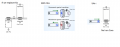
So in caseA there will be no net/average attraction/repulsion

as per

CaseA.png
document https://sciencedemonstrations.fas.harvard.edu/presentations/attractive-and-repulsive-phases
"
(1) At resonance, the phasor representations of the inductive and capacitive reactances are equal in magnitude and 180˚ out of phase with each other.

Thus the total impedance of the circuit is purely resistive

and the current is in phase with the emf. The following graphic depicts the phase relationships between the various parameters, including the Lorentz force on the current in the coil. Since the Lorentz force is equal to the cross product of the current and magnetic field, the graph was generated by simply taking the product of the induced current graph and the magnetic flux graph. [Note that the magnetic field from the iron core actually diverges and the interaction responsible for pushing the coil longitudinally is with the radial component of the magnetic field through the coil; the longitudinal component generates the emf.]
The vertical scale is arbitrary, but nevertheless, one can see that the net force on the coil is zero in one complete cycle of the magnetic flux—it is as much negative as it is positive. When an appropriate capacitor is connected across the coil to make the circuit's resonance frequency equal to 60 Hz, the current is in phase with the emf and the coil is neither attracted to nor repelled by the magnetic field. [As a side note, this is exactly the reason why simply invoking Lenz's Law is not enough to explain the action of the Ring Flinger demonstration.]"


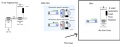
in caseB (With added Resistor load ) there will be net/average attraction/repulsion (With the configuration with resistor)
CaseB.png

The phase relationship in caseB will not change. (The phase relationship between currents in primary and secondary coils of the initial setup with 120VAC Source for example).


-------------------------------------------------------------------

In the initial document

https://sciencedemonstrations.fas.harvard.edu/presentations/attractive-and-repulsive-phases
it is mentioned already :
"Thus the total impedance of the circuit is purely resistive "


Does adding resistor(increasing the purely resistive impedance) as in case B change the situation ?
 
Last edited:

MrAl

Joined Jun 17, 2014
13,680
Hello and thank you for reply.

--------------------------------------------
the magnet is moving back and forth in such a way, that the varying magnetic field through secondary coil (with resonance capacitor in series) is of sinewave waveform. The frequency of this sinewaveform , match the resonance frequency of secondary coil (with capacitor(s)).
--------------------------------------------


So in caseA there will be no net/average attraction/repulsion

as per

View attachment 354222
document https://sciencedemonstrations.fas.harvard.edu/presentations/attractive-and-repulsive-phases
"
(1) At resonance, the phasor representations of the inductive and capacitive reactances are equal in magnitude and 180˚ out of phase with each other.

Thus the total impedance of the circuit is purely resistive

and the current is in phase with the emf. The following graphic depicts the phase relationships between the various parameters, including the Lorentz force on the current in the coil. Since the Lorentz force is equal to the cross product of the current and magnetic field, the graph was generated by simply taking the product of the induced current graph and the magnetic flux graph. [Note that the magnetic field from the iron core actually diverges and the interaction responsible for pushing the coil longitudinally is with the radial component of the magnetic field through the coil; the longitudinal component generates the emf.]
The vertical scale is arbitrary, but nevertheless, one can see that the net force on the coil is zero in one complete cycle of the magnetic flux—it is as much negative as it is positive. When an appropriate capacitor is connected across the coil to make the circuit's resonance frequency equal to 60 Hz, the current is in phase with the emf and the coil is neither attracted to nor repelled by the magnetic field. [As a side note, this is exactly the reason why simply invoking Lenz's Law is not enough to explain the action of the Ring Flinger demonstration.]"


in caseB (With added Resistor load ) there will be net/average attraction/repulsion (With the configuration with resistor)
View attachment 354221

The phase relationship in caseB will not change. (The phase relationship between currents in primary and secondary coils of the initial setup with 120VAC Source for example).


-------------------------------------------------------------------

In the initial document

https://sciencedemonstrations.fas.harvard.edu/presentations/attractive-and-repulsive-phases
it is mentioned already :
"Thus the total impedance of the circuit is purely resistive "


Does adding resistor(increasing the purely resistive impedance) as in case B change the situation ?
Hello again,

I believe this is a case of understanding which level of 'theory' we are talking about.

The statement about the impedance being 'purely resistive' comes from a real-life circuit where we ALWAYS see at least some resistance. It is customary to say it that way because of the ever-present resistance in real circuits what we ordinarily deal with. However, this is not at the same level of theory as the question you had asked about there being no resistance, or at least the case I was talking about when we talked about the circuit with no resistor R.
When we say there is no resistance, we mean just that. We don't mean there is even a little resistance. We say there is no resistance for the first case and that means it's impossible to have an impedance that is "purely resistive". The wires have no resistance, the coil has no resistance the cap has no resistance, and the mechanical mechanism has no friction. That's the most basic level of theory so it could be called 'highly' theoretical especially since this would be too hard to see in real life.

Now when we add resistance, then we know for sure we might be able to have a "purely resistive" impedance at some point. Since there will be a phase shift though it's likely that there is at least some reactance left in the circuit no matter how small.

This ideology allows us to examine the two cases as distinct, where one has absolutely no losses whatsoever, and the other one does. With no resistance or friction (case 1) we have a perfect transfer of energy to and from the coil. With some resistance (case 2) and/or friction, we lose some energy so the transfer is no longer perfect.

This kind of thought is probably better observed with a pure inductance and pure capacitance, which after we apply at least some energy, can oscillate forever without the addition of any more energy. Thus we can say that with a perfectly lossless electromechanical system we would see the same thing as long as the system was capable of reverse action where the electrical part could drive the mechanical part in the same way that the mechanical part could drive the electrical part. It seems unlikely that we could ever actually achieve that miracle though in real life, at least not in ordinary situations in an ordinary environment.
 

Thread Starter

Stoyan.Nikolov.2Induction

Joined Nov 26, 2023
44
Hello again,

I believe this is a case of understanding which level of 'theory' we are talking about.

The statement about the impedance being 'purely resistive' comes from a real-life circuit where we ALWAYS see at least some resistance. It is customary to say it that way because of the ever-present resistance in real circuits what we ordinarily deal with. However, this is not at the same level of theory as the question you had asked about there being no resistance, or at least the case I was talking about when we talked about the circuit with no resistor R.
When we say there is no resistance, we mean just that. We don't mean there is even a little resistance. We say there is no resistance for the first case and that means it's impossible to have an impedance that is "purely resistive". The wires have no resistance, the coil has no resistance the cap has no resistance, and the mechanical mechanism has no friction. That's the most basic level of theory so it could be called 'highly' theoretical especially since this would be too hard to see in real life.

Now when we add resistance, then we know for sure we might be able to have a "purely resistive" impedance at some point. Since there will be a phase shift though it's likely that there is at least some reactance left in the circuit no matter how small.

This ideology allows us to examine the two cases as distinct, where one has absolutely no losses whatsoever, and the other one does. With no resistance or friction (case 1) we have a perfect transfer of energy to and from the coil. With some resistance (case 2) and/or friction, we lose some energy so the transfer is no longer perfect.

This kind of thought is probably better observed with a pure inductance and pure capacitance, which after we apply at least some energy, can oscillate forever without the addition of any more energy. Thus we can say that with a perfectly lossless electromechanical system we would see the same thing as long as the system was capable of reverse action where the electrical part could drive the mechanical part in the same way that the mechanical part could drive the electrical part. It seems unlikely that we could ever actually achieve that miracle though in real life, at least not in ordinary situations in an ordinary environment.
In the initial document they make experiment with "with purely resistive" secondary circuit, where they cancel counter force.


Referring to initial situation
https://sciencedemonstrations.fas.harvard.edu/presentations/attractive-and-repulsive-phases

Initial document.png


picture of phase shift of initial document

more purely resistive circuit will not change the phase shift between
induced current
and
magnetic flux
More "purely resistive " secondary circuit will changle only the amplitude of the induced current (amplitude will be lower).


1755231704170.png
Phase shift will stay the same.
So the resultant Lorentz force will oscilate same as initial condition.
 

Attachments

Last edited:

MrAl

Joined Jun 17, 2014
13,680
In the initial document they make experiment with "with purely resistive" secondary circuit, where they cancel counter force.


Referring to initial situation
https://sciencedemonstrations.fas.harvard.edu/presentations/attractive-and-repulsive-phases

View attachment 354254


picture of phase shift of initial document

more purely resistive circuit will not change the phase shift between
induced current
and
magnetic flux
More "purely resistive " secondary circuit will changle only the amplitude of the induced current (amplitude will be lower).


View attachment 354251
Phase shift will stay the same.
Why don't you do your own proof? That's the only way to be sure sometimes. If you believe that article is true (I have not read the whole thing) then try to prove it or try to disprove it. See what you can come up with.
 

Thread Starter

Stoyan.Nikolov.2Induction

Joined Nov 26, 2023
44
Why don't you do your own proof? That's the only way to be sure sometimes. If you believe that article is true (I have not read the whole thing) then try to prove it or try to disprove it. See what you can come up with.
Thanks for Reply.
The article is from Harvard university
I guess it is correct.

To check if adding Rload I need to prepare same experimental set up, that is precise and perhaps expensive .

If I could avoid the need to make experimental set-up, that is precise and perhaps expensive, will be very glad
 
Last edited:

MrAl

Joined Jun 17, 2014
13,680
Thanks for Reply.
The article is from Harvard university
I guess it is correct.

To check if adding Rload I need to prepare same experimental set up, that is precise and perhaps expensive .

If I could avoid the need to make experimental set-up, that is precise and perhaps expensive, will be very glad
Hi again,

It does not matter where it came from. The level of detail is different for your question than for what they presented.
This is a hard concept for some students to get their head around. It means that there is not one right and one wrong version, they are both right. The difference is the context and that involves the set of assumptions.

I tried to explain this to you twice now. The USUAL assumption is that there is ALWAYS some resistance in the circuit, and that means ALWAYS. However, in a more highly theoretical context, we can remove even that resistance and this leads to a different solution, and it can be VERY different.

If this is still not clear then you are just going to have to wait until you have more experience with these matters of theory.
This class of reasoning comes up a lot with other components like the diode. Sometimes we assume the diode is either fully on or fully off, then other times we assume it has a voltage drop when 'on', and other times we assume it has resistance when 'on' and either infinite resistance or very high resistance when 'off'. Still other times we go to the full exponential model, or a simpler exponential model.
The point is, in each case we have a different level of theory which we could call a different level of the model. The fully 'on' and fully 'off' model might be called LEVEL 1, and the model with the 0.7v voltage drop might be LEVEL 2, etc. You MUST know which model you are using before you can get the same result as someone else using that model. If you use a different model you are bound to get a different answer.

Now you specifically stated that everything was prefect in your setup so you are not assuming ANY resistance at all, while the article you posted assumes at least the standard real-life default resistance. To me it does not make any sense to include the real-life default resistance if you are going to later add your own resistance in case 2. You'll get the results you want with case 2 if you just change the value of the resistance a little.

So the bottom line is that the article can be correct under the assumptions it wants to use. I do not think that is the same as the first question you asked though where everything is ideal.
 

Thread Starter

Stoyan.Nikolov.2Induction

Joined Nov 26, 2023
44

MrAl

Joined Jun 17, 2014
13,680
Ok. Here is the question :
Referring to initial situation
https://sciencedemonstrations.fas.harvard.edu/presentations/attractive-and-repulsive-phases


Initial document.png


and picture of phase shift of initial document

will more purely resistive circuitchange the phase shift between
induced current
and
magnetic flux ?


1755231704170.png


Will we able to see cancelation of counter force as initial situation
if we have additional resistor RLoad?

Hi,

I am not entirely sure what you are asking now but if here is any resistance at all then there will be losses.

If you are unsure about a model that contains resistance or does not contain resistance when you only have the text to go by, then simply try to identify exactly where the resistance is located. If you can find the resistance then it must be there, but if you cannot find the resistance then it's not there. If it is there and you found it, then you can either leave it there or eliminate it by either shorting it out (making it a perfect zero Ohms) or letting the value approach zero in the limit.
 
Top