What is "it"?
What exactly are the power supply requirements and the output load resistance and current requirements, and the frequency response needed?
We're flying blind here.
What concerns me is that you persist in talking about theoretical calculations while ignoring the limitations of op amps in real circuits.
Those circuit values (and op amp voltages) in post #17 are certainly not what I used in my circuit.
Look in the op amp data sheet and design the circuit within its limitations.
Then your circuit will operate closer to the theoretical calculations.
What is "it"?
What exactly are the power supply requirements and the output load resistance and current requirements, and the frequency response needed?
We're flying blind here.
Sorry, the maximun voltage to use in the circuit is 5 V. So that is my supply for the OpAmps and also the Vin must be lower than 5 V to avoid saturation, and basically thats it, the load could be changed between 1 - 1k Ohm and the current must be greater than 2mA and not vary more than 100 uA in that interval of loads(1-1k Ohm). It is made for being all with DC, so no particular frequency response is needed or requested.
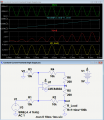
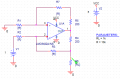
Now that we know your requirements, below is a circuit using a rail-rail op amp with a single 5V supply that should do what you want. Here's a discussion of how it works.
Now that we know your requirements, below is a circuit using a rail-rail op amp with a single 5V supply that should do what you want. Here's a discussion of how it works.
So changing the circuit and the OpAmp worked fine, thanks.
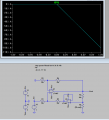
As you see the linear behavior of the source changes at about 750 Ohms. Is there any way to Improve that? Maybe changing the OpAmp?
it is fairly easy to see how the new circuit will not work - different topology, and load-dependent output.
simulation is a very powerful tool. because of that, it can be dangerous when the trust is mis-placed in the simulation. anyone can run a simulation program - even the caveman can do it, as the commercial would have it.
to use simulation, however, you have to know its limitations and when it does not work. only then it becomes a useful tool for you.
it is fairly easy to see how the new circuit will not work - different topology, and load-dependent output.
simulation is a very powerful tool. because of that, it can be dangerous when the trust is mis-placed in the simulation. anyone can run a simulation program - even the caveman can do it, as the commercial would have it.
to use simulation, however, you have to know its limitations and when it does not work. only then it becomes a useful tool for you.
I know that my original Circuit in a paper works. But I can't make it work in Simulation. The circuit is a derivation of the simplest Howland Source that crutschow suggested. I have to look for the best OpAmps for doing the task.
You are trying to output more voltage and current then that circuit can deliver into a load of 1kΩ.
With a 5V maximum output and 200 ohms in series with the load, the maximum current it can deliver into 1kΩ is ≈4.1mA, thus the maximum output load resistor is about 750Ω.
Change the input to about 0.75V and it should work up to a 1kΩ load.
You can reduce the value of R4 and R4 (keeping them equal) to increase the maximum output current into a 1kΩ load but that also increases the circuit gain (equal to V1/R4).
You can reduce the value of R4 and R4 (keeping them equal) to increase the maximum output current into a 1kΩ load but that also increases the circuit gain (equal to V1/R4).
Before you do that, note that in your schematic shown in post #28 you have the opamp's (+) and (-) inputs reversed. Also, if you want to try this circuit out on a breadboard, make sure you install a decoupling cap (0.1 μF or so) across the opamp's power pins to discourage oscillation. It may also be necessary to connect a small (30 pF or so) capacitor from the opamp's output to its (-) input, for the same purpose. Given those changes, I'd say go ahead and breadboard it.
Before you do that, note that in your schematic shown in post #28 you have the opamp's (+) and (-) inputs reversed. Also, if you want to try this circuit out on a breadboard, make sure you install a decoupling cap (0.1 μF or so) across the opamp's power pins to discourage oscillation. It may also be necessary to connect a small (30 pF or so) capacitor from the opamp's output to its (-) input, for the same purpose. Given those changes, I'd say go ahead and breadboard it.

 Facebook
 Google
 GitHub
 Linkedin