I live in Adelaide Australia ak. https://en.m.wikipedia.org/wiki/AdelaideIt sounds like you're doing very well on your own. This weekend is a bit busy, but I'll get back into this thread by Monday. Where are you located?
ak
I live in Adelaide Australia ak. https://en.m.wikipedia.org/wiki/AdelaideIt sounds like you're doing very well on your own. This weekend is a bit busy, but I'll get back into this thread by Monday. Where are you located?
ak
Thanks for your reply max.I appreciate you might want to hone your electronic skills, but irrigation timers with relay out put are dime a dozen here, not only a real time clock but sequential operation.
Max.
Thanks for that clarification scottwang. I take your point. It is a 5v relay and it does everything I want it too. It's current is I think within the range of the transistor amplifier that #12 and AK have in mind to bookend their switching and timing circuitryWhat voltage of relay that you should use, normally if the Vcc is 12V then you can pick up the 12V relay, if the Vcc is 5V then you can pick up the 5V relay, if you know more about the current of components then you can using it quite easy, as you can using a 5V relay in a 12V circuit, the first you have to know the current of relay and you could calculate the current limiting resistor to limits the current to flows through the coil of relay to suit the relay needed and then the 5V relay will be survive in the 12V circuit, but you can't using a 12V relay in a 5V circuit, because the current will be not enough to drive the coil of relay, unless the you have a boost circuit to raising the voltage and providing enough current for the circuit and relay.
Max I was referring in that post to the dc relay coil not the solenoid valve. The arithmetic regarding ohms law seemingly worked out pretty well so maybe the impedance of the relay coil is not the same issue as the one you describe.Using the resistance method for DC solenoids is valid, but of no use for AC type as the current is limited by the Inductive Reluctance.
Max.
Look up these three parts and see what you think:I live in Adelaide Australia ak. https://en.m.wikipedia.org/wiki/Adelaide
Ok thanks for the start AK. I will read up on themLook up these three parts and see what you think:
Oscillator/divider: CD4060B
Counter: CD4017B
Relay driver: ULN2003
With these parts you can have 1 to 7 outputs that step through at a constant rate. At the end of a cycle it can repeat or halt. With one of those little twp-pin shunts and a 2x7 header you can select how many steps are in a cycle without any wiring changes.
Don't let the 4060 scare you. It actually is more simple than a 555. In the standard astable configuration, a 555 has 8 pins that are connected to something. For the 4060 to do the same thing, there are only 7 pin connections. Plus, the timing capacitor is 16,000 times smaller.
ak
Thank you for the kind replay Mellisa.hello dendad,
i really appreciate your interest in my post and especially the fact you went to the trouble to write such a detailed and helpful reply.
you copped a bit of flak for mentioning arduino in this forum. dont worry about the purists! hehe.
i would like to learn arduino but i want to do the hard yards learning about solid state electronics first by using transistors and resistors and diodes and capacitors. previous responders to my posts have indicated i can achieve what i currently want to do with this component based circuitry. if not i will be on your doorstep.
i have been thinking about some other uses for arduino or something similar that has a whole computer in it. this includes some home automation and some web based remote control applications but they are only a dream at the moment. i need to crawl before i can run and i am likely to get much more satisfaction from working with an embedded computer like arduino if i have some electronics knowledge to beging with.
thanks again and best wishes
mellisa king
By "this site" did you mean aac? I went here after googling 555 and this seems an amazingly informative and well written article on it. Wld u recommend I use this article to learn abt 555?I can't quite remember if it was the favorite of this site, The Dreaded
You said: "individual times set for each step and will try to remember how I did it"Thank you for the kind replay Mellisa.
I too am in Oz, about 2 hours North of Melbourne.
About 30 years ago I made a hamburger flipper timer that had individual times set for each step and will try to remember how I did it.
Something like a variable resistor or Potentiometer (pot) fed from each output used for the relay drive, so at each step the time delay is adjustable.
I can't quite remember if it was the favorite of this site, The Dreaded 555 Timer that I used or what, then it was fed into a 4017 counter/divider I think, and the output after the last relay was used to reset it all. So to add more relays, you just need to move the reset link to the next output and add the FET relay driver or optocoupler or whatever other output configuration you are using, along with the pot to set the time delay. This way you could have a max of 10 relays, all adjustable.
The pot outputs are connected to the 555 via diodes so they do not interact with each other.
I'll try later today to figure out the circuit if you want that level of help
Oh, it maybe mentioned elsewhere, but if you are going to drive water solenoids, use 12VAC or 24VAC ones, and a power transformer. Do NOT use 240VAC ones as that involved dangerous volts. Also, do nor use DC solenoids as that can encourage electrolysis. The local big hardware stores have them. And you can switch them with Solid State relays to give isolation, or just mechanical relays if you prefer.
I have to go off line now AK. Thx again for these three leads. I will be able to re engage tonight and I will give u feedback on yr reading suggestions sometime tmrw. Dendad is also helping pls see his correspondence.Look up these three parts and see what you think:
Oscillator/divider: CD4060B
Counter: CD4017B
Relay driver: ULN2003
With these parts you can have 1 to 7 outputs that step through at a constant rate. At the end of a cycle it can repeat or halt. With one of those little twp-pin shunts and a 2x7 header you can select how many steps are in a cycle without any wiring changes.
Don't let the 4060 scare you. It actually is more simple than a 555. In the standard astable configuration, a 555 has 8 pins that are connected to something. For the 4060 to do the same thing, there are only 7 pin connections. Plus, the timing capacitor is 16,000 times smaller.
ak

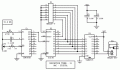
Wow AK!!!First pass at the circuit. Only one relay is shown for clarity. The ULN2003 has relay coil protection diodes built-in. The whole circuit can run on anything from 5 V to 15 V, but at the higher voltages you should change the 2003 to a 2004. Moving the shunt along P1 changes the number of outputs. Never install more than one shunt.
With R2 centered, the output period will be approximately 5 minutes. You can change R1 and R2 to get different adjustment ranges. The equation is in the 4060 datasheet.
ak
View attachment 124831
Hi dendad,Thank you for the kind replay Mellisa.
I too am in Oz, about 2 hours North of Melbourne.
About 30 years ago I made a hamburger flipper timer that had individual times set for each step and will try to remember how I did it.
Something like a variable resistor or Potentiometer (pot) fed from each output used for the relay drive, so at each step the time delay is adjustable.
I can't quite remember if it was the favorite of this site, The Dreaded 555 Timer that I used or what, then it was fed into a 4017 counter/divider I think, and the output after the last relay was used to reset it all. So to add more relays, you just need to move the reset link to the next output and add the FET relay driver or optocoupler or whatever other output configuration you are using, along with the pot to set the time delay. This way you could have a max of 10 relays, all adjustable.
The pot outputs are connected to the 555 via diodes so they do not interact with each other.
I'll try later today to figure out the circuit if you want that level of help
Oh, it maybe mentioned elsewhere, but if you are going to drive water solenoids, use 12VAC or 24VAC ones, and a power transformer. Do NOT use 240VAC ones as that involved dangerous volts. Also, do nor use DC solenoids as that can encourage electrolysis. The local big hardware stores have them. And you can switch them with Solid State relays to give isolation, or just mechanical relays if you prefer.
Ok thx moderator it's just my inexperience. I will try. Thx for yr forbearancePlease reply carefully when you using quote, you already had serveral times that the replied contents and the contents of quote whom you reply to were separated, it will make the replied without contents became meaningless, I already done the megered two posts to one for you a couple times, please put your reply contents and the contents of quote together.