Relay switching circuit

dendad

Joined Feb 20, 2016
4,637
That's ok Mellisa.
I was busy yesterday so did not get around to it.
AK's circuit looks quite good, and if you are getting a stack of parts you can later try others.
Are you going to build it first on a breadboard? they are a great prototyping aid. If you can get a bit of old Telecom cable you then have a good supply of various coloured wires that will fit the breadboard.
Then will you transfer your design to Proto board? There are various designs, those with strips you cut with a drill bit, and those that just have pads at each hole. They do require soldering so make sure you wear eye protection when you solder. And wash hands afterwards as the solder is not good for you. It is a good idea to have a well ventilated area to work in, and invest in a temperature controlled iron too.

Have you a multimeter and power supply yet? Ebay is a very good source of stuff. I wish it was around when I first started.
Later on, if you like, I can post a couple of other options for the circuit. there are many ways to do it and that is part of the fun.
For a bit of a shortcut, you could probably Ebay a relay card to use.

I'll be interested to see how you go. Please post your results so we can see :)
 

Thread Starter

Mellisa_K

Joined Apr 2, 2017
391
That's ok Mellisa.
I was busy yesterday so did not get around to it.
AK's circuit looks quite good, and if you are getting a stack of parts you can later try others.
Are you going to build it first on a breadboard? they are a great prototyping aid. If you can get a bit of old Telecom cable you then have a good supply of various coloured wires that will fit the breadboard.

Then will you transfer your design to Proto board? There are various designs, those with strips you cut with a drill bit, and those that just have pads at each hole. They do require soldering so make sure you wear eye protection when you solder. And wash hands afterwards as the solder is not good for you. It is a good idea to have a well ventilated area to work in, and invest in a temperature controlled iron too.

Have you a multimeter and power supply yet? Ebay is a very good source of stuff. I wish it was around when I first started.
Later on, if you like, I can post a couple of other options for the circuit. there are many ways to do it and that is part of the fun.
For a bit of a shortcut, you could probably Ebay a relay card to use.

I'll be interested to see how you go. Please post your results so we can see :)
Great advice on so many practical things dendad. Thankyou. I do have a good solering iron already. I bought it a couple of years ago thinking I wld start learning abt electronics then but life got in the way. Now I am READY! The iron has a digital temp read out and adjustable set thingy. That wld be a "PID" ? Hehe.

I used my dad's stuff when I was a kid. It was a 3.3v scope. Had a ring sleeve u pushed and a cabon element. Only did electrical things though. Mucking around with cars and caravans lights and helping wiring house

One piece of equipment you mentioned I haven't got though is a lab power supply. They look expensive. I don't know abt the features to consider. Maybe I wld be paying for things I don't I need right now. For this type of hobby and from what I have said already cld u recommend one pls?
 

AnalogKid

Joined Aug 1, 2013
12,132
The 555 + 4017 combination is very popular, but when the clock period is more than a few seconds I prefer the 4060. It's oscillator circuit is actually less precise than the 555, but the complications of very large capacitors far outweigh that small advantage.

ak
 

dendad

Joined Feb 20, 2016
4,637
One piece of equipment you mentioned I haven't got though is a lab power supply. They look expensive. I don't know abt the features to consider. Maybe I wld be paying for things I don't I need right now. For this type of hobby and from what I have said already cld u recommend one pls?
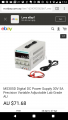
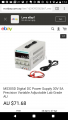
I use a 305D from Ebay, something like...
http://www.ebay.com.au/itm/MS305D-D...256266?hash=item25d22258ca:g:9ckAAOSwsW9Y0OR5
But another way is to get an old plug pack to supply your DC without having to much around with mains, and add a regulator.
You can build one or there are quite a few on Ebay that you can use. Get one with a variable current limit as well as variable voltage.
A simple LM317 circuit will do for a start, but it does not have settable current limiting. There are lots of instructions on how to build one.
For example...
http://diyaudioprojects.com/Technical/Voltage-Regulator/
And this AAC site will have info too.
 

Thread Starter

Mellisa_K

Joined Apr 2, 2017
391
That's ok Mellisa.
I was busy yesterday so did not get around to it.
AK's circuit looks quite good, and if you are getting a stack of parts you can later try others.
Are you going to build it first on a breadboard? they are a great prototyping aid. If you can get a bit of old Telecom cable you then have a good supply of various coloured wires that will fit the breadboard.
Then will you transfer your design to Proto board? There are various designs, those with strips you cut with a drill bit, and those that just have pads at each hole. They do require soldering so make sure you wear eye protection when you solder. And wash hands afterwards as the solder is not good for you. It is a good idea to have a well ventilated area to work in, and invest in a temperature controlled iron too.

Have you a multimeter and power supply yet? Ebay is a very good source of stuff. I wish it was around when I first started.
Later on, if you like, I can post a couple of other options for the circuit. there are many ways to do it and that is part of the fun.
For a bit of a shortcut, you could probably Ebay a relay card to use.

I'll be interested to see how you go. Please post your results so we can see :)
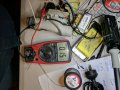
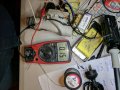
PS: I have got a DMM i bought it SH on gumtree a few days ago. $5. Do u think it's ok for what I need?
 

Attachments

Thread Starter

Mellisa_K

Joined Apr 2, 2017
391
I use a 305D from Ebay, something like...
http://www.ebay.com.au/itm/MS305D-D...256266?hash=item25d22258ca:g:9ckAAOSwsW9Y0OR5
But another way is to get an old plug pack to supply your DC without having to much around with mains, and add a regulator.
You can build one or there are quite a few on Ebay that you can use. Get one with a variable current limit as well as variable voltage.
A simple LM317 circuit will do for a start, but it does not have settable current limiting. There are lots of instructions on how to build one.
For example...
http://diyaudioprojects.com/Technical/Voltage-Regulator/
And this AAC site will have info too.
Thanks that will do me that's worth the money I reckon. I will get that one.
 

Attachments

dendad

Joined Feb 20, 2016
4,637
They seem to be ok. I managed to kill the relay in mine after a lot of heavy use but it was easily replaceable. It has had a lot of use, in fact it is in use at the moment driving a drill.
A lot of the others come from the same factory I think. You do get what you pay for to a certain extent but so far I've been pretty pleased with the stuff I get from similar places.
It should be ok for your use I think.
 

AnalogKid

Joined Aug 1, 2013
12,132
As an alternate opinion, I recommend a supply with less output current but two outputs. Eventually you will get into something that needs bipolar supplies, like an opamp circuit or audio stuff. A dual supply that makes at least 24 V and 2 A on each output will serve you for years. By the time you need more power, you will be able to build your own. Look for one that can parallel the two outputs so you in effect have three supplies.

ak
 

Thread Starter

Mellisa_K

Joined Apr 2, 2017
391
As an alternate opinion, I recommend a supply with less output current but two outputs. Eventually you will get into something that needs bipolar supplies, like an opamp circuit or audio stuff. A dual supply that makes at least 24 V and 2 A on each output will serve you for years. By the time you need more power, you will be able to build your own. Look for one that can parallel the two outputs so you in effect have three supplies.

ak
Ok thx for that I will look into it and see how much they are. I might have more money by the time a cheaper one becomes unfit for purpose
 

Thread Starter

Mellisa_K

Joined Apr 2, 2017
391
As an alternate opinion, I recommend a supply with less output current but two outputs. Eventually you will get into something that needs bipolar supplies, like an opamp circuit or audio stuff. A dual supply that makes at least 24 V and 2 A on each output will serve you for years. By the time you need more power, you will be able to build your own. Look for one that can parallel the two outputs so you in effect have three supplies.

ak
Forgive me AK but I started looking for the three terms you used seemingly interchangeably in yr post ie bipolar/ dual/ two output power supplies. I quickly got bogged down in terminology.

The two links below illustrate what I mean.

https://www.quora.com/What-is-a-dual-power-supply-in-electronics

https://www.eevblog.com/forum/testgear/looking-for-a-budget-bipolar-bench-psu/

I don't have the background to differentiate and I don't want to buy a white elephant!

Could you please give me the exact, correct terminology to search with? And if you've got the time an actual example pls?

Not time critical.

Many thanks AK

Regards
MK
 

AnalogKid

Joined Aug 1, 2013
12,132
Bipolar - two polarities. In the zone of this discussion, usually two opposite polarities, such a +12 V and -12 V. There are different ways to achieve this. One is to package two independent, floating power supplies in one instrument. Floating means that the two outputs do *not* shave a common ground. So you can connect the two supplies together in series to make either a larger overall output voltage or proclaim the center connection to be your system ground and have bipolar outputs.

Two features make some supplies better than others. One is the ability to connect the two outputs in direct parallel, so the total available current adds. Example, if you have two outputs of 12 V / 1 A, then you can get either 24 V at 1 A or 12 V at 2 A depending on the connections. Another feature is tracking. When the supply is in bipolar mode, and you want to vary the +/- outputs over a range to see how it affects your circuit, you normally have to adjust both the + output and the - output separately. With tracking enabled, adjusting one supply output automatically adjusts the other output.

A typical supply like this has two "analog" outputs like 2 x 30 V at 1 to 3 A, and one "digital" output of 5 V at 3 A, non-adjustable.

Or for way less cash, a couple of LM317 kits, one transformer, one bridge - enough to get by until you get a feel for what you really want.

ak
 

dendad

Joined Feb 20, 2016
4,637
A dual power supply can be very useful but mostly they will be of a fixed value, like +12V and -12V.
For general mucking about, an adjustable voltage AND adjustable current limited one is better in my opinion. And yes, build a +/-5V and +/-12V supply as a project. I think it is "A Rite Of Passage" into electronics to build a power supply of some sort ;)
When we had work experience kids come, I'd get them to build a simple adjustable supply based on an LM317 so they had something to show for their time with us.
A great lot of the stuff I design and build is 24V powered and I have an old hashed together 24V supply that has a 24V headlight lamp in series with the output. At "normal" low current it is cold and so I get 24V out, but as soon as there is an overload, the lamp lights and goes higher resistance to limit the amount of smoke hat comes out of the work. A very handy rough protection!
You will no doubt end up with a number of power supplies. It is a case of More Is Better !
And I don't think the supply will be a white elephant. If you continue in this fun hobby, time will come when you are running multiple supplies. Good test gear is never a waste.
 

Thread Starter

Mellisa_K

Joined Apr 2, 2017
391
Bipolar - two polarities. In the zone of this discussion, usually two opposite polarities, such a +12 V and -12 V. There are different ways to achieve this. One is to package two independent, floating power supplies in one instrument. Floating means that the two outputs do *not* shave a common ground. So you can connect the two supplies together in series to make either a larger overall output voltage or proclaim the center connection to be your system ground and have bipolar outputs.

Two features make some supplies better than others. One is the ability to connect the two outputs in direct parallel, so the total available current adds. Example, if you have two outputs of 12 V / 1 A, then you can get either 24 V at 1 A or 12 V at 2 A depending on the connections. Another feature is tracking. When the supply is in bipolar mode, and you want to vary the +/- outputs over a range to see how it affects your circuit, you normally have to adjust both the + output and the - output separately. With tracking enabled, adjusting one supply output automatically adjusts the other output.

A typical supply like this has two "analog" outputs like 2 x 30 V at 1 to 3 A, and one "digital" output of 5 V at 3 A, non-adjustable.

Or for way less cash, a couple of LM317 kits, one transformer, one bridge - enough to get by until you get a feel for what you really want.

ak
AK It's great to get yr thoughts on this. Thankyou.

I get it now. I am clear. I will get a $70 single output PS for now as suggested by the equally helpful dendad.

I do want to do audio in future. And opamps(?)

I am looking forward to building my own dual supply in good time. Yr advice abt the chip kits has opened my eyes to what's available. I think I could right now get side tracked with my poor soldering skills. Risking a circuit board mess with lifting copper tracks and over heating tiny feet of ICs will only discourage me at this stage on my quest to learn about 4060 oscillators!! Onward!
Many thx
M
 

Thread Starter

Mellisa_K

Joined Apr 2, 2017
391
A dual power supply can be very useful but mostly they will be of a fixed value, like +12V and -12V.
For general mucking about, an adjustable voltage AND adjustable current limited one is better in my opinion. And yes, build a +/-5V and +/-12V supply as a project. I think it is "A Rite Of Passage" into electronics to build a power supply of some sort ;)
When we had work experience kids come, I'd get them to build a simple adjustable supply based on an LM317 so they had something to show for their time with us.
A great lot of the stuff I design and build is 24V powered and I have an old hashed together 24V supply that has a 24V headlight lamp in series with the output. At "normal" low current it is cold and so I get 24V out, but as soon as there is an overload, the lamp lights and goes higher resistance to limit the amount of smoke hat comes out of the work. A very handy rough protection!
You will no doubt end up with a number of power supplies. It is a case of More Is Better !
And I don't think the supply will be a white elephant. If you continue in this fun hobby, time will come when you are running multiple supplies. Good test gear is never a waste.
Thanks dendad. Pls see my reply to analogue kid
 

Thread Starter

Mellisa_K

Joined Apr 2, 2017
391
As an alternate opinion, I recommend a supply with less output current but two outputs. Eventually you will get into something that needs bipolar supplies, like an opamp circuit or audio stuff. A dual supply that makes at least 24 V and 2 A on each output will serve you for years. By the time you need more power, you will be able to build your own. Look for one that can parallel the two outputs so you in effect have three supplies.

ak
Hi Analogue Kid

Following yr advice abt PSs I've been reading abt opamps and audio amps and the more I do the more ubiquitous they seem to my future as an electronics hobbyist. Yr advice advocating a dual PS is reinforced by this. Sooooo...

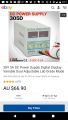
A dumb question (I don't know) but is there anything wrong with this logic: if I buy one of these cheap PSs now due to lack of funds and ease of choice (eg attached) is there anything stopping me from one day buying an identical one and thereby deriving the benefits of a dual PS at that time?

Regards

Mellisa
 

Attachments

AnalogKid

Joined Aug 1, 2013
12,132
Nothing is stopping you. The only reason to get a true dual supply is if you need (not just want) the tracking feature. OK, that and less bench space.

ak
 
Top