Relay switching circuit

Thread Starter

Mellisa_K

Joined Apr 2, 2017
391
Way back somewhere in this thread you said:


Our local hospital has a lot of "wave here" type of switches for door openers.

e.g. Look at the Next Gen switches here: http://www.disabilitysystems.com/door-controls/handicap-door-activation.html

Reneasys (sp?) has a lot of uP based cap sensor stuff.

Take a look here https://www.itead.cc/itead-touch-network-intelligent-switch.html as well. They had some basic breadboard cap switches somewhere on their website at one time. I don;t have time to look right now. This one is unique.
thanks very much for suggesting these solutions KISS. i will chase them up with enthusiasm and let you know how i go. (It might be a while but I will. :)
 

Thread Starter

Mellisa_K

Joined Apr 2, 2017
391
1. Almost. The "timing node" or "Rx-Cx-Rs node" (there is a typo in my original post) is the point in Figure 1 where (R1+R2), C1, and R3, or the point in figure 3 where Rx, Cx, and Rs are connected. There is a modified sawtooth wave at this node, and that is the heart of how this circuit works. It takes time for the voltage on the capacitor to wander up and down between approx. 1/3 and 2/3 Vdd. That time, set by the Rx and Cx values, sets the oscillator frequency.

Rs is not supposed to affect the Rx-Cx timing relationship. CMOS gates have protection diodes on the input to protect them from external transients. Those diodes can distort the timing sawtooth, affecting the accuracy of the timing equation. By isolating the diodes with a large resistor, that distortion is reduced. Rs should be at least 10 times Rx.

2. Yes.

3. Calling out external timing components with alphabetic subscripts goes way back. TI called the 74121 monostable timing components Rt and Ct. This is because the components are mandatory for the circuit to work, but of course the manufacturer does not know where they fit in on the bill of materials for the user's design. So in a final design they might be R12 and C73.

4. Yes, yes, not sure what you mean. I don't mention the Reset input. Clearly, it must be in the non-reset state for the circuit to work.

5. - - -

6a. In figure 3, the second inverter after pin 12 enters the side of the inverter at pin 11. This is one way of showing an enable function. Pin 12 enables or disables pin 11. This visual is common in devices with tri-state output stages like octal latches:

View attachment 129540
Th effect is the same as a NAND or AND gate.

6b. The R-C time delay does not translate well into a truth table.

ak
thanks AK. all grist for the mill. I am advancing ... slowly.
 

Thread Starter

Mellisa_K

Joined Apr 2, 2017
391
@dendad @AnalogKid just letting you know i am planning to build the circuit on post #131 of 5 may 17 and the other variants around that date either next weekend or the one after depending on when my last shipment of parts arrives. I have been accumulating component stocks from ebay for this and other circuits and i have been reading up on theory, and i am close to starting to build big time :) soooo looking forward to it!!
 

Thread Starter

Mellisa_K

Joined Apr 2, 2017
391
hello @dendad and @AnalogKid .

I didnt have all my parts still but today i went ahead and built the circuit using only the only pot i had. (i am still waiting on this large shipment of parts from china which will keep me going for ages I hope.)

I couldnt get the circuit to work using just the one feedback loop from the output of the 4017 and back to pin 7 of the 555 via one of the single pot. I will check it tmrw and post confirmation of what i have done then. The circuit will work with a smaller capacitor and if the discharge pin is connected to the 5v positive rail via the pot. this will drive the decade counter to a variable speed. but it wont work as per your schematic of post number 131. anyway dont do anything now just giving you feedback as i said i would.
regards
Mellisa
 

Thread Starter

Mellisa_K

Joined Apr 2, 2017
391
Hi again :)
Try it with just resistors in place of the other pots to see if the circuit works for you.
Wow @dendad - It works!

Did you hear that @AnalogKid ??? it. works!!

The pots came today and I have just put them in.

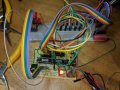
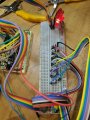
I currently have it running using LEDs in place of the relays so as to see whats going on. I can control the period of the loads individually. Its running currently using a 4.7mF electrolytic cap and the value of the two resistors are as originally indicated in the circuit schematic. This speeds the whole thing up to assist in testing so I can observe the sequential switching through the loads.

This configuration gives a range of between about 3.5 mins and about 11 mins. i will keep experimenting with bigger capacitors and let you know how i get on.

I am very happy with it. Thankyou so much

You guys are awesome.

Mell :p:p:p:p
 

Attachments

dendad

Joined Feb 20, 2016
4,639
Congratulations :) It is neat to get a design going!
You may do better to use a Tantalum cap in place of the electro one used as the timing cap as they are more stable, have lower leakage and will last longer.
Old TVs and stuff are a good source of parts. Just make sure you wear safety specs when un-soldering them to prevent wires flicking solder into your eyes.
And if you are getting parts from TVs and monitors keep away from the picture tubes as they can pop. There are safe ways with dealing with them but that is another subject.
If you can manage to stick with new parts so much the better.
 

Thread Starter

Mellisa_K

Joined Apr 2, 2017
391
Congratulations :) It is neat to get a design going!
You may do better to use a Tantalum cap in place of the electro one used as the timing cap as they are more stable, have lower leakage and will last longer.
Old TVs and stuff are a good source of parts. Just make sure you wear safety specs when un-soldering them to prevent wires flicking solder into your eyes.
And if you are getting parts from TVs and monitors keep away from the picture tubes as they can pop. There are safe ways with dealing with them but that is another subject.
If you can manage to stick with new parts so much the better.
Thankyou.

Good advice about the second hand parts: I'm learning electronics on a shoe string budget :( Finding a source for scavenging things is a lot harder than it used to be. I remember going to the tip with my dad and finding heaps of stuff. We'd bring back more stuff than we tipped! Not so these days. They'd shoot you. There were disposal stores too. Don't see them these days.

Do you have any ideas where I could source old TVs and radios?
 

dendad

Joined Feb 20, 2016
4,639
I see a lot of old TVs and monitors dumped on the nature strips here. But garage sales are not bad, and opp shops. If you have an opp shop handy, usually they have to get rid of the old TVs and monitors dumped on them as no one wants an old TV anymore.
You may be able to give them a couple of $ for them if you tell them you are going to junk it.
make sure you wear safety specs, overalls and gloves when you get the chassis out, then put the cover back on and take the case with the tube to the dump for glass recycling if they will take them.
I'm off to bed now.
Good night :)
 
Top