Reading a schematic

MisterBill2

Joined Jan 23, 2018
28,331
Consider also that the drawing is a PICTORIAL wiring diagram, not a circuit schematic. It is also clear that some of the comments come from folks who have never opened one of those starter-motor power relays, and possibly not even worked in a car engine compartment. I have done both.
MOST of the high current relays coils are only rated for short on times, they will overheat and burn out in a few minutes. AND some of them also include a second smaller contact to bypass the ignition coil ballest resistor during the cranking time.
I very much doubt that you would ever find one of those relays with normally closed contacts, because of the coil heating issue.

What is unfortunate is that the comment about the drawing error in post#2 was apparently made without looking at the drawing to see that CERTAINLY THERE IS AN ERROR! !
It is immediately clear that the battery is shown connected to the wrong terminal.
(Additional remarks deleted.)
 

MrChips

Joined Oct 2, 2009
35,190
What is unfortunate is that the comment about the drawing error in post#2 was apparently made without looking at the drawing to see that CERTAINLY THERE IS AN ERROR! !
It is immediately clear that the battery is shown connected to the wrong terminal.
(Additional remarks deleted.)
Ok, somebody made a mistake in the drawing and I did not catch the mistake on first viewing. Get over it!
 

MisterBill2

Joined Jan 23, 2018
28,331
But that makes no sense.

You still have the situation that the battery is permanently connected to the starter motor so that it runs continuously.

But, leaving that aside, does it make any sense at all that someone designing an electrical system for a boat motor is going to design it so that there has to be a backup power supply of some kind to power everything else in the system, including the starter relay, while the engine is cranking. Just think of what's going to happen if the motor doesn't start quickly enough (using your suggestion of a capacitor). The capacitor runs down enough so that the starter relay drops out, this disengages the motor and reconnects the battery to the rest of the electrical system, which will charge the capacitor up just enough to re-engage the starter motor, taking a fraction of a second, which will then disconnect the battery and re-engage starter motor, but since it only charged up just barely enough to re-engage the starter relay, it will proceed to drop out again almost immediately, resulting in nothing more than a chattering of the relays, probably destroying them in short order.
My first few cars did just exactly that!! And some folks would turn on things to warm up the battery prior to cranking the engine with the starter.
SO the fact remains that the drawing we see in post #1 has an error in the drawing that quite a few failed to comment on. Of course it is likely that not every reader is intimately familiar with car electrical systems, and that many folks have never investigated a starter motor with an integral solenoid to engage the pinion with the flywheel.
 

WBahn

Joined Mar 31, 2012
33,209
My first few cars did just exactly that!! And some folks would turn on things to warm up the battery prior to cranking the engine with the starter.
SO the fact remains that the drawing we see in post #1 has an error in the drawing that quite a few failed to comment on. Of course it is likely that not every reader is intimately familiar with car electrical systems, and that many folks have never investigated a starter motor with an integral solenoid to engage the pinion with the flywheel.
I'm not following. You're saying that your first few cars completely disconnected the car's entire electrical system from the battery while it was cranking the starter and had some kind of back-up power supply to provide power to everything else, such as the ignition as well as well as the the solenoid coil itself, until you stopped cranking???

What was one of those cars? Make/Model/Year? I'd like to try to track down one of them and take a look at it.
 

MisterBill2

Joined Jan 23, 2018
28,331
When the ignition switch was rotated to the "crank engine" position it switched OFF the "ACC" position! So it switched off the radio and the heater blower, and the instruments, gas gage and temp gage, I think.
 

B-JoJo-S

Joined Jan 3, 2026
543
When the ignition switch was rotated to the "crank engine" position it switched OFF the "ACC" position! So it switched off the radio and the heater blower, and the instruments, gas gage and temp gage,I think.
My dad's Nash Rambler was like that. Mom's Oldsmobile Cutless (1970) was like that, dad's Ford F150 pickup and Ranchero were like that. My 1972 Chevy Nova was like that. I don't think until 1990's I recall headlights dimming as the battery tried to start the car. But at the same time I also remember seeing older cars dim the headlights when starting. Not that it was programmed that way - it was because the starter motor was drawing most of the current. I have no idea about cars over the pond (not US cars) have ever done that. But as you describe, cutting power to everything other than the starter is something that makes sense and something I've personally experienced on numerous occasions. I think the last car my dad owned - a Ford LTD Country Squire Station wagon, 1970's era is the last car I can recall that did exactly as you described.

Today my 2009 Venza, 2017 Tacoma - headlights dim out as the starter draws the bulk of the current.
 

WBahn

Joined Mar 31, 2012
33,209
When the ignition switch was rotated to the "crank engine" position it switched OFF the "ACC" position! So it switched off the radio and the heater blower, and the instruments, gas gage and temp gage, I think.
That's entirely normal. But I'd be willing to bet quite a bit that it did not remove power from everything except the starter. There still has to be power to the ignition coil for the engine to actually start, not to mention to the ignition switch itself in order to send power to the solenoid coil. I'd also bet it did not remove power to things that drew quite a bit more current, like the headlights. Removing power from SOME things while cranking is not the same as removing power from absolutely EVERYTHING other than the starter.
 
Last edited:

WBahn

Joined Mar 31, 2012
33,209
My dad's Nash Rambler was like that. Mom's Oldsmobile Cutless (1970) was like that, dad's Ford F150 pickup and Ranchero were like that. My 1972 Chevy Nova was like that. I don't think until 1990's I recall headlights dimming as the battery tried to start the car. But at the same time I also remember seeing older cars dim the headlights when starting. Not that it was programmed that way - it was because the starter motor was drawing most of the current. I have no idea about cars over the pond (not US cars) have ever done that. But as you describe, cutting power to everything other than the starter is something that makes sense and something I've personally experienced on numerous occasions. I think the last car my dad owned - a Ford LTD Country Squire Station wagon, 1970's era is the last car I can recall that did exactly as you described.

Today my 2009 Venza, 2017 Tacoma - headlights dim out as the starter draws the bulk of the current.
My first car was a 1971 Ford Country Squire LTD and I became very familiar with that car's electrical system. I assure you, the battery was NOT disconnected from everything other than the starter while cranking. The ignition switch merely didn't send power to SOME things, namely the accessories.

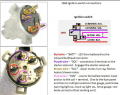
Here's a diagram of a common ignition switch from that era:

1790608113758.png
There are three sets things that are powered. When in the RUN position, both the ACC and IGN circuits get power, when in the ACC position, only the ACC circuits get power, when in the START position, both the IGN and the SOL circuits get power.
 

MisterBill2

Joined Jan 23, 2018
28,331
That's entirely normal. But I'd be willing to bet quite a bit that it did not remove power from everything except the starter. There still has to be power to the ignition coil for the engine to actually start, not to mention to the ignition switch itself in order to send power to the solenoid coil. I'd also bet it did not remove power to things that drew quite a bit more current, like the headlights. Removing power from SOME things while cranking is not the same as removing power from absolutely EVERYTHING other than the starter.
I addressed that in post #65. What I neglected to nention is that the "IGN" (ignition) terminal stayed hot while cranking. That terminal powers the spark system and probably the electric fuel pump. Moving the switch onto the steering column certainly changed a whole lot as far as the wiring goes. The last time that I examined an actual car electrical circuit diagram it was a vast document that was rather a challenge to follow.
 
Generally speaking of auto electrics - not everything was powered during start-up. I'm sure some things were. Ignition (breaker point) the coil power bypassed the ballast resistor giving full power to the coil to aid in spark ignition. Once the engine started and the key was released power to the coil flow was through the ballast resistor. We used to HOT wire the ignition and use a screwdriver to crank the engine. If you left it on HOT wire it would eventually burn up the coil. So - no - not everything else was cut from battery power.
 
Not sure how that relates to this conversation.
You're right. It does not relate to the conversation. However, it is a response to an argument in semantics. When starting an older car SOME of the electrical's were disabled. Radio, Heater, Headlights, all were not necessary to starting a car. The statement that the battery is disconnected from ALL other electrical's is an error. During starting of an older model car only the ignition and starter were engaged. As for brake lights (not afore mentioned) they are directly wired to the battery. Whenever you step on the brake pedal, engine running or not - the brake lights would light up.

Since the conversation revolved around the starter and the related drawing we've been discussing (or belaboring the point) that the drawing was inaccurate. That has been said far too many times for me to bother to go back and count all the different people who've said so, or the number of times it has been said.

Today, if I go out and start my truck, the moment I push the button (with the lights set to automatic) and the truck is in the garage, the headlights will come on. They will noticeably dim as the starter cranks the engine. So it is no longer true that all (there's that word again - it should be said "some") the electronics are shut off during startup.
 
Not now of days. But I remember seeing headlights and radio completely extinguish during starting. But now we're going WAY off topic. I'll not address this issue again.
 
Top