A PWM signal has a minimum duty cycle of 5% and a max d.c. of 95%. I need to switch on a LED when the d.c. is above or equal to 10%. And switch when d.c. il less then 10%.
Thank You for any suggestion.
Do you want an analog solution or do you prefer a digital (microcontroller) solution?
For an analog solution, you could use a low-pass filter which will give a voltage proportional to the duty cycle. Then a comparator could assess that voltage for your LED's.
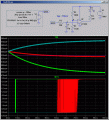
Green is 9% duty cycle, Red is 10% duty cycle, and Blue is 11% duty cycle. Note how the LED goes from full off to full on as the voltage from the LPF decays below the trip-point voltage of 528mV. Note that with R2 and R3 as shown, the trip point is ratiometric with the 5V supply, so if it is not exactly 5.00V, you will have to tweak R2/R3...
Green is 9% duty cycle, Red is 10% duty cycle, and Blue is 11% duty cycle. Note how the LED goes from full off to full on as the voltage from the LPF decays below the trip-point voltage of 528mV. Note that with R2 and R3 as shown, the trip point is ratiometric with the 5V supply, so if it is not exactly 5.00V, you will have to tweak R2/R3...View attachment 85016
Do you want an analog solution or do you prefer a digital (microcontroller) solution?
For an analog solution, you could use a low-pass filter which will give a voltage proportional to the duty cycle. Then a comparator could assess that voltage for your LED's.
Green is 9% duty cycle, Red is 10% duty cycle, and Blue is 11% duty cycle. Note how the LED goes from full off to full on as the voltage from the LPF decays below the trip-point voltage of 528mV. Note that with R2 and R3 as shown, the trip point is ratiometric with the 5V supply, so if it is not exactly 5.00V, you will have to tweak R2/R3...View attachment 85016
Very good solution.
From the Linear Technology datasheet of the LT1018, it seems that it can be used as Op Amp also. It may be of some advantage, use the second half of the LT1018 as an active low pass filter ? For all i know, a comparator is not a good choice for an op amp, but in this case, LT seems to propose that.
Thank You MikeML.
You can use any comparitor. I used the LT1018 because I knew it works on a single , low voltage supply....
The only advantage an active filter over the single pole RC filter I used is that the LED would turn on more abruptly, and follow changes in duty cycle a bit faster.
You can use any comparitor. I used the LT1018 because I knew it works on a single , low voltage supply....
The only advantage an active filter over the single pole RC filter I used is that the LED would turn on more abruptly, and follow changes in duty cycle a bit faster.

 Facebook
 Google
 GitHub
 Linkedin