Astable oscillator using transistor, capacitor and resistor and change duty cycle automatically

Thread Starter

hhsting

Joined Apr 25, 2024
395
Hi:
Please no Ics, no microcontrollers, no opamps, or any other semiconductor chips for below. Just a transistor, a capacitor, inductors, diodes, resistor.

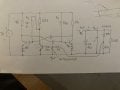
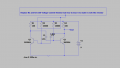
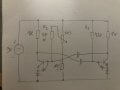
I have designed astable oscillator as shown below. However, now I want to change its duty cycle automatically. I am going to feed the output of the astable oscillator to the buck converter, which then would boost the voltage to get a steady 5.7 vdc. However, the problem is that I have 9vdc battery and as the battery drains, its voltage lowers. Therefore, I am not able to feed astable oscillator to the buck booster converter. I would need the oscillator to change its duty cycle and frequency as my battery voltage goes low, so that I get a steady 5.7vdc output from the buck converter. The only way to change this is to replace R2 and R3 with a transistor voltage control resistor without using any ICs, without using any microcontroller, and without any other chips, without opamps. However, I need help as to what size and where the resistor is needed in the transistor voltage control resistor, how to bias the transistor voltage control resistor, and finally, where to connect it. Can someone help me with that?
1755400367796.png
 
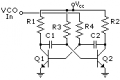
R3 let at it is and the top R2 connect to variable DC instead of permanent 9V. I recommend this variable DC should be in range 4-9V. With voltages under 4V the slope at Q2 base would have a slow rise and it could cause a jitter.

With this the signal at Vout will have fixed Ton and variable Toff.
 
Last edited:

Thread Starter

hhsting

Joined Apr 25, 2024
395
R3 let at it is and the top R2 connect to variable DC instead of permanent 9V. I recommend this variable DC should be in range 4-9V. With voltages under 4V the slope at Q2 base would have a slow rise and it could cause a jitter.

With this the signal at Vout will have fixed Ton and variable Toff.
I don't have any other source. My 9V is my battery would drain voltage lower over time from supplying the load, and so I am trying to get a stable voltage through a buck converter, but I would need to feed that buck converter with a square wave with variable duty factor that changes as the battery voltage gets lower.

I don't follow how you say this can be done?
 
You can get variable DC for supplying the R2 from trimpot:
IMG_2688.jpeg
Note: when you supply multivibrator with voltages higher than about 7V (your case) you have to block the EB breakdown by using 4 diodes (all 1n4148). So I rather supply the multivibrator with 6V so I don’t have to use them. The 6V you can get with zener diode.
 

Thread Starter

hhsting

Joined Apr 25, 2024
395
You can get variable DC for supplying the R2 from trimpot:
View attachment 354329
Note: when you supply multivibrator with voltages higher than about 7V (your case) you have to block the EB breakdown by using 4 diodes (all 1n4148). So I rather supply the multivibrator with 6V so I don’t have to use them. The 6V you can get with zener diode.
I can't do it manually. So no pottrim. I like to someone get a feedback loop to sense and change the resistance. I like all automatic no manual
 
It was just for illustration so you see how you can vary the duty.

For automatic feedback control you change this trimpot with transistor amplifier. As the Vout rises too much this transistor pull the top of R2 lower and increases the Toff (lower the duty) so the Vout falls back to normal.IMG_2689.jpeg
 

Ian0

Joined Aug 7, 2020
13,112
Does anyone else find it really annoying when someone asks for help on a project with seemingly arbitrary restrictions with no explanation?
Definitely, but what if he had asked "how was the oscillator and mark-space control on a switched-mode power supply implemented before the days of ICs?"
 

MisterBill2

Joined Jan 23, 2018
27,312
OK, the way to maintain a constant output voltage with a dropping supply voltage is to design a regulated switching mode supply. The bad news is that creating an efficient, accurate and stable, low noise switcher supply is a complex task indeed. Others have done it, though.
 

BobTPH

Joined Jun 5, 2013
11,483
Definitely, but what if he had asked "how was the oscillator and mark-space control on a switched-mode power supply implemented before the days of ICs?"
I would say “I don’t know.”
But I would guess that switching power supplies were rare at that time.
 

Ian0

Joined Aug 7, 2020
13,112
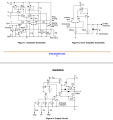
I think Motorola put the answer to the question (however it was posted) in the SG3525 datasheet.
Now, who has some transistors in stock with two collectors?

Screenshot from 2025-08-17 21-57-03.png
 

crutschow

Joined Mar 14, 2008
38,401
cs, no microcontrollers, no opamps, or any other semiconductor chips for below. Just a transistor, a capacitor, inductors, diodes, resistor.

I have designed astable oscillator as shown below. However, now I want to change its duty cycle automatically.
So you do the easy part of designing a standard two-transistor multivibrator, and want us to do the hard part of making it into a voltage-controlled circuit, with those strange restrictions on the types of parts that can be used.
Sorry, but I'm not wasting my time on that. :rolleyes:
 
Last edited:

Thread Starter

hhsting

Joined Apr 25, 2024
395
It was just for illustration so you see how you can vary the duty.

For automatic feedback control you change this trimpot with transistor amplifier. As the Vout rises too much this transistor pull the top of R2 lower and increases the Toff (lower the duty) so the Vout falls back to normal.View attachment 354330
Nice. Thanks, but what if Vout is lower than the threshold voltage I set? Then how does the circuit adjust the duty cycle to increase it?
 
When the Vout goes above 5V the voltage across 470ohm is 0.7V because of 4v3 zener. The transistor in the middle starts to conduct a bit and shifts its collector voltage lower than 9V.
The R2 is supplied with lover voltage now (than initial 9V) causing the Toff will be longer, i.e. it lower the duty cycle and decreases the Vout a bit (back to 5V). Also vice versa when Vout is too low like 4.9V it shifts the transistor collector higher.
 

Alec_t

Joined Sep 17, 2013
15,112
Please no Ics, no microcontrollers, no opamps, or any other semiconductor chips for below. Just a transistor, a capacitor, inductors, diodes, resistor.
With all those restrictions, is this a school/college/employer assignment you have been tasked with?
 

Thread Starter

hhsting

Joined Apr 25, 2024
395
With all those restrictions, is this a school/college/employer assignment you have been tasked with?
No its not school project. Its my personnel project as hobbyist. Thats all you need to know. You should note this all my posts are personnel projects. I am well out of school and I have no homework. I dont like repeating this over and over again different posts
 
Last edited:
Top