Push on, push off

AnalogKid

Joined Aug 1, 2013
12,126
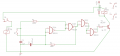
To be clear to the TS, the circuits in #1 and #3 are *not* equivalent. The circuit in #1 will not work as intended; the output will not toggle with each successive button press. Neither will the circuit in #11.

For this type of circuit (#3 and #10) to work, note that neither end of the switch is connected to either Vdd or GND. That is critical to the circuit's operation. In both #1 and #11, one end of S1 is connected to the +12. This will not work. For the circuit in #11 to work correctly, delete the connection between the R1-C1-S1 node and the +12 V.

ak
 

eetech00

Joined Jun 8, 2013
4,705
Hello

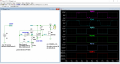
This is kinda what AK is suggesting.
I've changed the BJT to a Mosfet to relieve the output current requirement of the CD40106B.
You can replace the CD40106B with CD4093B connected as inverters if you like..

1573759654426.png
 

Thread Starter

FroceMaster

Joined Jan 28, 2012
708
HAve found that i have all the componentes except one,
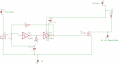
Can i substitude the Reed Relay (K2) with an Optocoupler 4N33. ?

And how ?
push4.png
 

AlbertHall

Joined Jun 4, 2014
12,625
and then there is this...

That circuit, as discuessed in another thread on here has a problem with a load which has capacitance. When the button is pressed to turn off, the capacitance maintains the output voltage then when the button is released the output voltage, via the 100k resistor, keeps the left hand transistor and therefore the MOSFET swoitched on.
 

Sensacell

Joined Jun 19, 2012
3,784
That circuit, as discuessed in another thread on here has a problem with a load which has capacitance. When the button is pressed to turn off, the capacitance maintains the output voltage then when the button is released the output voltage, via the 100k resistor, keeps the left hand transistor and therefore the MOSFET swoitched on.
... Solved with a Schottky diode and resistor?
 

Reloadron

Joined Jan 15, 2015
7,888
Just as a side note if you have not already done so, the CD4011 is a quad NAND chip and you are using two of the four gates. All unused inputs should be tied to VCC or GND so the inputs of the remaining two gates need to go to either VCC or Ground the outputs matter not and can be left floating.

Ron
 

MisterBill2

Joined Jan 23, 2018
27,507
It is difficult to read circuit intent from your drawing style.

This is what I transcribed (substituting inverters for NANDs) and put in a more conventional layout:
View attachment 191421
The circuit has some issues.
  1. You're loading the output of a logic gate that you need to maintain proper logic levels.
  2. You don't have a snubber diode on the coil.
  3. C2 might need to be larger. I have used this circuit and typically use 100nF.
What is the coil resistance?
Use the unused NAND gates to buffer the output of the flip flop.
The circuit is not the same as the original post. In that post one side of the switch went to +12 volts. That circuit would switch on when the button was pressed, but I did not see a way for it to switch off. It will start in an indeterminate state and will probably not change when the button is pushed.
Copy a normal bistable circuit and it may work, or use a CD4013 dual FF with a capacitor to assure a predictable state at power on, and your alternate action will be assured. But only if there is no contact bounce. It is also possible to have the circuit switch when the button is released, musch less likely to be falsely triggered.
 

AlbertHall

Joined Jun 4, 2014
12,625
That circuit, as discuessed in another thread on here has a problem with a load which has capacitance. When the button is pressed to turn off, the capacitance maintains the output voltage then when the button is released the output voltage, via the 100k resistor, keeps the left hand transistor and therefore the MOSFET swoitched on.
The thread I was looking for is below. See #12.
https://forum.allaboutcircuits.com/...oads-but-not-with-others.163057/#post-1431294
 
Top