How to trigger a relay based on a resistance drop in a Push to Start Switch

Thread Starter

Restomod

Joined Jan 17, 2026
70
My intent is to repurpose an automotive Push to Start switch.

This thread started to get close but they're chasing voltage signals... and I'm not sure I could apply power in the same way
https://forum.allaboutcircuits.com/...er-a-relay-when-voltage-drops-to-zero.138295/

What I have
open, the intended wire registers 1000 ohm resistance
When pushed 680-700 ohms

Would like a device to sense that specific drop in resistance to trigger a relay.

If it helps I will take that relay output using a readily available inverter to then arrive at the negative ground signal.
I will have two of these, one to trigger the starter, and the second to trigger the Ignition On circut.

thoughts on how to do this?
 

panic mode

Joined Oct 10, 2011
4,864
the answers in that thread very clearly state solutions to the stated problem. what part of that does not satisfy you?
variable resistance (your switch) connected in series with a fixed resistance, powered from constant voltage will result in current change when resistance changes. this change in current creates varying voltage drop at the mid point.
and this is something voltage comparators are designed for. comparators can drive relays. so where is the problem?
 

Thread Starter

Restomod

Joined Jan 17, 2026
70
Thank you for the reply.

The concern is knowing the voltage source - automobile - will vary, thus was hoping to not power, however similar to GM exhaust valves repurposed on stable 10v, will incorporate stable dc into this.

What is your reccomendation, 5v?
 

BobTPH

Joined Jun 5, 2013
11,463
Thank you for the reply.

The concern is knowing the voltage source - automobile - will vary, thus was hoping to not power, however similar to GM exhaust valves repurposed on stable 10v, will incorporate stable dc into this.

What is your reccomendation, 5v?
A constant current source can supply a consistent voltage across a resistor from a variable input voltage. Or, simply use a voltage regulator.
 

panic mode

Joined Oct 10, 2011
4,864
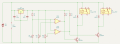
there are different ways to do this. example shown uses voltage comparators and stable voltage is obtained by 5V regulator.
one of the other obvious option is to use constant current source instead of R2 in schematics above.
but one would still need stable voltage for the two potentiometers... so why bother, resistor is cheaper and simpler.

the U2 can be any voltage but 2-6V is the sweet spot. instead of U2, you could also use resistor and Zener diode for example.
 

Thread Starter

Restomod

Joined Jan 17, 2026
70
There are two things that are with doubt, the article I referenced discussed a LM339, yours and another source, albeit incomplete LM393, LM393 is the correct choice?

Second RV1 10k, and the RV2, what is the purpose to have a potentiometer?
 

panic mode

Joined Oct 10, 2011
4,864
LM393 and LM339 are functionally equivalent. main difference is the number of comparators inside same IC. LM393 is smaller since only dual comparator.

trimpots can be replaced by fixed resistors if you know the thresholds that feel right.
if you do not know this in advance, they give you option to make an adjustment and choose exact point of activation (how much to press to see response). also resistors come in certain fixed values while with trimmer you can set value to anything - even "in-between" those fixed values/

i chose larger values (10k) to reduce current draw. but you can replace each RV with pair of resistors.
for example if you tested and found that one of resistances you are interested in is 820 Ohm, you can replace RV1 with 1k and 820 Ohm - just like trigger circuit. and if you want to reduce current consumption, increase values while maintaining the ration. for example use 10k and 8.2k
 
Last edited:

MisterBill2

Joined Jan 23, 2018
27,163
I started at post #1 and then looked at the other posts and while they certainly could work, it seems to me that something is overlooked, UNLESS the switch is in some rather unconventional circuit.
"Resistance Change" is not normally used in relation to anything else! In normal use, resistance is measured between two points, either at the ends of a resistor of some kind, or between two points in a circuit. So if "open, the intended wire registers 1000 ohm resistance
When pushed 680-700 ohms" my question is "TO WHAT POINT". OR, is this one of the "single-pair/multi-command" circuits that have a number of switches connecting different resistance values between two points?? That is a simple scheme avoiding a lot of wires to some control module, possibly a radio, allowing remote control from a steering wheel.
So the second question becomes "What else is connected??
 

Thread Starter

Restomod

Joined Jan 17, 2026
70
The Push Start circuit is used on nearly all automobiles these days and the voltage increase due to corresponding resistance drop is exactly how they do this in most switches, steering wheel controls included.

In this case - lets stay on point, push start buttons to not directly connect to radios, etc., they trigger one function - the starter to turn over the engine.

Only thing I am waiting on is the LM393 to make the board.

I'm not clear on the function of the second relay above so we are going to try this two ways.
 

MisterBill2

Joined Jan 23, 2018
27,163
The Push Start circuit is used on nearly all automobiles these days and the voltage increase due to corresponding resistance drop is exactly how they do this in most switches, steering wheel controls included.

In this case - lets stay on point, push start buttons to not directly connect to radios, etc., they trigger one function - the starter to turn over the engine.

Only thing I am waiting on is the LM393 to make the board.

I'm not clear on the function of the second relay above so we are going to try this two ways.
Post #11 did not at all answer, or even attempt to answer, my questions. I asked "Resistance relative to what point??, among other questions. One terminal resistance measurements have been questioned in other threads as well. They seem to be similar to one terminal voltage measurements.
 

Thread Starter

Restomod

Joined Jan 17, 2026
70
Post #11 did not at all answer, or even attempt to answer, my questions. I asked "Resistance relative to what point??, among other questions. One terminal resistance measurements have been questioned in other threads as well. They seem to be similar to one terminal voltage measurements.
input wire relative to GND wire OEM solutions are using 12,5,maybe 3 v and passing that to the BCM within same has a comparator circuit
 

MisterBill2

Joined Jan 23, 2018
27,163
input wire relative to GND wire OEM solutions are using 12,5,maybe 3 v and passing that to the BCM within same has a comparator circuit
OK, that was the missing information! An alternative scheme to interpret various commands would be to use a pull-up resistor to a constant voltage point, and then multiple resistances to allow several different voltages to be presented. I saw that scheme used in the setting keypad input for an alarm system. it used 16 keys through a single wire providing an analog input to an A/D converter IC. That was a brilliant design scheme, since the remote already had DC provided.
 

Thread Starter

Restomod

Joined Jan 17, 2026
70
Has anyone built this?

I'm not getting the expected function, connected to power the second relay clicks-engages, without the COM connected...thoughts?
 

MisterBill2

Joined Jan 23, 2018
27,163
A similar scheme could use one of those ten LED level indicator ICs (LM2914?) and not need any decoding. In my grand caravan there is some similar scheme used for the dozen buttons on the steering wheel. It is a really cheap way to carry a lot of commands thru a single wire.
But now the question is what other controls might be using the same wire???
 

sghioto

Joined Dec 31, 2017
8,633
Has anyone built this?

I'm not getting the expected function, connected to power the second relay clicks-engages, without the COM connected...thoughts?
The Com has nothing to do with the relay activating.
Are you saying when power is applied to the circuit the second relay activated without pressing the switch?
 
Top