Facebook
 Google
 GitHub
 Linkedin


panic mode
- Joined Oct 10, 2011
- 5,450
for connect battery and 100 Ohm resistor to the heart, you would need to go through layers of flesh. That alone i would constitute serious injury. in my career i have handled many different power sources but never managed to rip someone's chest cavity to connect electrodes to the heart. i guess one could say that i am not that experienced...1. Remember even 9V can electrocute a person. Imagine the heart is connected to the 9V battery with only 100Ohm resistance. I=V/R = 9V/100 Ohm = 90mA enough to stop the heart. Remember the story of the sailorman with faulty multimeter who died from 9V battery.
and no, I don't recall sailor with multimeter story. I mean sailors were also explorers and of course they got killed left right and center. they were dying from everything, dawning, burning, freezing, crushing, being bitten, burned by lava, being hanged, speared, gunned down, bombed, exposure to diseases, malnutrition, rogue waves, meteors, STD, jealous husbands, jealous wives, etc. I suppose it is only right that one of them could have died a multimeter...
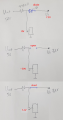
if there is a diode, diode would conduct and clamp that to +8V thus likely saving the IC. That is because Vf of the diode is nearly constant and Vs is a constant. So input at IC would be tied to something constant. in this case it does not matter what Vin+ is (except for R1 which could be getting hot or burning).3. I know your point 8V will be what the input to the bottom IC will always see. But what if there is no diode. In the bottom . Won't 7.2V still be seen by the input of the IC? Or 50V + 7.2V? 57.2? What voltage would it exactly see? Thanks.
if there is no diode (diode is replaced by a short circuit) then IC input would see Vs which is 7.2V, regardless of what voltage is at Vin+ (0V, or 50V or 100V makes no difference - except for R1 which could be getting hot or burning).
if there is no diode (diode is replaced by an open circuit) then IC input would see nearly full voltage of 50V if the IC input is high impedance. if you model that impedance as a fixed resistor of not too high value, then voltage would be as if R1 and that resistor have formed a voltage divider.