Checking zener diodes

Thread Starter

Rufinus

Joined Apr 29, 2020
306
Hi, I have a batch of SMD 2,5V 0,5W zener diodes. 5% tolerance (they are form a good supplier)

I is my first time checking zener diodes.

I pun in series with 1K resistor and the positive to the cathode.

These are my readings Vi is the power supply and Vo what I get with the DMM (also it is a good multimeter and a good power supply)
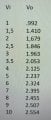
zen.jpeg
Are ok these numbers? I thought the diode should give the same voltage than te power supply under 2,4 volts and over 2,4 volts the voltage across the diode should increase slower.

Thank you

Best regards
 

WBahn

Joined Mar 31, 2012
32,811
Could you please go back and edit your first post to clean up all of the typos. It's making it very difficult to be sure what you are saying.

Also, please provide a sketch of your circuit and identify where you are taking your measurements. Vo is measured from what to what?

Do you have a part number for the diode or, better, a link to the data sheet?
 

ronsimpson

Joined Oct 7, 2019
4,686
The data sheet will tell you how the factory tested the part. Maybe at 5mA. (depends on the size of the diode)
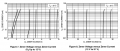
Here is a page showing how this diode was tested at 5mA, and 1mA and 30mA.

My guess is that Vin is the voltage across 1K resistor and the diode. Adjust the power supply so approximately 5V is across the resistor to make 5mA. (5V on the resistor and 2.5V on the diode = 7.5V) Now you should have the 5mA.
Note this is at 25C
1780318718529.png
This graph below shows the voltage and current for different diodes. High voltage Zeners are OK, low voltage Zeners are not good. A 5V Zener has a very flat V verses I curve. A 12V Zener has about the same voltage a 0.01mA and at 10mA. A 2.4V part changes voltage with current. 1780319061447.png
Hope this helps. RonS.
 

panic mode

Joined Oct 10, 2011
4,973
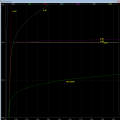
also note that zener diodes are not ideal... specially ones for lower voltage. here is an example of 5.1V diode and using variablle input voltage.

1780319719421.png

note that 5.1V output is not very firm... and it increases with zener diode current.
1780319879906.png
 
Last edited:

dl324

Joined Mar 30, 2015
18,321
Are ok these numbers? I thought the diode should give the same voltage than te power supply under 2,4 volts and over 2,4 volts the voltage across the diode should increase slower.
You misunderstand how zener diodes work.

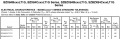
You mention that your diode is 2.5V, then mention 2.4V above. Here is the data for 1N5321 and 22 (the B suffix indicates 5% tolerance):
1780321185728.png
Note that the nominal voltage is specified at Iz. For 2.5V (and 2.4V) zeners, that's at 20mA. You never get to that current in your "tests".

The knee of lower voltage zeners isn't very sharp, so operating current is more important than for higher voltage diodes. At 20mA, a 5% tolerance 2.5V zener diode can be 2.375-2.625V.
 

panic mode

Joined Oct 10, 2011
4,973
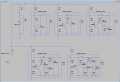
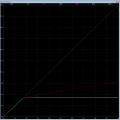
and if you are really into getting sharp response, usual remedy is to keep the current through zener low and more or less constant. the other issue with zener is that voltages come in certain "step" sizes. if you need to tweak it, or want sharper response curve, consider using some circuit rather than simple diode. here is an example of using BJTs as zeners. zener voltage is set using R5/R9/R14/R20 etc resistor.

1780320844389.png
it is easy to see that increasing number of transistors results in flatter curve. variant with 2x BJT is comparable to real zener.
1780320942050.png

in principle one can add one or two more stages
1780321532558.png
 

crutschow

Joined Mar 14, 2008
38,498
here is an example of using BJTs as zeners.
Those circuits are, of course, temperature sensitive, with the voltage dropping by about 0.3%/°C due to the change in the Vbe of the transistors.

You can make a low voltage, adjustable Zener type circuit with a sharp break and a very flat, stable voltage using the programmable TL431 or TLV431 inexpensive voltage references along with three resistors.

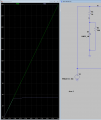
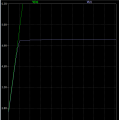
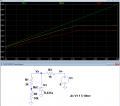
Below is the LTspice sim of an example circuit using the TL431 configured to give a 3V output (yellow trace):
The TL431 starts to conduct when the REF voltage (red trace) reaches 2.5V, as determined by the voltage divider resistors R1 and R2.

If you eliminate R1 and R2, and connect REF directly to the TL431 cathode, the output will be a regulated 2.5V.

1780327779670.png
 
Last edited:

MrChips

Joined Oct 2, 2009
34,796
The bottom line is, don't expect sharp and stable zener voltages especially for low voltages, anything below 5 V.
If you want 2.5 V, use a voltage reference instead of a zener diode.
 
Top