Strange result from I-V curves to characterize photodiodes

Thread Starter

christjjones

Joined Nov 6, 2020
4
We use photodiodes to study plasmas and they are subject to a lot of neutrons. This damages them over time and we swap them out without really any analysis. I saved a bunch that had various amounts of exposure to see if they're I-V curves varied in a predictable way. It's looking very promising except new ones show a strange curve. Can anyone explain what I'm seeing here?
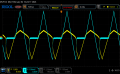
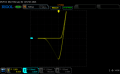
S2_Y-T.pngS2.png
Thanks!
 

MrChips

Joined Oct 2, 2009
34,626
I am going to hazard a guess that what you are seeing is the effect of capacitance of the diode.
The I-V curve follows the expected path for increasing forward voltage.
Then as the voltage swings back into the negative direction, it pushes the current negatively before recovering owing to reverse leakage current.

Try decreasing the sweep frequency of the generator.
 

Thread Starter

christjjones

Joined Nov 6, 2020
4
I am going to hazard a guess that what you are seeing is the effect of capacitance of the diode.
The I-V curve follows the expected path for increasing forward voltage.
Then as the voltage swings back into the negative direction, it pushes the current negatively before recovering owing to reverse leakage current.

Try decreasing the sweep frequency of the generator.
I thought that at first too but the current goes negative before the voltage crosses zero.
 

MisterBill2

Joined Jan 23, 2018
27,159
Quite interesting indeed. Now we can understand that neutron bombardment is a serious potential hazard.
What sort of effect has the bombardment had on the phototdiode sensitivity to light?? Or have they become sensitive to neutrons, instead??
Next question: Is that a plasma stream from a plasma cutting torch?? or something less common??
I know that a plasma torch is a fire hazard, are they a neutron hazard is my question.
 

Thread Starter

christjjones

Joined Nov 6, 2020
4
Quite interesting indeed. Now we can understand that neutron bombardment is a serious potential hazard.
What sort of effect has the bombardment had on the phototdiode sensitivity to light?? Or have they become sensitive to neutrons, instead??
Next question: Is that a plasma stream from a plasma cutting torch?? or something less common??
I know that a plasma torch is a fire hazard, are they a neutron hazard is my question.
I don't have any practical knowledge of plasma torches but I doubt they're emitting many neutrons. Also, neutrons aren't a direct hazard as far as radiation goes. They can cause secondary radiation hazards by making other things radioactive.
Our experiments involve high energy plasmas used to heat fuel for fusion experiments. I'm not a physicist but I'm pretty sure all the neutrons are coming from the fusion reactions. As for the damage, it causes regular LEDs to dim over time and photodiodes loose sensitivity and their dark currents go up. We usually use them until the dark current starts to dominate the output. I'm guessing they create irregularities in the crystal lattice of the semiconductor.
 

MisterBill2

Joined Jan 23, 2018
27,159
I don't have any practical knowledge of plasma torches but I doubt they're emitting many neutrons. Also, neutrons aren't a direct hazard as far as radiation goes. They can cause secondary radiation hazards by making other things radioactive.
Our experiments involve high energy plasmas used to heat fuel for fusion experiments. I'm not a physicist but I'm pretty sure all the neutrons are coming from the fusion reactions. As for the damage, it causes regular LEDs to dim over time and photodiodes loose sensitivity and their dark currents go up. We usually use them until the dark current starts to dominate the output. I'm guessing they create irregularities in the crystal lattice of the semiconductor.
Thanks for responding! Certainly there are evidently many varieties of plasma at many different energy levels. And knowing that the plasma mentioned is certainly quite high energy is good news.
 
I have made many Radiation detectors using a photodiode with a scintillation crystal attached to it for measuring Gamma radiation produced by our Synchrotron and storage ring. Over time the dark current increases due to radiation dosage. One particular location saw the photodiode's demise in a week due to very high radiation. I used a PMT (Photo Multiplier Tube) with a scintillation crystal instead. The PMT has not suffered any degradation in over a year of use.
 

MrChips

Joined Oct 2, 2009
34,626
I have made many Radiation detectors using a photodiode with a scintillation crystal attached to it for measuring Gamma radiation produced by our Synchrotron and storage ring. Over time the dark current increases due to radiation dosage. One particular location saw the photodiode's demise in a week due to very high radiation. I used a PMT (Photo Multiplier Tube) with a scintillation crystal instead. The PMT has not suffered any degradation in over a year of use.
Semiconductor photodiodes and PMT operate by completely different physics principles. It is not surprising that one suffers from radiation damage and not the other.

Have a look at THGEM, thick gaseous electron multiplier.
 
I looked into THGEM, very interesting. It would not work for me, our radiation is very high that it would turn the G10 PCB material into conductive carbon in a few months. I found this out when I made some Ionization sensors.
 
Top