Programmable Microsecond Pulse Generator

Ya’akov

Joined Jan 27, 2019
10,235
How you do envision controlling these?

I had envisioned a program I have written here that would trigger the pulses specifying their frequency and duration. It takes an arbitrary input I have here then returning output pulse specifications.

It can be computer controlled, by LabView if you are using it. It has direct entry for all the signal parameters. It does more than you want because it's not a programmable pulse generator but those are usually for very high frequency applications and cost a lot more.

I'm not using LabView so far, I had written my own application that creates the triggers - just nothing to connect it to at the moment; although it appears I can integrate existing code with it so will have a look; thank you.
LabView is sort of like Matlab: terrible but the best you can get for some things because it is ubiquitous.
If you are using LabView than you can look for data acquisition boards that it supports for your recording.
 

Reloadron

Joined Jan 15, 2015
7,889
I may need a different thread for this, but in addition to sending pulses I also need to record what is sent back from other electrodes. There are up to 256 electrodes that send back, I'll need to build some sort of mount to hold those wires but is there an off the shelf receiver that you would recommend too?

Just wanted to say thank you though for all your help so far, very grateful!
When you start looking at Data Acquisition units and want 256 channels you start looking at very expensive stuff and after the channel count you start looking at sample rates and bit counts for resolution. When you get into 256 very low level signals with for example 16 bit you start looking at very high end stuff. I bought systems from Measurement Computing before I retired just to name one. I would call a few suppliers and ask to speak with an applications engineer. You will have to answer a few questions like type interface you want for example USB or Ethernet. Amplitude of expected signals and other things. A Google of "256 channel data logger" should get you a few more suppliers. Again, you are not looking at inexpensive.

Ron
 

Danko

Joined Nov 22, 2017
2,169
I'm new to the electrical side of things, but I'm looking for a pulse generator that can send pulses in increments of 100 microseconds, 600 mV, frequency range 0.01-1 Hz.
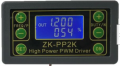
Here you go: https://www.ebay.com/itm/313602780316
1652413892903.png

Unit Price: US $7.31

ZK-PP2K High Power PWM & Pulse Generator Frequency Duty Cycle Adjustable Driver
Features:

1. Dual mode PWM mode and PULSE mode
2. LCD high definition display
3. Support frequency adjustment
4. Support duty cycle adjustment
5. High precision detection
6. Support power-down memory function
7. 1-Channel signal output
8. Support reverse protection
9. Support enabled/disabled output
10. Direct drive LED/Motor/solenoid valve

Parameters:
1. Product name: ZK-PP2K PWM Signal Generator
2. Model: ZK-PP2K
3. Work voltageDC 3.3V-30V
4. Frequency range:1Hz~150KHz
5. Frequency accuracy:2%
6. Duty cycle range:0.00%-100%
7. Output Current:8A(Max)
8. Number of pulses:1~9999 or Infinite
9. Delay time:0.000s~9999s
10. Pulse width:0.000s~9999s
11. Time accuracy:1ms
12. Signal loading capacity: less than 8A (MOS switch tube)
13. Output amplitude:Same to input voltage
14. Work Temperature:-20℃~85℃
15. Work Humidity:0%~95%RH
16. Size:79*43*26mm
 

dcbingaman

Joined Jun 30, 2021
1,065
There is also the option of using high gate count CPLD or a low end FPGA programmed in VHDL/Verilog etc. with a crystal clock source. FPGA modules can be purchased for less than $200 with extremely high precision that could achieve this goal with ease. You may have to invest some time in learning a hardware description language, but for your application, this would be a good solution.
 

Thread Starter

analogtv

Joined May 12, 2022
10
Thank you, for generation I've gone ahead and bought the SDG2042X. It only has two channels for output, so I would be interested in what components I would need to build out my own if I was looking at 256 outputs as well (this isn't terribly serious for now, just curious). For the FPGA modules let me know if you're thinking of any specific ones, I've previously used HDL a little and I was expecting to have to use that eventually after I've worked out the kinks with the smaller setups. Or if there's schematics and a BOM for having your own made.

For the reading/input, I've been trying to understand what is on https://www.ni.com/en-us/shop/data-acquisition.html but am a bit lost. And while I have googled 256 channel data loggers, I'm seeing a fair bit of difference. ni.com seems to have 8 channel ones from $1k to $8k; while whereas mccdaq.com has 8-64 channel ones for $1-$1.5k (here) and there are also stackable 8 channel DAQs for the Raspberry Pi from $100. Looking at the description of the specs I can't see what the difference is to account for the range in price? Is this just because it comes from a well known brand?
 

Danko

Joined Nov 22, 2017
2,169
I would be interested in what components I would need to build out my own if I was looking at 256 outputs as well
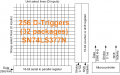
You can build it, very cheap:
1652575332824.png ________1652575624134.png
Price for 40 packages of SN74LS377N is US $15.47, include shipping - see HERE
ADDED:
You can remove "16-bit serial to parallel register".
In this case "Unit select lines" should be connected
to 16 GPIO leads of microcontroller, where data will
refreshed with 160 kHz frequency, so you will do
not need use 2560 kHz for periphery lines.
 
Last edited:

Reloadron

Joined Jan 15, 2015
7,889
stackable 8 channel DAQs for the Raspberry Pi from $100.
OK and looking at these units:

"Norton, Mass. Based Measurement Computing Corp. (MCC) has released a $99 measurement DAQ HAT for the Raspberry Pi that is optimized for single point and waveform voltage. MCC claims its board offers higher resolution, greater accuracy, and much faster sample rates than most other digital acquisition HAT add-ons for the Raspberry Pi. The MCC 118 provides 8x single-ended, 12-bit, ±10 V analog inputs with sample rates up to 100 kS/s."

Can you live with 12 bit? Can you live with +/- 10 Volt on each channel and no programmable gain? Can you live with that sample rate and keep in mind as you add channels the sample rate slows down. Can you live with single ended inputs?

That is just a little of what needs considered for your application. If you are looking at low level signals I do not see +/- 10 volts as useful. Pretty much what I wanted to stress back in post #25,

You really need to sit down with blank paper and a pencil with a large eraser and list shat id important to your project,

Ron
 

UweX

Joined Sep 2, 2020
35
Concerning the read back: the question is about expected frequency components and amplitude of the received signal.
for very low signals you can expect some unwanted noise at line frequency.
So what data you want to record? Line frequency signals can be removed by using shielded cable ( what is the source impedance = a long shielded cable can limit the maximum frequency response), by using an analog notch filter ( expensive, you need one for every recorded channel in front of any mux) or digital calculation ( works similiar as analog notch filter, but only piece of code).
 
Top