Problems Measuring DC HV

Thread Starter

Jazz2C

Joined May 27, 2016
52
So I know about the issues when a meter is floated but that's not the case with this setup b/c the output is ground referenced. The voltage source is clean DC continuously adjustable from 0 to 60kv at 5ma.

Ok here's where it gets weird, if I measure the output with two identical EHT voltmeters connected in parallel they track each other through their range 0-40kV no problem! But if there is anything else connected to the output that creates any sort of minor electrical noise (like corona) the paralleled EHT voltmeters disagree in a very strange way b/c one moves way upscale and the other slightly dips. I don't think it's ES fields doing it b/c the effect is similar no matter the layout.:confused:

Just so you know, the voltmeters are manufactured not DIY and each one is just a 20cm long 600M resistor in series with an analog uA meter movement.

Thanks!:)
 

jpanhalt

Joined Jan 18, 2008
11,087
Can you swap the resistors to see whether the different behavior is related to the uA meter movements or the resistors? How are the resistors made (e.g., carbon film, metal film, ??)?

If you can't do that, what happens if one meter is shorted?

John
 

nsaspook

Joined Aug 27, 2009
16,324
Ok here's where it gets weird, if I measure the output with two identical EHT voltmeters connected in parallel they track each other through their range 0-40kV no problem! But if there is anything else connected to the output that creates any sort of minor electrical noise (like corona) the paralleled EHT voltmeters disagree in a very strange way b/c one moves way upscale and the other slightly dips. I don't think it's ES fields doing it b/c the effect is similar no matter the layout.:confused:
It almost certainly is the fields having different surface loop interactions for each meter. If there is a corona you no longer have an electrostatic condition so the circulation of EM energy changes from pure KVL non-interaction between circuit elements.
 

Thread Starter

Jazz2C

Joined May 27, 2016
52
Big time thanks for all your help and time devoted to my problem!:cool:

Can you swap the resistors to see whether the different behavior is related to the uA meter movements or the resistors?
I haven't tried exchanging the resistors but altering the dress of the grounding leads can flip the effects or cause more bizarre readings even if the grounding leads are electrically pinned together right at the meters:confused:
If you can't do that, what happens if one meter is shorted?
A meter with a short across its movement reads zero.

I think it's time for some photos of the setup.
I wish I could! Rackin frackin VPN proxy!:(

Do the two probes have different frequency response specifications?
The probes are of identical manufacture and model number and are intended for measurement of DC only (for CRT 2'nd anode voltage).

It almost certainly is the fields having different surface loop interactions for each meter. If there is a corona you no longer have an electrostatic condition so the circulation of EM energy changes from pure KVL non-interaction between circuit elements.
That's a little over my head:oops: So are you saying the noise is producing AC phenomena like mutual induction, eddy currents, etc. and in that way interfering with the readings?

FWIW I'll try some more experiments with the layout and relate the results!:cool:


Aleph(0)

Joined Mar 14, 2015
597
So I know about the issues when a meter is floated but that's not the case with this setup b/c the output is ground referenced. The voltage source is clean DC continuously adjustable from 0 to 60kv at 5ma.

Ok here's where it gets weird, if I measure the output with two identical EHT voltmeters connected in parallel they track each other through their range 0-40kV no problem! But if there is anything else connected to the output that creates any sort of minor electrical noise (like corona) the paralleled EHT voltmeters disagree in a very strange way b/c one moves way upscale and the other slightly dips. I don't think it's ES fields doing it b/c the effect is similar no matter the layout.:confused:

Just so you know, the voltmeters are manufactured not DIY and each one is just a 20cm long 600M resistor in series with an analog uA meter movement.

Thanks!:)
JC I was having the very same kind of problems and asked HP about it here:
http://forum.allaboutcircuits.com/t...n-and-construction.113504/page-22#post-977176

So she gave brief explanation of reason for difficulty on that thread (which you claim to have totally read all the way through:rolleyes:) and more detailed suggestions for remedy by email. Sry cuz I don't have time now but I can post on here later:)!

But to summarize; @nsaspook nailed it:cool:!
 

#12

Joined Nov 30, 2010
18,224
In a doctors office, a patient said, "It hurts when I move my elbow like this."
The doctor said, "Don't move your elbow like that.":eek:

I understand that you want to know the, "why" of it, but as a pragmatist, I recommend you simply don't use 2 meters to measure the same thing at the same time.:rolleyes::D
 

Aleph(0)

Joined Mar 14, 2015
597
Yup, Me too, Try 100 kV@ 0.1A ot 15 kV at 1,5 Amps. 6.3 V at 3000 A is a bit weird too. So is 2 pA at 100 V or 1000 W RF 13.56 MHz in to 50 ohms.
KeepItSImpleStupid I like playing with electricity too (which I come by naturally from HP:D) Her 240v line operated transformers give 150kv at 100mA continuous and like 500mA on a 1:6 d/c so up to 75kw so that's 320 amps on primary (which is 312.5A+ abt 8 amps to overcome core losses). But I say the most awesome of all is the one with 480v three phase primary which has a 320kv 625mA (which is 200kw) secondary:cool:! HP got POed with the poco for tearing up landscape adding a little substation to supply her electrical toys but it's more fun to run them to full potential (npi) than just ballasting them:D I say HP is an electrical snob cuz she insists on filtered HV so she uses huge caps she calls _power factor correctors_ to filter rectified HV. I don't know their capacitance but once one flashed over and shock front broke windows in building 200 yards away!

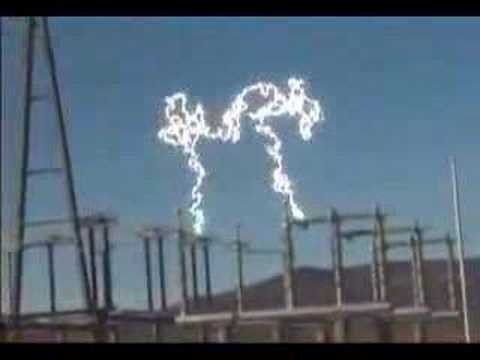
I can't stop thinking what a mean Jacob's ladder the big 320kv, 200kw transformer could make if HP would give her mantra about _conservation of materials_ (by which she means never taking a chance with rare items) a rest:rolleyes:

Maybe like this:D!


PS 10kw, 15kw or 75kw on 13.56 mhz? what's up with that? And 19kw worth of filaments:confused::)!?
 
Last edited:

Aleph(0)

Joined Mar 14, 2015
597
In a doctors office, a patient said, "It hurts when I move my elbow like this."
The doctor said, "Don't move your elbow like that.":eek:

I understand that you want to know the, "why" of it, but as a pragmatist, I recommend you simply don't use 2 meters to measure the same thing at the same time.:rolleyes::D
#12 I think JC's concern is well founded cuz it means those meters aren't reliable if there's just tiny electric noise in the circuit even if he's using just one:(.

In a doctors office, a patient said, "It hurts when I move my elbow like this."
The doctor said, "Don't move your elbow like that.":eek:
To me it sounds more like a duck (as in quack) than a _doc_ I say time for a change of provider:D!
 
Last edited:

Aleph(0)

Joined Mar 14, 2015
597
@Jazz2C after this keep conversations you have in threads totally on thread cuz it's confusing and rude to ppl trying to help you when you also ask by email behind the scenes:mad:!

So here's link to pdf you emailed me
http://www.netaworld.org/sites/default/files/public/neta-journals/NWsu08 - Genutis.pdf

Here's pdf text you mistakenly think _exonerates_ corona as problem:

Article said:
DC leakage currents are typically measured in units of microamperes, and corona (and partial discharge) can be
measured in units of charge known as picocoulombs. One coulomb is defined as one ampere second. Although it is
not quite correct to compare leakage current with charge, we can get a relative feel for the fact that it will take a lot
of corona to influence the leakage current values. Experiments performed in our laboratory seem to support this
statement. So, under most circumstances corona is unlikely to significantly affect test results.
JC you totally missed the point that author of article is talking about leakage currents caused by corona! Your problem is down to transmission line effects and electric fields caused by corona or other modes of disruptive discharge! It doesn't have to be so difficult, JC! Anyhow HP will be back in a few days so she can show you whys and wherefores cuz she has more patience!
 
Last edited:
KeepItSImpleStupid
PS 10kw, 15kw or 75kw on 13.56 mhz? what's up with that? And 19kw worth of filaments:confused::)!?
1 KW at 13.56: RF sputtering system
100 kV @ 0.1 A - X-ray diffraction set
The 15 kV at 1.5 A - e-beam evaporation system

All systems I had to maintain or maybe i should say re-build. When I got done with the 100 kV system, it was more stable than it ever was. When I got done with the ebeam system (It used to break every six months before my time), it quit breaking.

There's no room for error working on this stuff and frequently I did this alone.

the arc lamp power supply was another weird one. 22 V at 45 A with a 40 kV pulse to start.

I never had to deal with the 6.3 V AC system at 3000 Amps, though. The wires were like 8" x 1/4" solid copper bars.

Maintaining an old SEM (Scanning Electron Microscope) was fun too. It was built with all 741 OP-Amps. Later we got a Microscope with a service contract. One of our earlier systems I helped put together was an EDAX (Energy Dispersive Analysis of X-rays). We just used a cheap multi-channel analyzer, a modified pre-amp and a commercial detector. The most the detector could stay without LN2 was about 4 days then it was bad. The software makes the EDAX.

Working in the Pico-amp regime is yet another ball game.

Vacuum systems is another are. I wondered why there were so many bolts on a 8" port. There's like 800 lbs of force on that flange.
 

AlbertHall

Joined Jun 4, 2014
12,625
I did once find myself unscrewing the output cable from a 3kW 1GHz transmitter when I suddenly realised that it was still switched on.
I decided it was probably not a good idea to continue unscrewing,
 

Aleph(0)

Joined Mar 14, 2015
597
100 kV @ 0.1 A - X-ray diffraction set
KeepItSImpleStupid Plz tell more about 100kvp diffractometer? I've never heard of PEs above 40kvp (which is λ of 31pm) being used for crystallography:confused: So was it special purpose instrument?

1 KW at 13.56: RF sputtering system
KeepItSImpleStupid now I know what 13.56mhz ISM band is for:)!

I did once find myself unscrewing the output cable from a 3kW 1GHz transmitter when I suddenly realized that it was still switched on.
I decided it was probably not a good idea to continue unscrewing,
AlbertHall that reminds me of old time Star Trek episode when the ensign tried to unplug Dr. Daystrom's computer:eek:!
 
Last edited:
KeepItSImpleStupid Plz tell more about 100kvp diffractometer? I've never heard of PEs above 40kvp (which is λ of 31pm) being used for crystallography:confused: So was it special purpose instrument?
It was indeed a defractometer. The X-ray supply was built like in the 1940's. No regulation. All of the "electrics" was build on like a 2' x 2' panel.
Varacs, meters, rheostats, relays. The transformer was a big cicrular object, Maybe 2' in diameter and a foot high, the diodes were mounted on top of the xformer. The filament xformer was mounted on the HV output.

I do believe it operated around 40 kV and like 7 mA? I think we had copper and Moly.

==

There was a joke that implicated me about doing something. they all said they didn't do it. They always got me to do it.

One guy invented a name for some of my not so perfect set-ups. They were known as Kill-me-quicks".
A typical example. Had to turn on a bunch of 3 WATT valves, but the controller wasn't designed yet, So, you stuff the wires into a outlet strips sockets with integral switches and it works fine.

Or, someone has to haul out a huge TIG welder (200 AMPS plus) to weld a 1/4" tube. So, I grabbed the nearest outlet. Maybe 208, 60 A and pulled the rather smallish wires out to run a 200 A TIG welder that was like 5' x 3' x 2.5'. Disconnecting the tubes really wans;t an option.

The lines were initially orbital welded with a rented machine.

In an upgrade, we had to do a tube within a tube deal because it left the vented space.
 

Aleph(0)

Joined Mar 14, 2015
597
I do believe it operated around 40 kV and like 7 mA? I think we had copper and Moly.
Ok so I get it! 100kv is max xfmr output but 40kv is actual operating point for your application:)?

One guy invented a name for some of my not so perfect set-ups. They were known as Kill-me-quicks"...
Ha ha! Been there! HP calls my not so safe designs "lay_a_you in your grave" contraptions:rolleyes::D
 
Top