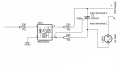
Problem with SCR and Optocoupler triggering

Thread Starter

Ahmad786

Joined Feb 4, 2025
1
I have developed a dimmer circuit for 1000w halogen lamp.... But the problem is that when voltage applied to lamp is less than 200v,it works perfectly. But when i increase voltage to 220v or connect circuit at nearest point to the power supply, the optocoupler stop wokering..... I have used two MOC 3021 optocouplers to trigger two back to back connected SCRs(BT-152).....Don't know what's the problem.... Circuit diagram is attached... Please help me out...
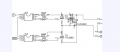
EG57_ 2643.png
 
Last edited by a moderator:

MisterBill2

Joined Jan 23, 2018
27,159
Questions: Do BOTH opto-couplers stop working, or just one, AND is the poser supply adequately filtered. Consider that half cycle power would probably only operate one or the other opto isolator.
 

sghioto

Joined Dec 31, 2017
8,633
.Don't know what's the problem.... Circuit diagram is attached... Please help me out...
First thing, why use two SCRs when a single Triac like the BTA16 with one MOC3021 works better?
Show the rest of the schematic on the control and power supply sides.
1738856846967.png
 
Last edited:

MisterBill2

Joined Jan 23, 2018
27,159
While the two guesses at the whole circuit seem quite reasonable, WHY did the TS hide part of it??? In some cases the flaw is in the part that is kept from us, and that greatly delays the arrival of any useful solution.
 
Do you have greater than 15mA of drive current for the coupler LEDs? FYI you only need a single optocoupler if you follow figure 8.1.b of the GE SCR manual: https://archive.org/details/GESCRManual1964/page/n219/mode/1up
Had to join to thank you for that interesting link. I have an old 5kW lamp dimmer I'm intending to use for phase control of a 3kW heater. It has back to back SCRs which look like they'd survive a nuclear explosion, and there's no reason to replace those with a triac. The drive circuit (containing germanium transistors) is transformer-coupled to the SCRs and although I could keep this transformer and emulate the rest, it would be easier and neater to use opto-coupling.
 

BobaMosfet

Joined Jul 1, 2009
2,211
Lamp dimming circuits are zero-cross detectors so that they can switch on and off and control the waveform without spikes, etc.

Normally, a lamp dimmer circuit has a small circuit to rectify AC so that it can capture and hold enough DC power to operate the main controller. Almost all commercial lamp dimmers use 2 ICs, one for control and one for chopping.

These are used for 3-touch dimming lamps:

TT6061A <- controller
BT136 <- Triac

Data Sheets here:
 

Attachments

Thanks, but this is rather more sophisticated. It is to feed excess solar power into the heating element, so will be under computer control, which will be via a Modbus RS485 interface. I'm currently using burst firing, pulsing the element at full power for a proportion of each second. This worked splendidly until I got a new electricity meter which has a different algorithm to emulate an electromechanical meter. It is far less forgiving of short bursts of energy import followed by export, charging me even though the net import is zero. So I have to go the phase control route, which of course requires a lot of EMI filtering. There is a large inductor and capacitor in the ancient dimmer to provide this.

I intend to use an Arduino Nano with an opto-isolated zero crossing detector generating an interrupt every 10 ms. The service manual for the dimmer shows the SCRs being triggered with a 1.25 kHz pulse train of 5% duty cycle. As the load is non-inductive it may not be necessary to emulate this. The Arduino will be powered with the guts of a USB power supply.
 

schmitt trigger

Joined Jul 12, 2010
2,027
The service manual for the dimmer shows the SCRs being triggered with a 1.25 kHz pulse train of 5% duty cycle. As the load is non-inductive it may not be necessary to emulate this.
This is what is called “picket fence triggering”, and is necessary if you’re using transformer gate drive only. For optocupler, all that is required is a pulse at the correct firing phase angle and with **the correct pulse width to allow the SCR to fully latch**
This last sentence is very important, because the latch time is wholly dependent on the time it takes to build up current to a value higher than the minimum latching current. You cannot imagine the several projects I have seen that fail because they didn’t follow this rule.
To make it fail safe, I would always stretch the trigger pulse all the way to the next zero crossing.
 
Yes good point - not being able to pass DC through a transformer. It's a tiny thing anyway and I am a bit dubious about its isolation - it's not a split bobbin which would make that obvious. The amplitude of the waveform is also about 15 V which is a pain as it would have to have its own supply rail. Thyristors are probably BTW24-600R which need up to 100mA gate current.
 

MisterBill2

Joined Jan 23, 2018
27,159
I have not seen the transformers being discussed, but at one time, long ago but not far aay, PULSE transformers were used to trigger SCR devices. They were low impedance so they could provide the current if driven correctly.
 

Ian0

Joined Aug 7, 2020
13,097
It is far less forgiving of short bursts of energy import followed by export, charging me even though the net import is zero. So I have to go the phase control route, which of course requires a lot of EMI filtering. There is a large inductor and capacitor in the ancient dimmer to provide this.
Is that going to help? Won't you get import during the time when the SCRs are on, and export while they are off?
How well is your inverter going to cope with a phase-fired load?
Do you have direct grid-connected solar, or does the solar charge a battery, and the inverter feed power from the battery into the grid?
 
Is that going to help? Won't you get import during the time when the SCRs are on, and export while they are off?
How well is your inverter going to cope with a phase-fired load?
Do you have direct grid-connected solar, or does the solar charge a battery, and the inverter feed power from the battery into the grid?
Good points. Yes, you will (likely) get import while the SCRs are on and export while they are off, but the emulation of the inertia of an electromechanical meter ought to average it out to zero. The old electronic meter did this for burst firing of one pulse per second; the new smart meter still appears to do this for a 1.8 kW kettle element, but not a 3 kW immersion heater, even if I double the frequency of the burst firing. (Another problem with the smart meter is that its pulsing LED flashes for import or export, whereas the old meter's LED glowed steadily on export. In addition, the in-home display not only doesn't display export amount, but only updates every 10 seconds. I had built a little module based on an Arduino that coupled to the LED on the old meter, displayed how many watts you were consuming and could even be set to bleep if not exporting - but this is now useless.)

Similarly, I hope the inverter will be fine with phase control as it's designed to deal with loads with low power factor, and experiments show it manages to maintain export of a few watts when there's a base load of a few tens of watts of mostly switch-mode power supplies, which will produce an extremely nasty current waveform.

A complete system would consist of a direct inverter plus a hybrid inverter with battery on an additional string of panels, being able to charge the battery from both. It will be necessary to adjust the heating element power to prioritise battery charging, which isn't as simple as just maintaining zero export.
 
Top