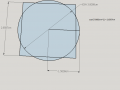
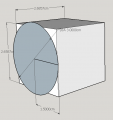
Problem collection

BR-549

Joined Sep 22, 2013
4,931
This is very basic geometry.

This is an old geometry examination question.

It only seems complicated.

It's purpose is to make you think the answer is complicated.

It use to be known as a trick question.

I haven't seen it in years.

We use to drive the calculus class nuts with it.

I can't believe it still works.


Bye to way.....those 12 curves lay on that non-existent sphere.

I suggest looking at some pipe welding videos and some pipe joint x-rays.

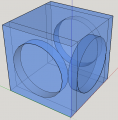
If that does not convince you, my last suggestion is build the hollow manifold......look down all three axis.

What do you see?

You see three round holes.

What looks round from three different directions?
 

studiot

Joined Nov 9, 2007
4,998
I didn't want to use wolfram alpha, but it is a good link.

Anyway here is a simpler explanation.
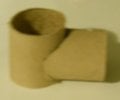
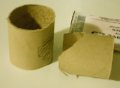
cyl1.jpg cyl2.jpg

The first shows two cardboard cylinders mated by flattening one and cutting out the appropriate circumference and reopening the cylinder to offer it up to the other.

The second shows the two apart with the surface of the whole cylinder that is inside the cut one shaded.

This surface cannot be part of the surface of a sphere.

This is because the surface of a cylinder has only one direction of curvature, whereas the surface of a sphere has two directions.

So any part of the surface of any cylinder cannot be part of the surface of any sphere.

This can easily be seen for yourself by playing with a cardboard tube.
 
Last edited:

Thread Starter

cmartinez

Joined Jan 17, 2007
8,762
Maybe what @BR-549 is trying to say is that a sphere does fit in the intersection, and that it can be auxiliary in calculating its volume somehow?
 

studiot

Joined Nov 9, 2007
4,998
They also explain how to lay it out for sheet metal work using circumscribing and inscribing spheres.
This may be what BR549 was thinking of.
Which is what I said in post#40.

What that meant was that the actual shape touches a sphere at certain points.
This may be used to by a draftsman when creating engineering drawings (the old fashioned way) of the intersection, to locate specific fixed points on his drawing.
It does not mean that the volume of the sphere bears any relation to the volume of the shape.
 

BR-549

Joined Sep 22, 2013
4,931
I have shown you my complete solution for the problem.

I have shown you the procedure, reasoning, the math and common sense ways to verify.

Where's yours?

Not only is my solution true and correct. It is the ONLY solution.

Where's yours?

I gave you an exact numerical answer to the problem(7.47cu.cm.).
I explained very precisely how I arrived at the solution.
No mumbo-jumbo....no magic....a very clear explanation.

Where's yours?

You can use "lathe" theory or "cut pipe end theory" or "hollow cylinder theory".

Let's say that you are right and I am wrong. So we don't have to talk about why I am wrong.

So now....you tell and explain to me....what is the volume of the holey cube?
 

WBahn

Joined Mar 31, 2012
32,833
You have NOT proven that your approach is correct. You have merely CLAIMED it is correct and then all of your "proofs" have been circular since they have relied on the assumption that your claim is correct.

That the intersection of the three cylinders is NOT a sphere is actually very easy to visualize (and I should have seen it before, but didn't). Start with a cylinder (you can picture this as been the material that is removed from the cube when the first hole is made). Now cut out a section from this cylinder using a second cylinder as the cutting tool at right angles to it. If you look down the cutting tool you will see a curved face that will be left intact by this cutting operation and this curved face is NOT spherical, but cylindrical. Now perform the final cut on this section using the same cylindrical cutting tool coming down the third axis. Look down this cutting tool and you will see part of the face left intact by the previous cut and this surface, which is NOT spherical, will be left intact by this third and final cutting operation. Hence the final intersection of the three cylinders is NOT spherical.
 

studiot

Joined Nov 9, 2007
4,998
Is it not the volume of the cube, minus three times the volume of one cylinder, plus twice the volume of the central shape ?
 

strantor

Joined Oct 3, 2010
6,875
Here goes my half baked solution:

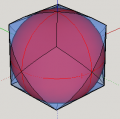
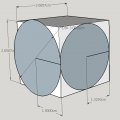
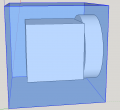
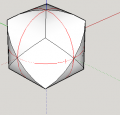
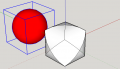
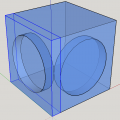
I expect that the internal shape (rhombic dodecohedron?) will have a volume slightly more than the volume of a sphere that is inside it of the same radius. I demonstrate that here, with a sphere of radius 1.5 and the internal shape made from cylinders of radius 1.5:
before merging:


after merging:
0.2.png

after merging, showing the red sphere contacts the internal shape only on 3 planes:


So to find the volume of this internal shape I find it easier to work with squares and cubes than circles and spheres.
I convert a circle of radius 1.5cm to a square of the same area:


Now I calculate the volume of a cube with dimensions of the square:


However this cube cannot represent the actual volume of the shape because the introduction of the 3rd axis in circular form (actual) will be less additive than in in cube form (simulated). So I must now bring in round shapes to the equation. I represent the 3rd axis as a circle/cylinder with a radius equal to half the side of the cube:
4.png
and make it a cylinder:
5.png

So initially I expected the volume of the internal shape to be just slightly more than the volume of the same sized sphere (14.1372cm^3) and this seems to fit the bill. I am not 100% certain of this answer but it seems likely correct to me, so I move on.

I take this calculated volume of the internal shape (14.7593cm^3) and turn the shape back into a cube. This internal CUBE shape has sides of 2.4529cm (14.7593^.333333), leaving a distance of .7736cm from each face of the internal cube to each corresponding face of the external cube.

Now we can calculate the volume of 6 cylinders with a height of .7736cm and a radius of 1.5cm
6.png

The volume of each cylinder is 5.4683cm^3. Multiplied by 6 cylinders is 32.8098cm^3. Plus the volume of the internal cube (14.7593cm^3) is 47.5691cm^3. Subract this value from the volume of the external cube (64cm^3), and you're left with 16.4309cm^3.
 

Attachments

strantor

Joined Oct 3, 2010
6,875
The intersection is not a sphere....only the shared volume of the intersection is a sphere.

A 4x4x4 cm cube is 64 cubic centimeters.

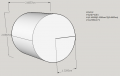
A cylinder 3 cm in diameter and 4 cm long is 28.27 cubic centimeters.

A sphere 3 cm in diameter is 14.14 cubic centimeters.

The volume of an end cap is 28.27-14.14/2.

The volume of an end cap is 7.07 cubic centimeters.

Six end caps is 42.40 cubic centimeters.

The total volume of the orthogonal structure is 6 end caps and 3 cm

sphere, which is 56.53 cubic centimeters.

That leaves the holey cube with a volume of 7.47 cubic centimeters.

Verify weight before and after.

Also verify water displacement before and after.

This should satisfy you.
That cannot be correct, I will prove:

If I calculate the volume of just one side of the cube as shown here (the highlighted section), I do not need to think about the internal shape or anything. I keep my calculation constrained to the point where the internal cylinders meet, and I can calculate just the volume of a box and subtract the volume of a cylinder:

7.png

The volume of the highlighted box is 4cm*4cm*0.5cm = 8cm^3.
The volume of the cylinder inside is 3.53cm^3.
8-3.53 = 4.47cm^3

This shape will exist on the opposite side of the cube as well:
8.png

So 4.47 *2 = 8.94cm^3

The cube already has more volume than 7.47cm^3, and I haven't even added the other (smaller) sides yet, or the curved volumes.


Edit:
I have applied this check to the remaining sides:
after the two 4cmx4cm sides are calculated (8.94cm^3), we are left with 2 sides of 4cmX3cmX.5cm with a volume totalling 4.94cm^3, and 2 sides of 3cmX3cmX.5cm totalling 1.94cm^3.
Add all that up, and you get 15.82cm^3 not including the internal curved surfaces. It is not possible for the final answer to be anything less than 15.82cm^3.
 
Last edited:

WBahn

Joined Mar 31, 2012
32,833
Is it not the volume of the cube, minus three times the volume of one cylinder, plus twice the volume of the central shape ?
In general (and I don't think for this problem) I don't think this is true because it does not account for the volume of material that is common to two, but not all three, of the cylinders.

In general, when we remove three volumes of material, {A',B',C'}, which have overlap we do not necessarily remove a total volume of (A'+B'+C') due to possible overlaps. We can break the three volumes into disjoint subvolumes {A, B, C, AB, BC, CA, ABC} where each subvolume consists of the material that is only within the named volumes and not within any unnamed volumes. Thus we have

A' = A + AB + CA + ABC
B' = B + AB + BC + ABC
C' = C + BC + CA + ABC

In our case, A', B', and C' are each the volumes of a right-circular cylinder the diameter of the hole and the length of the cube, while ABC is the volume of the central shape.

We can get the volume of the holey cube, in terms of these subvolumes, a couple of different ways.

First, we can note that each of these subvolumes, in reality, is removed exactly once. So if the starting volume of the cube is V, the final volume, X, is

X = V - (A + B + C + AB + BC + CA + ABC)

We can then simply manipulate it into a form that uses the cylindrical volumes:

X = V - ( [A + AB + CA + ABC] + [B + AB + BC + ABC] + [C + BC + CA + ABC] - 2(ABC) - (AB + BC + CA) )
X = V - [(A'+B'+C') - (AB+BC+CA) - 2(ABC)]

This makes sense because as we subtract a cylinder, we will subtract the volume unique to it once, the volume shared by it and just one of the other cylinders twice, and the volume shared by all three cylinders three times. Thus, we need to add back in one of the volumes shared by only by two cylinders and two of the volumes shared by all three.

In our case, by symmetry, we know that A'=B'=C' and AB=BC=CA, so we can reduce this to

X = V - 3(A') + 3(AB) + 2(ABC)

We should get this same result by walking through the processes directly.

We start with the volume of the cube and subtract one cylinder:

V -> V - A' = V - A - AB - CA - ABC

Next we cut the second cylinder, noting that we don't remove material already removed

V -> V - (B + BC) = V - A - B - AB - BC - CA - ABC

Finally, we cut the third cylinder, noting the same constraint

V -> V - V = V - A - B -C - AB - BC - CA - ABC

Which is what we started with before.
 

studiot

Joined Nov 9, 2007
4,998
W Bahn, that is what I said, in repentence.

Here is my worked solution. I have taken advantage of symmetry.

Edit sorry my reference to post 40 in the calcs should read post 38

It does not matter what the actual shape the joint pieces are, we only need the differences.
cyl3.jpg
cyl4.jpg
 

WBahn

Joined Mar 31, 2012
32,833
Okay. I didn't see the prior post (or don't remember the details).

I agree with your general solution. I need to look back over the details specific to this problem to see if I agree with your specific solution. I don't have time to do it now, but I think I see the approach you took and, if so, then I agree. At the very least it has brought an approach to mind that, if different than yours, may allow a somewhat different approach that will hopefully confirm your result. Maybe this weekend I can play with it some.
 

studiot

Joined Nov 9, 2007
4,998
The formulae given in cmartinez link (post#42) for the 'steinmetz' solids are the same as mine, except they are in terms of the radius, not the diameter.
 
Top