Problem collection

Thread Starter

cmartinez

Joined Jan 17, 2007
8,762
Ok, here are my two cents.


Using AutoCAD I drew a cube measuring 1x1x1, and I drew three intersecting cylinders, each 1 unit in diameter and 1 unit high

Capture02.JPG

Then I put the two together, and subtracted the cylinders from the cube:
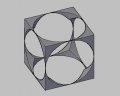
Capture03.JPG

And finally, I isolated one of the figure's 8 corners:
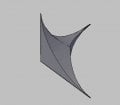
Capture04JPG.JPG

Calculating the volume of this figure would help us solve the entire problem. From my point of view, it's clearly a problem involving integral calculus.
 

t_n_k

Joined Mar 6, 2009
5,455
So it looks like the answer is given by

\( V=S^3-3\pi R^2 S+8\sqr{2}R^3 \)
Where S is the cube side length and R is the hole radii.
Certainly gives the answer which seems to be the correct value (V=17.360765 cc with S=4 cm & R=1.5 cm) as posted by @studiot
Took me a good deal of work to reduce it to that form. I started with an approach similar to that suggested in post #81 by @cmartinez.
 
Last edited:

studiot

Joined Nov 9, 2007
4,998
Well done tnk for deducing that formula.
It tidies up my working and I can confirm that it is equivalent to mine if you change the radius to diameter.
 

tjohnson

Joined Dec 23, 2014
611
From my point of view, it's clearly a problem involving integral calculus.
Actually, it can be solved without calculus if set notation is used. The thread on PhysicsForums.com that I mentioned explains this better than I can. To summarize the conversation in that thread, someone thought calculus was necessary to solve the problem and used it to find the answer, but later discovered that the following formula (which I mentioned in post #80 of this thread) is equivalent:
\(V = V_{cube} - 3 \times V_{cylinder} + 3 \times V_{bicylinder} - V_{tricylinder}\)
This formula makes use of the equations for the volume of Steinmetz solids, which are derived using calculus, but it avoids the use of calculus directly.

@t_n_k: Your equation is marvelously compact! I need to learn calculus.;)
 

studiot

Joined Nov 9, 2007
4,998
tjohnson, I'm not sure you can avoid calculus to fully derive the volume form first principles.

We all depend on tables of known data and formulae derived by earlier workers.
So we are familiar with the area of a circular disk and the volume of a spherical ball, and combine these to produces areas and volumes for more complicated shapes.
But could you derive circular areas and spherical volumes without calculus, (including calculus in disguse as a limiting process)?
 

tjohnson

Joined Dec 23, 2014
611
tjohnson, I'm not sure you can avoid calculus to fully derive the volume form first principles.

We all depend on tables of known data and formulae derived by earlier workers.
So we are familiar with the area of a circular disk and the volume of a spherical ball, and combine these to produces areas and volumes for more complicated shapes.
But could you derive circular areas and spherical volumes without calculus, (including calculus in disguse as a limiting process)?
@studiot: I'm not quite sure what you mean. I mentioned in my previous post that the formula makes use of equations that were derived using calculus. But since other people have already derived the equations for the volume of Steinmetz solids, I didn't need to use calculus to find the correct answer.

I simply plugged the necessary values into this equation:

\(V = V_{cube} - 3 \times V_{cylinder} + 3 \times V_{bicylinder} - V_{tricylinder}
= L^3 - 3\pi r^2L + 3\frac{16}{3}r^3 - 8(2 - \sqrt{2})r^3
= 4^3 - 3\pi (1.5^2)4 + 3\frac{16}{3}1.5^3 - 8(2 - \sqrt{2})1.5^3\)

and obtained the correct answer of 17.36 cm^3.
 
Last edited:

studiot

Joined Nov 9, 2007
4,998
: I'm not quite sure what you mean.
I'm not getting at you, that's effectively what I did, although I arrived at the volumes to be combined by a slightly different route.

I'm just observing that even the simplest (the full cylinder) require calculus to 'prove' the formula.
So there is nothing wrong with selecting suitable volumes to combine from a table of volumes of shapes.

I might add that the above solution relies heavily on symmetry.

If the holes were not drilled centrally to the faces or orthognal to them then it would be a much more difficult story.

:)
 

Thread Starter

cmartinez

Joined Jan 17, 2007
8,762
I'm wondering about problem #54, the one about the mercury mirror. It ends up asking: "Is it possible to avoid the drawback that such a mercury-based mirror will always point directly overhead?"
Intuitively, I say no, there is no way to avoid that. On the other hand, what would happen if we were to rotate a mirror that is already rotating at it center axis, then we tilt it and start rotating it around a second axis that's, say, 3 diameters away from the mirror's center? I'd say the mercury pool would turn into some kind of ellipsoid instead of a circle.
 

WBahn

Joined Mar 31, 2012
32,836
You need to create a frame of reference in which the gravitational axis, as seen by the mirror, is aligned with the direction you want the mirror to point. Think about what the situation would be if you mounted the mirror on a railroad car and then accelerated the car uniformly in one direction. Or what if you mounted the mirror on a rocket ship and accelerated it uniformly in one direction.
 

Thread Starter

cmartinez

Joined Jan 17, 2007
8,762
AAAAaaannndddd... the one currently on my head, and I intend it to be last problem I analyze from that list (I need to get busy doing something else) is problem #78, the one about the nails...
 

jpanhalt

Joined Jan 18, 2008
11,087
I would just weave them into a pad or twist them into a rope then balance the conglomerate on the other nail. CG will be a bit high.

It says they must be balanced on the head of the other nail, so if allowed, I would take the other nail and have it point head down. Whether that would be allowed would be up to a judge.

John
 

WBahn

Joined Mar 31, 2012
32,836
AAAAaaannndddd... the one currently on my head, and I intend it to be last problem I analyze from that list (I need to get busy doing something else) is problem #78, the one about the nails...
Here's a hint -- the presence of the heads makes it very easy to solve. If these were just pieces of wire it would be very difficult.

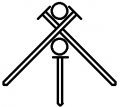
Here's another hint -- use two nails horizontally with the other nails draped diagonally between them. The heads lock the assembly together.
 

jpanhalt

Joined Jan 18, 2008
11,087
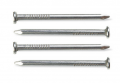
While in theory that makes sense. I will wager that in practice, hanging the nails between two rails made of identical nails would be quite difficult, if even possible. First, with common nails, the head size is only slightly larger than the shank. For example, with 16 d nails, the nominal head is 0.344 and the shank is 0.162. For 20 d nails the values are 0.195 and 0.406, respectively. Moreover, the underside of a common nail is not flat as is shown below. That will tend to force the rails apart.

upload_2015-3-7_19-13-47.png

John
 

WBahn

Joined Mar 31, 2012
32,836
While in theory that makes sense. I will wager that in practice, hanging the nails between two rails made of identical nails would be quite difficult, if even possible. First, with common nails, the head size is only slightly larger than the shank. For example, with 16 d nails, the nominal head is 0.344 and the shank is 0.162. For 20 d nails the values are 0.195 and 0.406, respectively. Moreover, the underside of a common nail is not flat as is shown below. That will tend to force the rails apart.

View attachment 81676

John
It's actually quite easy. This was one of the problems that we were given at a staff college I attended and once you figured out the idea actually implementing it was very straightforward.

nails.png

One person can assemble it, but it is much easier with two people.
 

WBahn

Joined Mar 31, 2012
32,836
It was an interesting puzzle and can be use effectively in a leadership training scenario, but only if it is set up such that it doesn't matter whether a solution is found or not. Unfortunately, most training sessions that use problems like this lose sight of that and think that if the class effectively uses the leadership and teamwork skills that are (supposedly) being learned that the team can solve any problem thrown at them. Fortunately, the staff college I was at did recognize this and so the mentors knew the solutions and had a list of hints that they gave out as the teams worked at it. The mentors were primarily looking at how we interacted and communicated and focused their suggestions on those things and used the hints to make sure that the teams had the opportunity to keep making some level of progress on the problem. I was lucky in that our team had three engineers and while none of us started out knowing how to do it, we figured it out between us without any hints. But even more so, we got kudos from our mentor because we didn't exclude the other four team members and, instead, moderated ourselves to let everyone participate. Once it was solved, however, our inner engineer came out and we couldn't resist playing with the problem and trying to see how far we could push things and, for that, we did exclude the others (who didn't care because they were more than happy to just chat amongst themselves while we geeked out).
 
Last edited:

studiot

Joined Nov 9, 2007
4,998
Teamwork

On most internet forums discussions all too often degenerate into a nit picking match, loosing the main point or the bigger picture.

We have all been guilty at times.

The thing I admire about AAC is that there are many threads displaying teamwork.
I think this better attitude leads to a far more convivial and productive site.

:)
 

#12

Joined Nov 30, 2010
18,224
The thing I admire about AAC is that there are many threads displaying teamwork. I think this better attitude leads to a far more convivial and productive site. :)
And I applaud you for being able to verbalize a point that I argue for regularly. If every response was an attempt to serve the TS, we would waste much less Internet space. Meanwhile, the, "Ignore" function is a valuable resource.
 
Top