Man ... that is great news. I already bought the "Noise Reduction Techniques" book that you recommended, but I haven't started reading it... now I will.
And btw, Joey ... you're not the only one who's been avidly working on something new. I too have been developing a top secret project for the last 4 months, and the crucial viability tests will be this weekend... wish me luck!
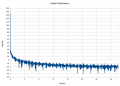
The sensor measures a real-world signal. The physical signal has a strong 1/f component that would stretch out over decades or centuries. That is the reason for the noise increase as frequency approaches DC.
My proof-of-concept for the new sensor is complete and fully tested. Here are some final stats:
Power supply: 2 'AA' batteries (about 100 hours of life) or 3-24VDC external power.
Four switching regulators.
Two voltage references.
Three SPI devices: 2 channels of 24 bit A/D @ 7.5 SPS, 2 channels of 24 bit A/D at 60 SPS, 1 channel of 16 bit D/A at 30 SPS.
Two EUSART devices: 1 RS-232 @ 19.2KBaud, 1 Bluetooth Radio at 115KBaud.
One parallel device: 2x16 character LCD display with backlight.
2 channels of on-chip 12 bit A/D at 1,953 SPS.
On-chip EEROM -- write leveled.
4 push-buttons and mechanical quadrature encoder with integrated 5th push-button.
Two on-chip timers: Timer0 and Timer1, and CCPM1 in compare mode attached to Timer 1.
16,664 lines of assembly code for an 18F65K22 MCU.
Clock speed: 8Mhz on-chip oscillator.
21,553 of 32,768 bytes of program memory used.
1,907 of 2,048 file registers used.
I can say now, with 100% certainty, that this project could never have been implemented on this hardware in C.
Seems like a wicked cool project, excited (and a bit jealous) for you and your knowledge. I hope you post what it's about sometime soon. I just read 9 pages of posts and still don't know what you're making
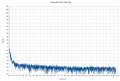
This is a chart of the noise performance with the addition of a 10s digital rise-time filter (RC) at the end of the signal chain. The scaling of the data changed a bit from post 164, so the DC level is about 120 dB, not 140 dB as above.
But, notice that the noise floor beyond 1 Hz is 170 dB (!) down from the DC level.
And, while I didn't show it here, the noise actually improves as the DC level gets smaller. I achieved this by using two 24 bit ADCs. The top-end ADC covers about 50dB of the dynamic range. The low-end ADC covers about 100dB of the dynamic range.
The two outputs are blended at the transition for smooth crossover.
And, while I didn't show it here, the noise actually improves as the DC level gets smaller. I achieved this by using two 24 bit ADCs. The top-end ADC covers about 50dB of the dynamic range. The low-end ADC covers about 100dB of the dynamic range.
The two outputs are blended at the transition for smooth crossover.
One is my go-to standard ADS1242. The other is secret for this discussion.
The transition occurs between two defined levels, with each output contributing a portion of the blended signal within the transition band. The proportion of each is just a linear function of the position between the two transition points.

 Facebook
 Google
 GitHub
 Linkedin